


Fed Chair Kevin Warsh Sends a Clear Signal on Where Interest Rates Are Headed
Key Points
Inflation remains the most pressing topic facing the Federal Reserve.
CME’s FedWatch tool shows a greater-than-90% probability that the federal funds rate will be higher at the end of 2026.
Long-term investors shouldn’t really pay much attention to what central bankers say or do.
- 10 stocks we like better than S&P 500 Index ›
Since taking over as Federal Reserve Chairman two months ago, Kevin Warsh has been under the microscope. Investors continue to pay close attention to any fresh commentary from the U.S. central bank. This can provide clues as to what might be coming.
Kevin Warsh recently testified before Congress, his first time doing so as part of a semiannual process. Investors can take what he said as a clear signal on where interest rates could go.
Where to invest $1,000 right now? Our analyst team just revealed what they believe are the 10 best stocks to buy right now, when you join Stock Advisor. See the stocks »
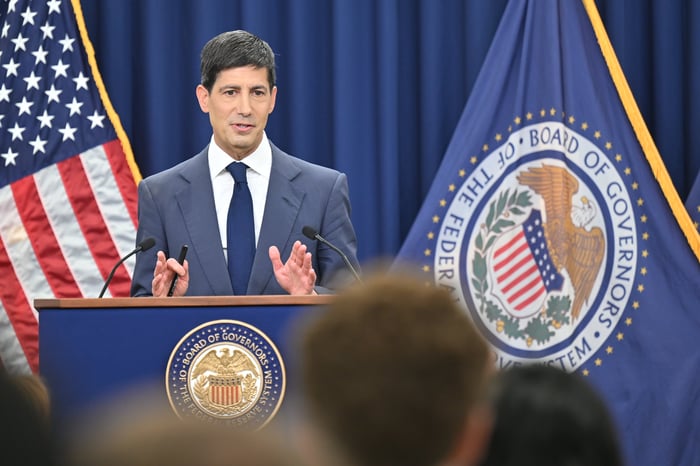
Image source: Federal Reserve.
It's all about prices
During the testimony, Warsh reiterated the Fed's focus on maintaining independence from any political influence. It's encouraging to know that this remains a priority. However, we'll have to wait and see how things play out. The White House might continue to apply pressure.
But what stood out was the attention given to prices across the economy. "The members of our Committee have no tolerance for persistently elevated inflation," he said. "And we share a resolute commitment to restoring price stability."
If investors were ever wondering where Kevin Warsh's head was at, there's now no doubt that his goal is to curb above-average inflation, which is still meaningfully higher than the central bank's 2% target. The Consumer Price Index increased 3.5% year over year in June. Shelter and food are areas where households continue to see prices rise.
There was speculation that President Trump nominated Kevin Warsh with the understanding that the new Fed chair would lower interest rates sooner rather than later. This doesn't seem likely. CME Group's FedWatch tool is showing a 90% probability that the fed funds rate will be higher at the end of this year.
What's interesting, however, is that the market appears to be shrugging off this hawkish monetary policy. The S&P 500 (SNPINDEX: ^GSPC) has climbed 10% in 2026 as of July 22.
Monetary policy is fluid
The Federal Reserve today is signaling that interest rates won't fall anytime soon. The best investors understand that this situation can change without notice. Conflict in the Middle East adds an element of uncertainty. This can keep impacting energy prices.
Moreover, other factors can contribute to declining inflation. For instance, advances in artificial intelligence can drive unprecedented productivity gains, lowering prices. If these sorts of things were to happen, the central bank would be more comfortable lowering the fed funds rate. No one can predict what will happen, though.
Long-term investors shouldn't be concerned. If you own high-quality stocks in a diversified portfolio, what the Federal Reserve says and does is mostly just noise.
Should you buy stock in S&P 500 Index right now?
Before you buy stock in S&P 500 Index, consider this:
The Motley Fool Stock Advisor analyst team just identified what they believe are the 10 best stocks for investors to buy now… and S&P 500 Index wasn’t one of them. The 10 stocks that made the cut could produce monster returns in the coming years.
Consider when Netflix made this list on December 17, 2004... if you invested $1,000 at the time of our recommendation, you’d have $377,990!* Or when Nvidia made this list on April 15, 2005... if you invested $1,000 at the time of our recommendation, you’d have $1,269,518!*
Now, it’s worth noting Stock Advisor’s total average return is 896% — a market-crushing outperformance compared to 206% for the S&P 500. Don't miss the latest top 10 list, available with Stock Advisor, and join an investing community built by individual investors for individual investors.
See the 10 stocks »
*Stock Advisor returns as of July 26, 2026.
Neil Patel has no position in any of the stocks mentioned. The Motley Fool has positions in and recommends CME Group. The Motley Fool has a disclosure policy.
Recommended Articles


