


Gold gains despite firm US Dollar
- Falling Treasury yields support Gold’s recovery.
- Oil pullback eases inflation fears despite weekly crude gains.
- Fed decision, GDP and PCE data drive next catalyst.
Gold price (XAU/USD) drifts higher on Friday as the Greenback stands firm, even as growing speculation that the US-Iran war may last longer than expected could, in the end, hurt the prospects of the yellow metal. The XAU/USD trades at $4,065, up 0.38%.
XAU/USD gains as softer US yields counter Fed hike bets
The US Dollar Index (DXY), which tracks the buck’s value against a basket of six currencies, is slightly higher at 101.46 and poised to end the week with gains of over 0.60%. The yellow metal is also being propelled by the decline in US Treasury yields, with the 10-year benchmark note dropping three basis points to 4.667%.
The last tranche of geopolitical news hasn’t changed the needle in the Gulf War. Reports said Pakistan is looking to resume US-Iran talks at China's urging. Meanwhile, Trump revealed that he is losing patience over Iran and confirmed that China and Russia are not giving or selling weapons to Iran.
Friday’s schedule was light with US business activity steady. The S&P Global Manufacturing PMI dropped slightly from 53.9 to 53.8, falling short of the expected 54.5. Meanwhile, the Services PMI rose from 51.2 to 53.6, surpassing forecasts of 51, helped by the World Cup held in the country.
Bullion’s advance is also propelled by easing Oil prices. West Texas Intermediate (WTI), the US Crude benchmark, is down 3.83% at $88.79, but is set to finish the week with gains of over 8.50%.
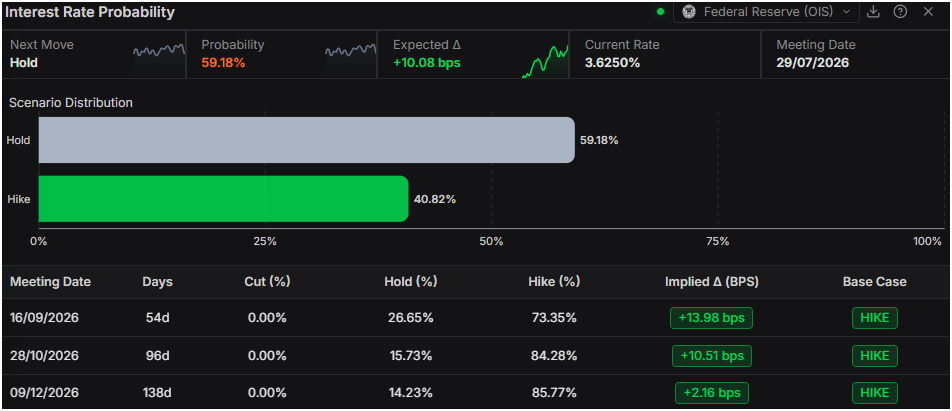
Money markets continued to increase the odds for a rate hike by the Federal Reserve (Fed) at next week’s meeting. On July 29, the Fed is projected to keep rates unchanged. There is a 59% chance of the US central bank standing pat, but a 25-basis-point (bps) rate hike has nearly a 41% chance.
For the September meeting, the odds of a rate increase are at 84%, according to Prime Terminal data.
Besides next week’s Fed meeting, traders will eye US Retail Sales and Durable Goods Orders, as well as jobs data, Gross Domestic Product (GDP) figures for Q2 and the Personal Consumption Expenditures report.
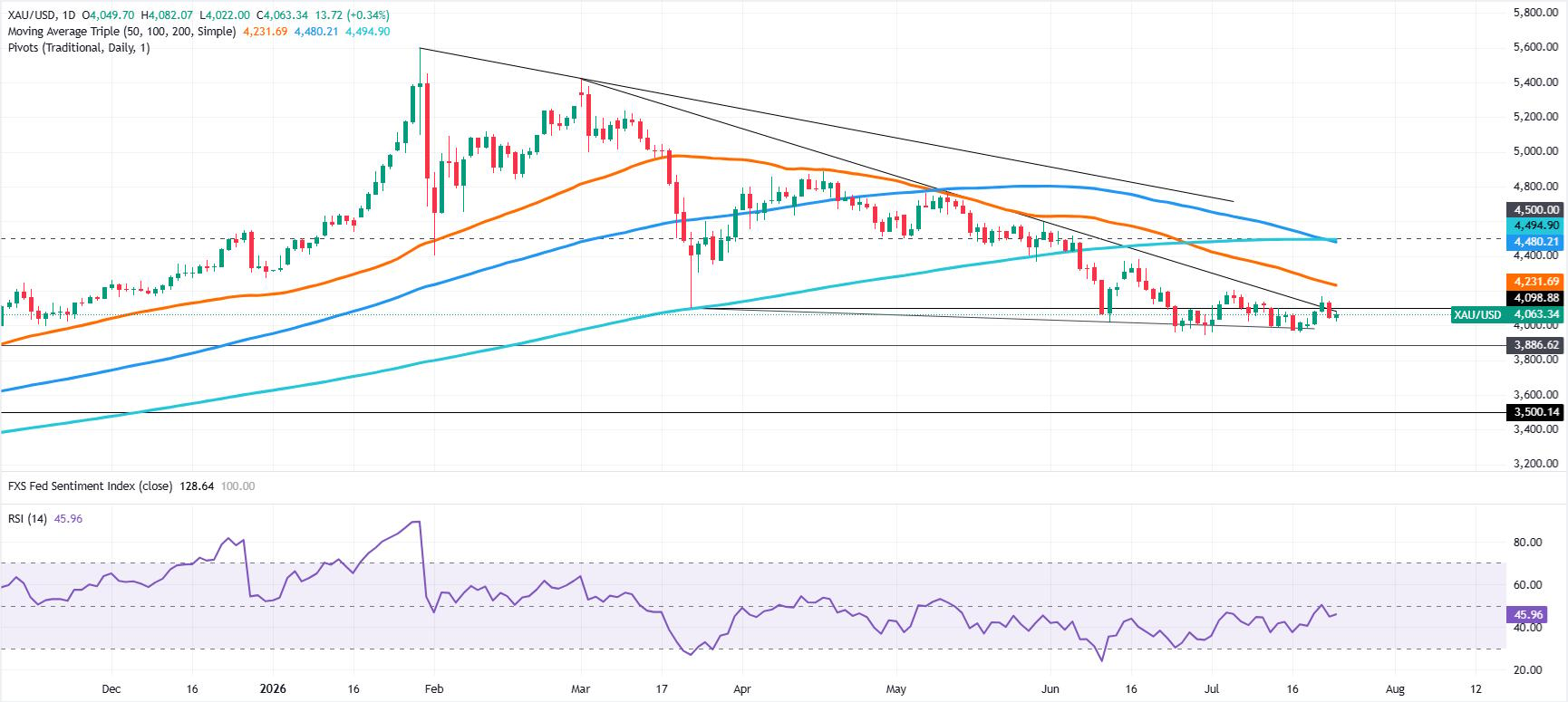
XAU/USD technical outlook: Gold drifts higher, but faces key resistance at $4,100
Gold’s downtrend remains intact as the market structure would be compromised until XAU/USD climbs above the June 17 cycle high seen at $4,382. Further signs of tailwinds for the downtrend are that the 50, 100, and 200-day Simple Moving Averages (SMAs) lie above the spot price of the yellow metal, and that sellers are dragging prices back below a resistance trendline.
Momentum as well, continues to push lower, with the Relative Strength Index (RSI) remaining bearish. Hence, the path of least resistance is downward.
The first support is $4,000, followed by the current year-to-date (YTD) low of $3,941. A breach of those two levels paves the way to challenge the October 28, 2025, low of $3,886, with further support seen on the swing high-turned-support at $3,500, hit on April 22, 2025.
Conversely, if buyers aim for higher prices, they need to surpass $4,100. Above this, the weekly high of $4,165 is the next target, followed by the $4,200 resistance.
Gold FAQs
Gold has played a key role in human’s history as it has been widely used as a store of value and medium of exchange. Currently, apart from its shine and usage for jewelry, the precious metal is widely seen as a safe-haven asset, meaning that it is considered a good investment during turbulent times. Gold is also widely seen as a hedge against inflation and against depreciating currencies as it doesn’t rely on any specific issuer or government.
Central banks are the biggest Gold holders. In their aim to support their currencies in turbulent times, central banks tend to diversify their reserves and buy Gold to improve the perceived strength of the economy and the currency. High Gold reserves can be a source of trust for a country’s solvency. Central banks added 1,136 tonnes of Gold worth around $70 billion to their reserves in 2022, according to data from the World Gold Council. This is the highest yearly purchase since records began. Central banks from emerging economies such as China, India and Turkey are quickly increasing their Gold reserves.
Gold has an inverse correlation with the US Dollar and US Treasuries, which are both major reserve and safe-haven assets. When the Dollar depreciates, Gold tends to rise, enabling investors and central banks to diversify their assets in turbulent times. Gold is also inversely correlated with risk assets. A rally in the stock market tends to weaken Gold price, while sell-offs in riskier markets tend to favor the precious metal.
The price can move due to a wide range of factors. Geopolitical instability or fears of a deep recession can quickly make Gold price escalate due to its safe-haven status. As a yield-less asset, Gold tends to rise with lower interest rates, while higher cost of money usually weighs down on the yellow metal. Still, most moves depend on how the US Dollar (USD) behaves as the asset is priced in dollars (XAU/USD). A strong Dollar tends to keep the price of Gold controlled, whereas a weaker Dollar is likely to push Gold prices up.
Recommended Articles


