


Apple (AAPL) Hits Record $334 on China AI Win; Can It Hold Into July 30 Earnings?
TradingKey - On Friday, July 17, Apple (NASDAQ: AAPL) ended trading at roughly $333 after hitting an all-time high intraday of $334.68. The move came following China's nod to Apple Intelligence, which uses Alibaba's Qwen AI model on a local basis, opening the door for the company to roll out its AI tools across its product lineup in its second-biggest market. The stock is up 23% year-to-date and nearly 60% over the past year, and attention may be turning to July 30 earnings.
China's Qwen Approval: Far More Than Just Compliance
Apple has rallied after news that China has allowed its AI model, powered by Qwen, to be used across the company's ecosystem in its second-largest market. Apple could use this as the next major catalyst for the stock as it continues to roll out AI features globally as well as see growing services revenue and new devices. Apple's stock has gained 23% YTD and nearly 60% in the past year, as it looks to extend gains in July 30 earnings report. The stock is up 23% year-to-date and nearly 60% over the past year.
China's NIA nod is big for several reasons. It clears Apple's China hurdle by allowing it to stay compliant with local regulations through its partnership with Alibaba, while continuing to leverage Apple's own device-based AI infrastructure. Apple has made significant moves to recover its Chinese business, with iPhone unit growth up 20% Y/Y in China Q1 2026 and up 24% Y/Y in China Q2 2026 against a weaker mobile market. That could happen as Apple begins to roll out the AI features sometime between late 2026 to early 2027 along with the anticipated Ultra foldable iPhone. Suppliers have reportedly lined up to make around 10 million units compared to the previously reported 7 to 8 million units. This means Apple could see 250 million+ iPhone shipments for FY2027 and potentially break a sales record.
Meanwhile, Citi, JPMorgan, and Morgan Stanley have boosted price targets on Apple stock to $365, $345, and $360, respectively, citing improving services revenue, AI monetization, and resilient consumer demand.
July 30 earnings: Wall Street analysts are increasingly bullish about Apple's prospects, with Citi raising the price target to $365, JPMorgan to $345, and Morgan Stanley to $360, citing "better services growth, strong monetization potential of the AI features, and resilient consumer demand." The report will be the next major catalyst for the stock.
OpenAI Lawsuit and Siri's New Direction: Parsing the Implications of July 10
Adding another dimension of strategic nuance to the situation involving China approval is the federal lawsuit filed against OpenAI by Apple on July 10. Apple claims that after the $6.4 billion purchase of Jony Ive's hardware company last year, OpenAI hired hardware executive Tang Yew Tan and engineer Chang Liu and then allegedly instructed them to steal trade secrets. According to the complaint, the company encouraged them to bypass Apple security, request sensitive information about Apple's suppliers, and bring Apple products to their own job interview.
On July 17, the day Apple filed the complaint, OpenAI introduced its first ever consumer hardware product, the $230 AI Keypad. So yes, tensions are real, and they are intensifying. On a separate note, Apple may be looking to use Google Gemini models to build its Siri voice assistant, instead of relying on OpenAI. A move in that direction would be even further removed from OpenAI, which is also in line with the complaint. The China Cyber Administration had approved several different smartphone AI services simultaneously, which likely was responsible for creating more of a stir than the China event really warranted, as Jefferies wrote.
That is the sober reality in the face of a stock currently trading above its analyst price target. Apple Services at $31 billion in quarterly revenue and the China AI opportunity are the two pillars the $333 AAPL valuation needs. FY2026 consensus EPS stands at $8.76. That implies growth of 17.4 percent over FY2025 EPS at $7.46.
AAPL Technical Setup: Double Top Breakout Holds, RSI 71, Key Levels for the Week
On the daily chart, AAPL settled at $333.26 and hit a new intraday all-time high of $334.68. The double-top neckline breakout from early July at $317.31 is the key level: The price is currently $16 higher, which confirms that the breakout is holding. RSI is at 71.43, so we are in an elevated territory which might lead to some near-term consolidation, but we are not yet at extreme overbought conditions.
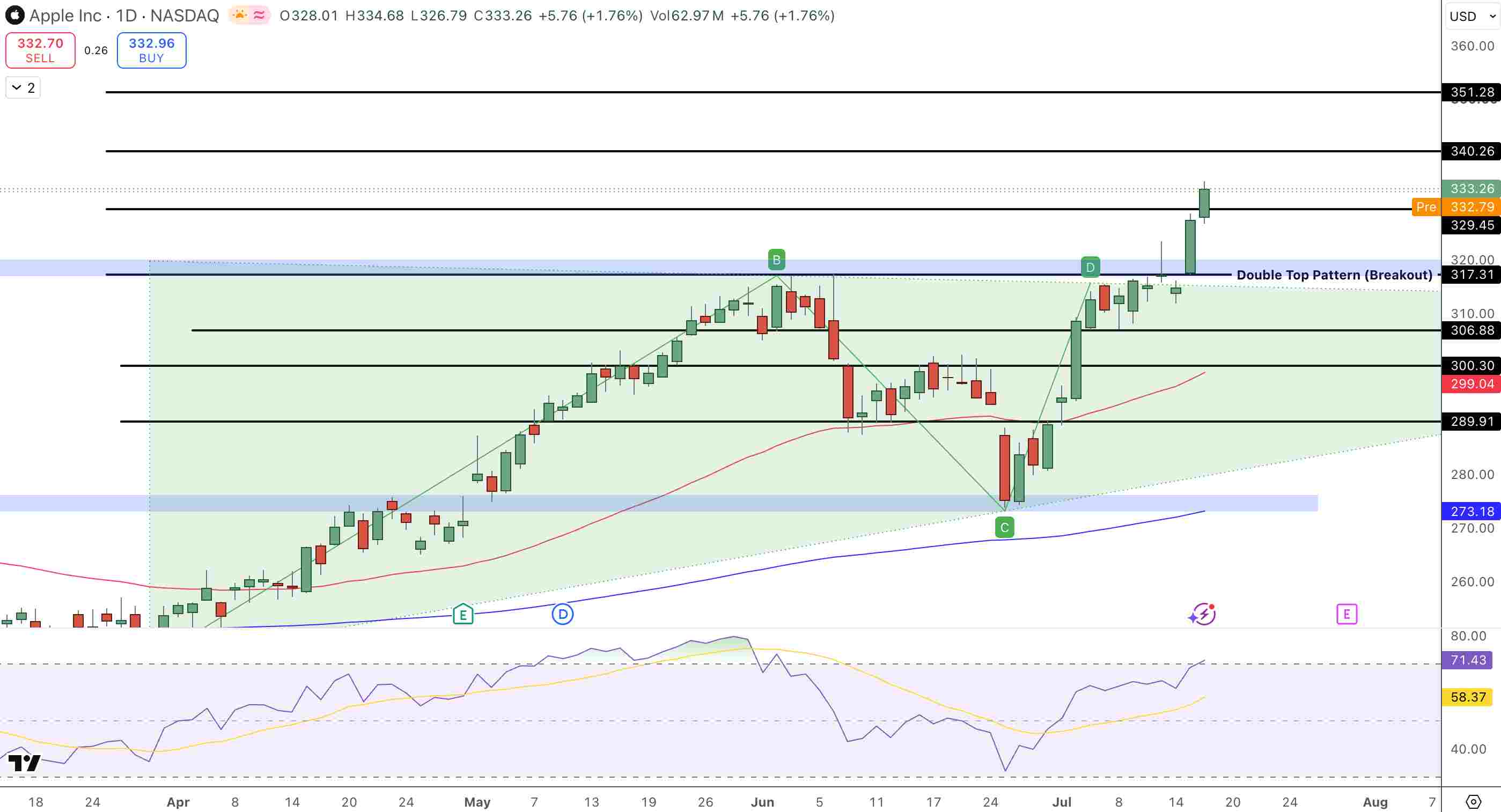
Apple (AAPL) Price Chart - Source: Tradingview
Here is the plan for this week: If AAPL closes above $340.26, the next target price will be $351.28. The immediate level to watch is the week-old consolidation range that has already been touched at $329.45. A dip that holds the double-top neckline at $317.31 would confirm the breakout, not undermine it. If prices break down below the neckline support, $306.88 is the next price level to test, then $299.04.
- Week Catalyst: Q3 FY2026 earnings July 30 (after hours)
- EPS consensus at $1.89
- Revenue consensus at $108.86B
- China AI: Apple Intelligence in China is powered by Alibaba's Qwen, which received China Cyber Administration approval in mid-July. We expect a rollout in late 2026 to early 2027
- Foldable iPhone: Apple is increasing supplier ramp to ~10M units (from 7-8M units per month previously). Apple has reportedly given the product the working name iPhone Ultra
- Confirmed Breakout Above: If the price holds above $340.26 for the week, $351.28 is the next target
- Breakout Floor: $317.31, the price level where the double-top neckline breakout is taking place and where bullish structure must hold to continue
- Support below $317.31: $306.88, then $299.04
How Did Apple Stock Set An All-Time High This Week?
Apple stock hit an all-time intraday high of $334.68 July 17, after China's Cyber Administration said that Apple Intelligence that uses Alibaba's Qwen AI model is now approved. China is the second-largest market, and iPhone shipments were already up 20% to 24% in China year-over-year in a weak smartphone market. Citi said $365, JPMorgan $345, and Morgan Stanley $360. Separately, a report had Apple raising the supply ramp for the foldable iPhone to about 10 million units. Morgan Stanley said a 250 million iPhone path in FY2027.
What Is Apple's Lawsuit About OpenAI?
Apple filed a federal suit against OpenAI July 10, saying it set out to get Apple trade secrets via former Apple hardware executive Tang Yew Tan and engineer Chang Liu, both of whom went to work at OpenAI. Apple alleges that OpenAI urged employees to avoid its security measures, to access Apple supplier data, and to bring Apple devices with them to job interviews. This happened after OpenAI's $6.4B hardware startup acquisition last year of Jony Ive. In related news, Apple said last week that it is considering changing Siri to run on Google Gemini models rather than OpenAI. OpenAI also released its first consumer hardware with its $230 AI Keypad July 17.
What To Look For On Apple's July 30 Earnings Call?
Apple reports July 30 after market close, Q3 FY2026, with EPS of $1.89 and revenue of $108.86 billion. Apple has beaten EPS estimates for the last four quarters in a row, and the last beat was a 4.15% EPS surprise. Three things that will move the market are: Growth in Greater China revenue, especially given the new approval for Apple Intelligence using the Alibaba Qwen model; whether Services growth has slowed in comparison to the latest run-rate quarterly record of $31 billion; and any comment on when the foldable iPhone production starts, as well as the iPhone upgrade cycle heading into holiday. The stock is trading above $328, the current analyst consensus. Earnings will be the test on whether analyst estimates move higher.
Bottom Line:
Apple's week-end price closed at $333.26, after setting an all-time intraday high of $334.68, as the China Cyber Administration approved Apple Intelligence using the Alibaba Qwen AI model. Apple also raised its supply ramp for the foldable iPhone to 10 million units. Citi said $365, Morgan Stanley $360, and JPMorgan $345. The double-top breakout at $317.31 held, while RSI was 71.43. If the weekly candle closes above $340.26 on a confirmed breakout it will target $351.28, but the double-top breakout of $317.31 needs to hold on any pullback. On July 30 earnings, how Greater China revenue, Services growth, and iPhone foldable are guided determines if the stock at its current $333 price earns the multiple it's trading at.
Recommended Articles


