


Gold Price Forecast: Cooling Inflation Fails to Offset Fed Hawkish Pressure, Gold Price May Fall to $3,500

 Trending Articles
- Gold Price Trend Forecast: Why Did Gold Prices Fall After US CPI Cooled? Fed Chair Speech and Iran Situation Become Obstacles
- Gold Price Trend Forecast: June CPI Plus Fed Chair Congressional Testimony, Can Gold Price Hold Above $4,000?
- Gold slides back closer to $4,050 as Iran risks and Fed hike bets boost USD
- Gold recovers above $4,100 as traders assess US-Iran conflict
- WTI rally takes a timeout amid signs of US-Iran war de-escalation
- Today’s Market Recap: Unexpected PPI Drop Boosts Markets, Apple Hits All-Time High, AI Hardware Stocks Remain Under Pressure, Micron, SanDisk Slump
TradingKey - As of the Asian session on July 17, gold prices ( XAUUSD ) fluctuated around $4,000. However, it is worth noting that gold closed at $3,969.41 yesterday, confirming a break below the $4,000 mark, which may tilt short-term market sentiment toward the bearish side. Meanwhile, the latest US CPI and PPI data both showed easing inflationary pressures, but gold prices failed to sustain their rebound, instead coming under pressure due to a recovery in US Treasury yields, hawkish remarks from Federal Reserve officials, and resilient US consumer spending.
CPI, PPI Signal Cooling Inflation But Retail Sales and Fed Remarks Cap Gold Rally
From a fundamental perspective, US inflation data released this week provided temporary support for gold. The US June CPI fell 0.4% month-on-month, marking the first monthly decline since April 2020; the year-on-year increase slowed to 3.5% from 4.2% in May, below market expectations. Core CPI also slowed to 2.6% year-on-year from 2.9% in May and remained flat month-on-month, indicating that price pressures excluding food and energy have also eased. For gold, cooling CPI typically implies a reduced necessity for further Federal Reserve rate hikes, leading to a pullback in Treasury yields and the dollar, which in turn lowers the opportunity cost of holding gold as a non-yielding asset.
The subsequent release of PPI data further reinforced the expectation of cooling inflation. The US June PPI fell 0.3% month-on-month, its largest decline in 14 months, driven primarily by falling energy and food prices; the year-on-year growth also slowed to 5.5% from 6.0% in May. With both CPI and PPI coming in below expectations consecutively, the market briefly believed that the probability of a Fed rate hike in July had dropped significantly, prompting a short-term rally in gold.
However, gold's rebound was not sustained, primarily because the market was not fully convinced that inflation risks had been eliminated. The drop in June's CPI and PPI was largely tied to a temporary decline in energy prices, whereas oil prices have recently climbed again on Middle East tensions and supply concerns, sparking fears that rebounding energy prices could push inflation higher in the coming months.
Meanwhile, the latest US retail sales data also dampened gold's upward momentum. US retail sales rose just 0.2% month-on-month in June, which on the surface suggested slowing consumption momentum. However, excluding gasoline stations, retail sales grew 0.7%, and control group sales rose 0.5%, showing that US consumers remain resilient. Solid performances in autos, online shopping, and certain sports and entertainment-related spending indicated that the economy is not weakening rapidly. For gold, this means it is difficult for the market to bet on an imminent Fed pivot to monetary easing, as consumer resilience supports economic growth and gives policymakers more justification to maintain a restrictive policy.
In addition, the latest remarks from Federal Reserve officials further pressured gold. Dallas Fed President Lorie Logan stated that although the June CPI showed progress, the path back to the 2% inflation target remains fragile, and the Fed should consider raising interest rates to continue suppressing price pressures. Meanwhile, Fed Vice Chair Philip Jefferson also noted that he remains open to rate hikes if inflation does not show further near-term improvement. These remarks indicate that the Fed is not pivoting to a dovish stance based on a single set of softer inflation data, and the risk of further rate hikes this year has not been ruled out.
Gold Price Trend Analysis: Gold Price Loses $4,000, Short-Term May Fall to $3,900
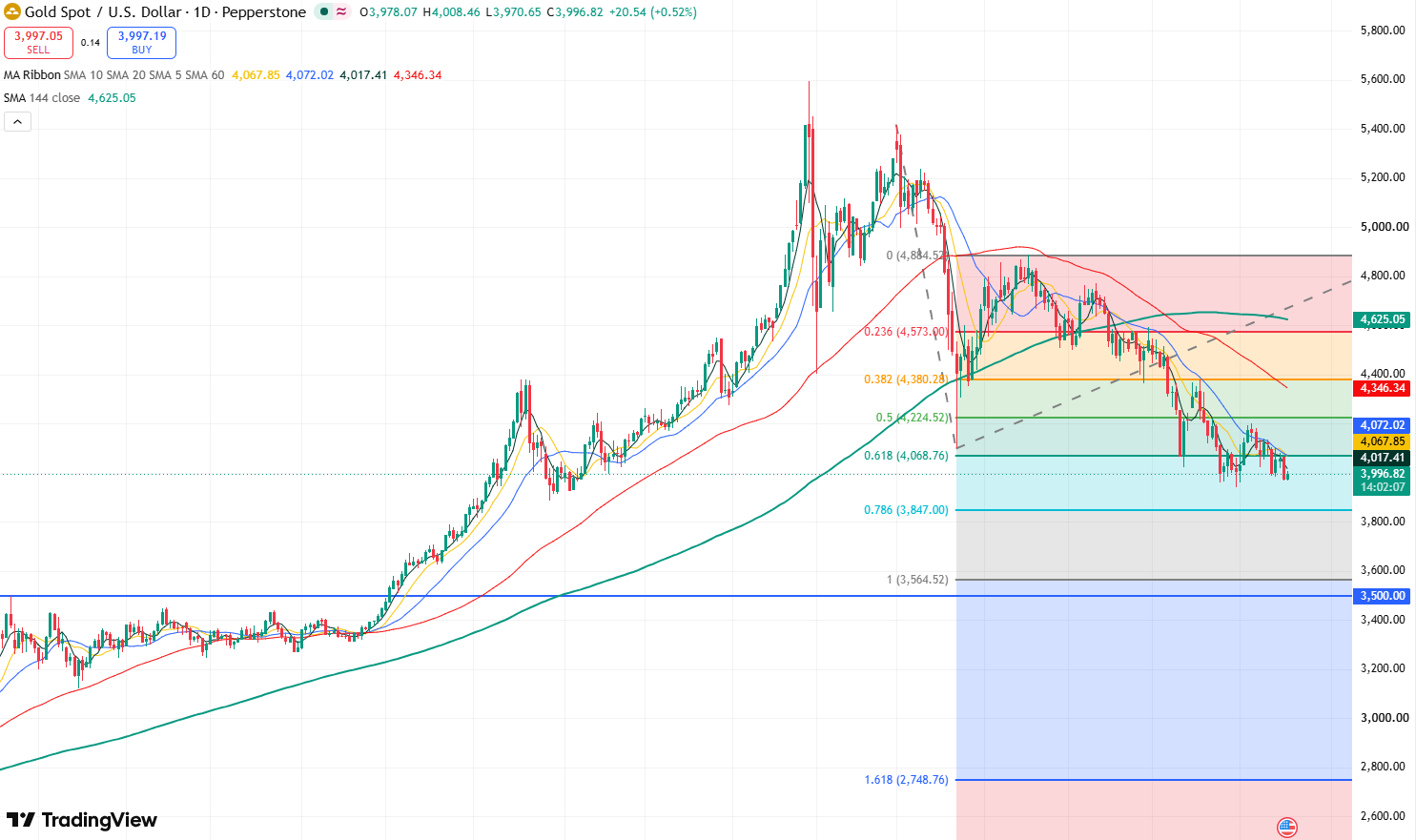
Gold price daily chart, Source: TradingView
Looking at the daily chart, gold's closing price on Thursday confirmed a break below $4,000. This indicates that in the recent battle between bulls and bears around the $4,000 psychological level, the bears have emerged victorious, and short-term market sentiment may shift to the downside.
To the upside, $4,000 has once again become a key battleground for the bulls. If today's closing price holds above $4,000, it suggests that gold prices may continue to fluctuate around the $4,000 level in the short term. The next resistance level to watch is $4,070; if gold can establish a foothold above this level, it may trigger a technical rebound, potentially testing the resistance level at $4,200.
To the downside, with gold's break below $4,000 confirmed, the immediate support level to watch is the June 30 low of $3,942.50, followed by $3,900. If gold fails to hold $3,900, it could open the door for a deeper decline, potentially testing the $3,500 level.
Read more
* The content presented above, whether from a third party or not, is considered as general advice only. This article should not be construed as containing investment advice, investment recommendations, an offer of or solicitation for any transactions in financial instruments.


