


Breaking Dependence on Three Memory Giants. TSMC Partners Winbond to Reconstruct Local DRAM Supply Chain
TradingKey - Against the backdrop of an increasingly acute supply-demand conflict in the global memory chip market, TSMC ( TSM) is accelerating its local supply chain substitution plan to reduce its reliance on Samsung, SK Hynix, and Micron ( MU ), the three major international memory giants.
According to reports, TSMC has reached a strategic partnership with Winbond Electronics, which will join TSMC's wafer-on-wafer (WoW) advanced packaging memory wafer supply chain, serving as a new alternative to the three major memory manufacturers.
Boosted by this positive news, TSMC's US shares rose 1.47% in pre-market trading.
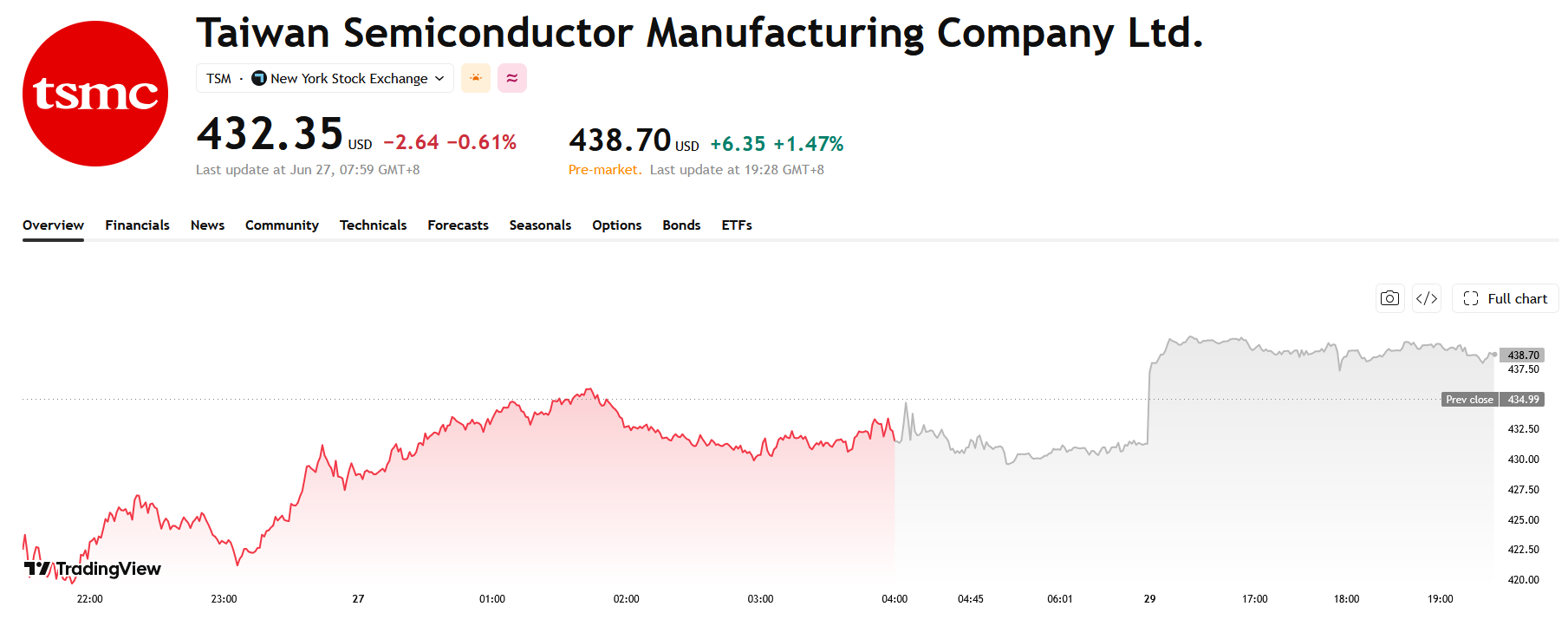
Source: TradingView
Winbond Electronics’ WoW process opens the door to TSMC’s AI chips
Wafer-to-wafer (WoW) stacking technology is regarded as a core integration solution for next-generation AI chips. By directly stacking logic chips and memory wafers vertically through a hybrid bonding process, it establishes tens of thousands to millions of micro-copper interconnects. This reduces the data transmission distance by over 90% compared to traditional packaging, achieving a performance leap with a 3- to 5-fold increase in bandwidth and a 40% reduction in power consumption, effectively breaking through the "memory wall" bottleneck that constrains AI computing.
TSMC's SoIC technology platform is based precisely on the WoW architecture and is currently applied to high-end AI chips, such as GPUs utilizing NVIDIA's Blackwell architecture.
Unlike traditional 2.5D packaging technology, WoW eliminates the need for silicon interposers to directly achieve wafer-level interconnects. This places extremely high demands on partners, requiring mature 12-inch wafer mass production capabilities, yield control levels of over 99.9%, experience in specialty process customization, and wafer-level integration capabilities.
Winbond Electronics' ability to break through TSMC's stringent threshold is due to its technical expertise accumulated over 30 years of deep cultivation in the niche DRAM and NOR Flash markets, particularly the differentiated advantages it has built in specialty manufacturing processes, wafer manufacturing precision, and quality management systems.
Winbond’s Customized DRAM Mitigates TSMC’s Supply Chain Concerns
Currently, the top three global memory chipmakers have shifted over 80% of their production capacity to higher-margin High Bandwidth Memory (HBM), resulting in a sharp contraction of conventional DRAM capacity and driving prices up by more than 300% over the past year.
This structural shortage has not only driven up TSMC's production costs but also exposed it to supply chain disruption risks. Liu Pei-chen, director of the Industrial Database at the Taiwan Institute of Economic Research, pointed out that establishing a localized memory supply chain can effectively mitigate geopolitical risks, capacity allocation constraints, and delayed customization responses, thereby enhancing local synergies.
From a technical perspective, this partnership also opens up new avenues of innovation for TSMC. As early as 2023, Winbond Electronics launched its CUBE 3D-stacked DRAM solution, which offers an 8GB capacity and 256GB bandwidth, making it particularly well-suited for the high-bandwidth, low-power requirements of edge AI devices.
For edge AI chips that neither require nor can afford HBM, adopting customized non-JEDEC standard memory solutions can boost performance while reducing costs, helping TSMC capture a broader range of AI application scenarios.
Regional Integration and Ecosystem Reshaping
For a long time, Taiwan has dominated the global wafer fabrication sector but has remained heavily reliant on external supplies for memory chips, creating an industrial asymmetry of "strong foundry, weak memory." Winbond Electronics' entry into TSMC's core AI supply chain not only opens up new markets for the company but also signifies a strategic upgrade for Taiwan's memory industry as it transitions from traditional niche markets to the core AI sector.
From a broader perspective, this partnership is a microcosm of the restructuring of the East Asian semiconductor industry. As AI technology drives exponential growth in hardware demand, the traditional global division of labor is being challenged, and regional integration of the entire industry chain has become a growing trend.
By nurturing its local supply chain, TSMC is gradually building a comprehensive AI chip ecosystem spanning design, manufacturing, packaging, and testing. This will not only bolster its bargaining power in the global market but will also elevate the overall strategic standing of Taiwan's semiconductor industry.
Recommended Articles


