


Samsung Electronics’ Largest Investment in History. Stunning Announcement of '2,655 Trillion Won' Plan Exceeding Expectations, Will Stock Price Hit Another Record High?
TradingKey - Samsung Group announces an expectation-beating 2,655 trillion won investment plan, with its stock price poised to rebound and hit new highs.
During the Asian trading session on June 29, South Korean memory giant Samsung Electronics staged a highly dramatic turnaround. In the morning, Samsung's stock price opened lower and continued to slide, but gradually rebounded in the afternoon following the South Korean government's announcement of a national investment plan, narrowing its decline to 4.86% to close at 323,000 won.
According to market sources, the South Korean government today announced its latest national industrial investment plan, which includes constructing a semiconductor base in the southwest, AI data centers, and the research, development, and expansion of advanced packaging clusters. It is reported that this 'Three Super Projects' strategy will be led by the South Korean government in collaboration with Samsung and SK Hynix, aiming to build South Korea into a global hub for AI and semiconductors over the next 10 to 15 years.
Although the plan announced by the South Korean government lifted Samsung Electronics' stock price, it remains range-bound within a 'triangle' pattern, maintaining a bullish technical structure. Over the past month, Samsung's stock price twice broke above 370,000 won but failed to stabilize, ultimately pulling back. However, the lows of these pullbacks have gradually risen—from 290,000 won to 310,000 won—forming a bullish structure, and Samsung Group's latest better-than-expected investment plan is poised to drive an upward breakout in its stock price, potentially pushing it to new highs.
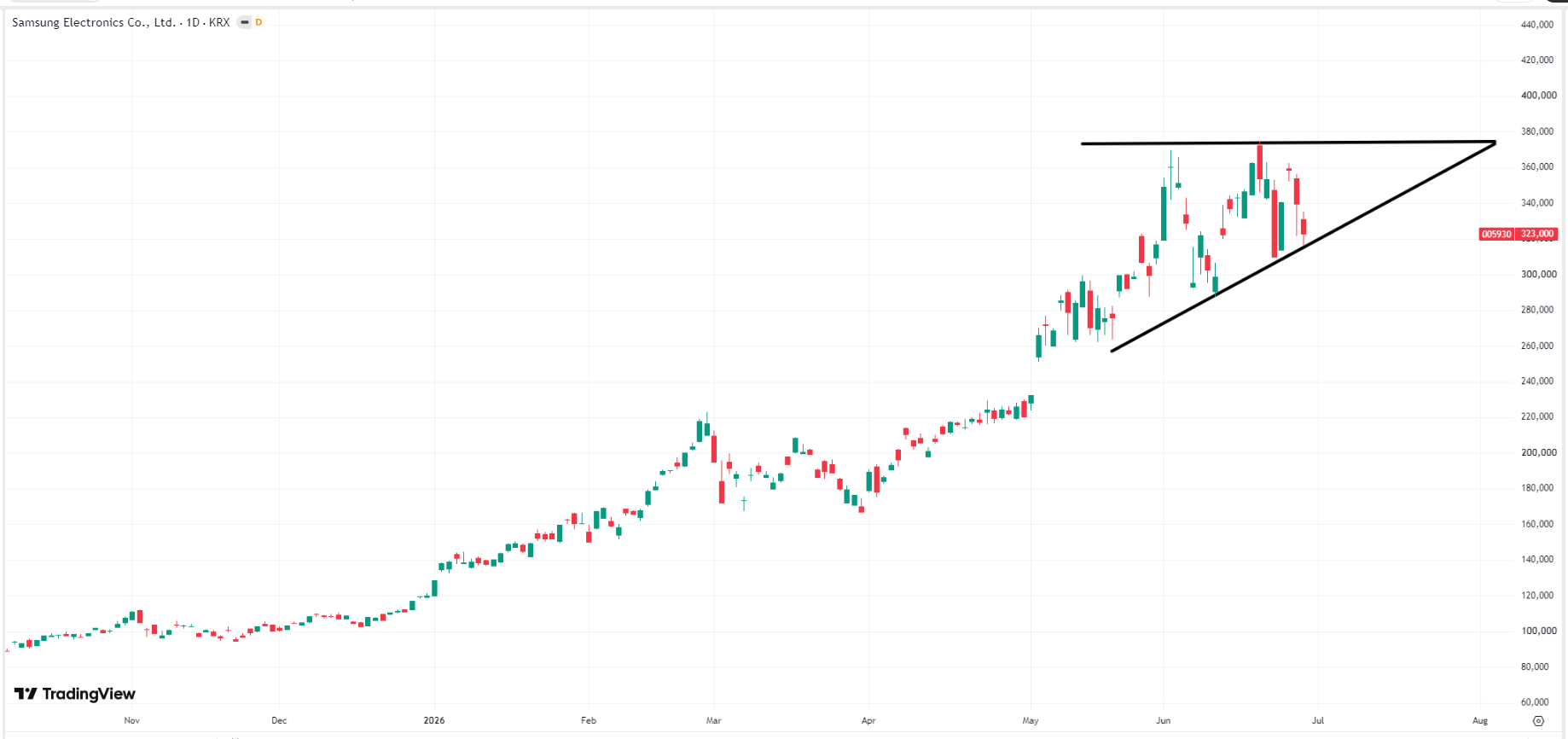 Samsung Electronics stock chart, source: TradingView
After today's market close, Samsung Group released a blockbuster announcement that sent shockwaves through global capital markets: it announced its largest-ever domestic investment plan in South Korea, totaling 2,655 trillion won, which exceeds the market's previous expectation of 2,000 trillion won.
Reportedly, Samsung will lock in more than 76% of the funds (approximately 2,030 trillion won) to its existing Pyeongtaek campus and the Yongin National Industrial Park. This capital will be used to aggressively expand its most advanced foundry processes and build the world's strongest capacity barriers for HBM4, HBM5, and next-generation ultra-high-bandwidth memory, as Samsung vows to reclaim absolute dominance in the AI memory market.
In response to President Lee Jae-myung's policy to ease pressure on the capital metropolitan area, Samsung has allocated the remaining funds to three other regions and sectors: 1. 425 trillion won to build a semiconductor production base (Honam region); 2. 140 trillion won to expand advanced packaging production lines (Chungcheong region); 3. 60 trillion won to develop a humanoid robot mass-production base, EV batteries, and core IT components (Yeongnam region).
Samsung Group's investment focus remains heavily on memory, likely because demand and prices continue to rise. Wall Street previously reported that 'as demand for high-bandwidth memory surges, memory chipmakers are reaping growing profits from the AI boom.' Meanwhile, Micron ( MU ), as one of the top three HBM manufacturers, previously stated that 'for the quarter ended May 28, its memory shipments grew only slightly, indicating that most of the revenue growth was driven by price increases.'
Recommended Articles


