


Bitcoin Price Forecast: Mild recovery as US and Iran agree to halt attacks, resume talks
- Bitcoin recovers slightly on Monday, trading above $60,000 after closing below the 200-week SMA the previous week.
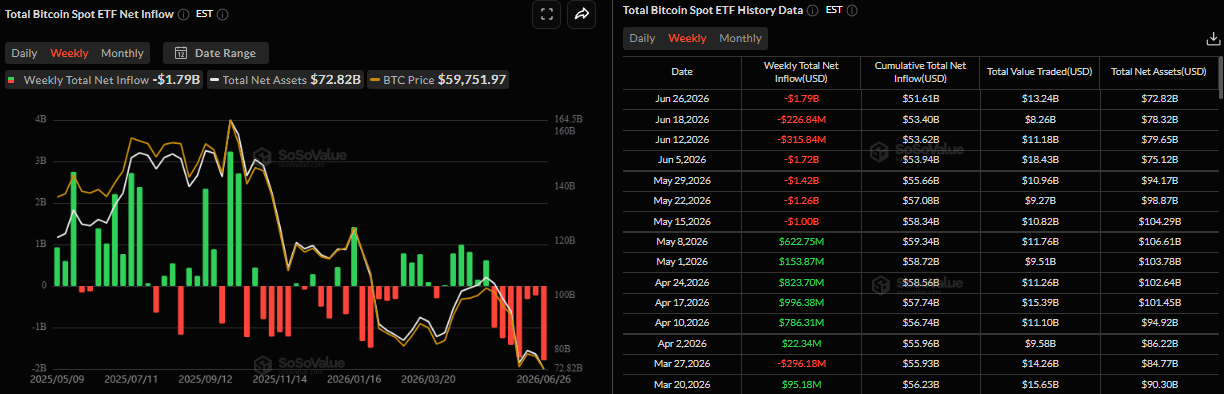
- US-listed spot ETF recorded a weekly outflow of $1.79 billion, the highest since the end of February.
- Market sentiment turned cautiously positive after the US and Iran agreed to halt attacks and renew peace talks.
Bitcoin (BTC) reclaims $60,000 on Monday after a nearly 6% correction and closing below the key technical level. Institutional selling intensified as spot Exchange Traded Funds (ETFs) recorded $1.79 billion in net outflows last week, the highest for this period since the end of February. Meanwhile, the US and Iran's agreement to halt recent attacks and resume talks over the Strait of Hormuz has improved risk sentiment, supporting a mild recovery in the Crypto King.
Iran and the US agree to halt attacks and renew talks
Iran and the United States agreed to halt recent hostilities in the Gulf and to renew talks over their dispute over the Strait of Hormuz, according to Reuters.
The development has modestly improved market sentiment, raising hopes that an interim peace agreement can still be preserved after several days of tit-for-tat strikes between the US and Iran put it under pressure. The slight easing of geopolitical tensions has provided a supportive backdrop for risk assets, with BTC reclaiming the $60,000 on Monday after a sharp correction the previous week.
Traders should remain cautious, as despite renewed negotiations, geopolitical uncertainty remains elevated. Any breakdown in talks or renewed military escalation between the two countries could weaken risk appetite, potentially triggering a fresh sell-off in BTC.
Institutional selling caps BTC
Institutional demand continued to weaken last week. SoSoValue data show that spot BTC ETFs recorded an outflow of $1.70 billion last week, the highest weekly outflows since the end of February. Moreover, last week marked the seventh consecutive week of withdrawals, the longest outflow streak since the BTC ETF launch.
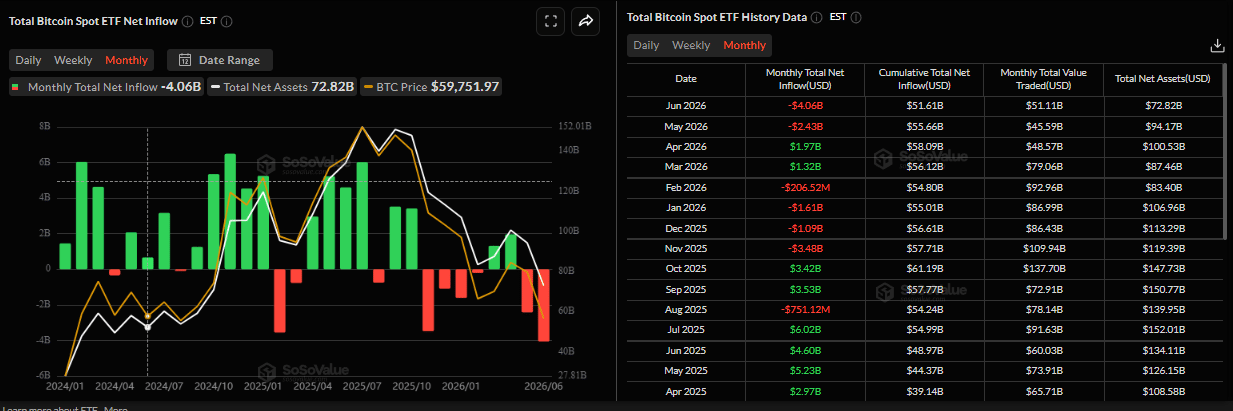
On the monthly chart, ETF outflows for June totaled $4.06 billion, marking the second consecutive month of outflows and the highest monthly outflows since the launch of Bitcoin ETF. This signals that institutional demand continues to weaken and fails to provide a cushion against falling BTC prices. If this continues this week, BTC could see further correction.
Bitcoin Price Forecast: BTC closes below key support zone
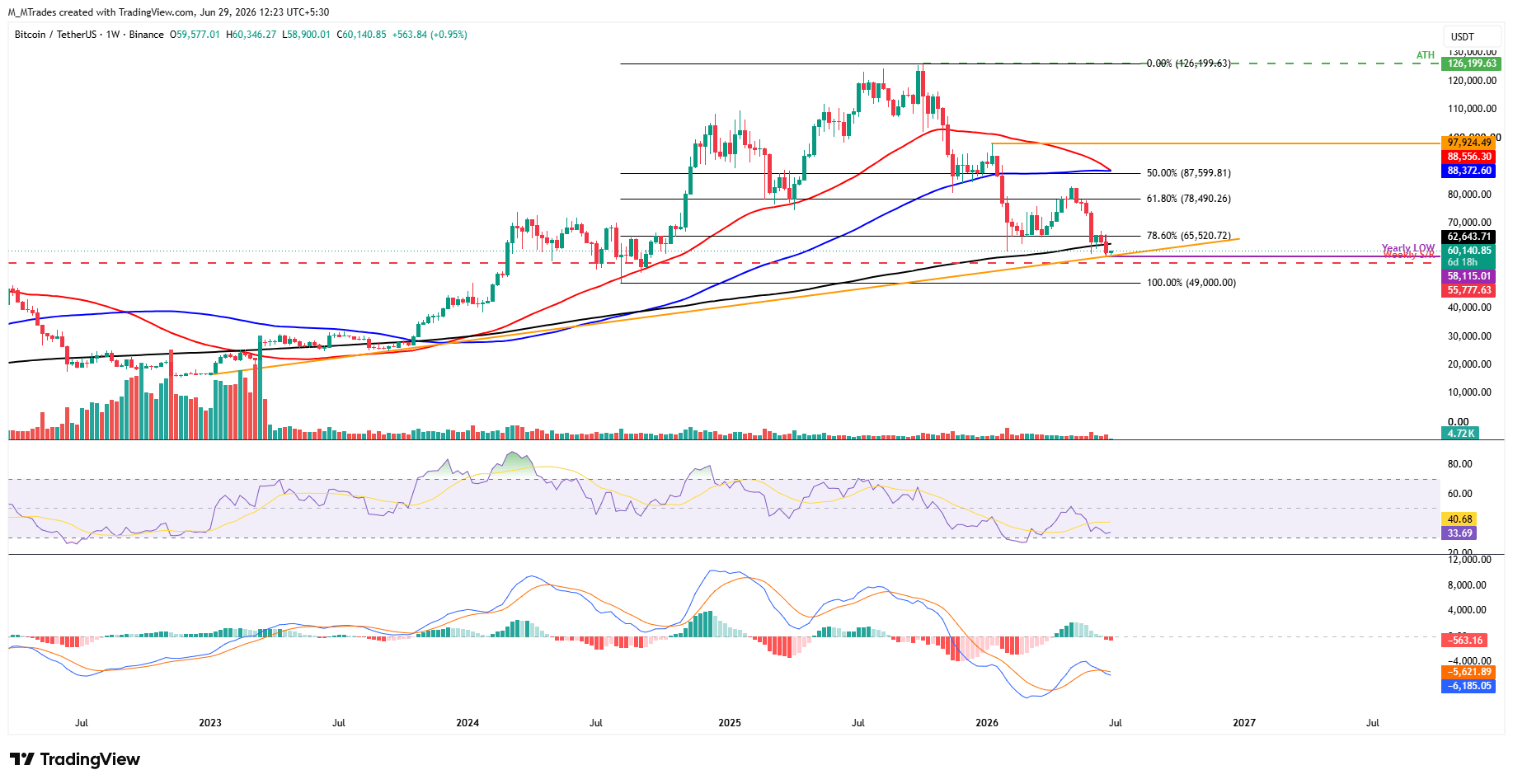
Bitcoin corrected 5.9% and closed below the 200-week Simple Moving Average (SMA) around $62,643 last week. BTC also hit a new yearly low of $58,115 during the same week. As of writing on Monday, BTC is recovering slightly after retesting the ascending trendline (drawn by connecting multiple lows since January 2023).
If BTC continues to hold this ascending trendline support roughly around $58,000, it could extend the recovery toward the 200-week SMA at $62,643.
Momentum indicators on the weekly chart show signs of concern: the Relative Strength Index (RSI) is trending lower and nearing oversold territory, with a reading of 33 on Monday.
Meanwhile, the Moving Average Convergence Divergence (MACD) flipped to a bearish crossover on June 22, and the bearish signal remains intact, supporting a negative outlook.
However, if BTC closes below the ascending trendline support, roughly around $58,000 on a weekly basis, it could extend the losses toward the next weekly support at $55,777.
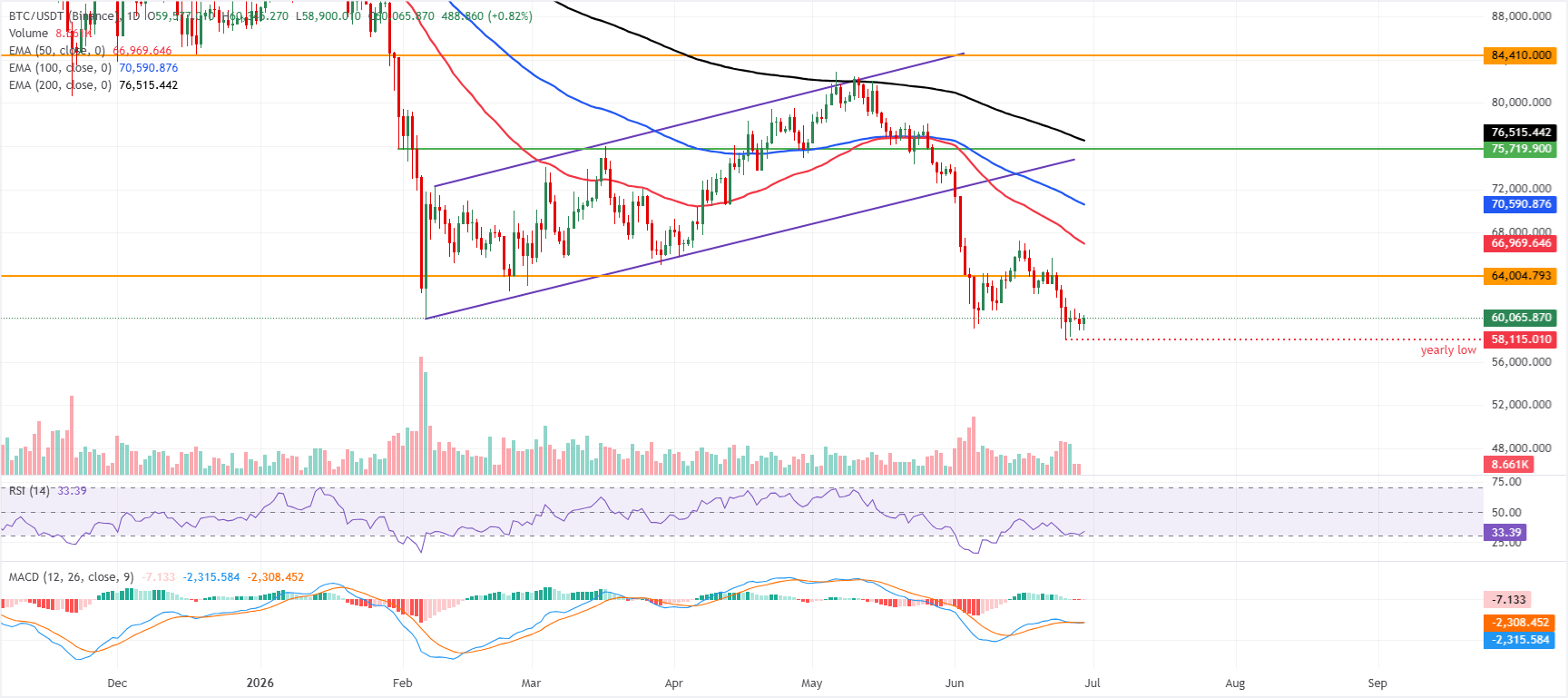
On the daily chart, BTC is maintaining a bearish bias, with price remaining below the 50-day, 100-day, and 200-day Exponential Moving Averages (EMAs) at $66,969, $70,590, and $76,515, respectively.
The MACD indicator on the daily chart hovers near the zero line with a marginally negative reading. At the same time, the RSI at 33 sits just above oversold territory, hinting at fading bearish momentum but not yet signaling a decisive recovery.
On the topside, initial resistance emerges at the horizontal barrier around $64,004, ahead of the 50-day EMA at $66,969 and the 100-day EMA at $70,590, which collectively cap the upside and reinforce the broader downbeat structure. Further up, the 200-day EMA at $76,515 and the prior horizontal level at $84,410 form a wider resistance band that would need to be cleared for the medium-term outlook to shift back to bullish. The absence of nearby defined support leaves the pair vulnerable to further downside probes if selling pressure resumes.
(The technical analysis of this story was written with the help of an AI tool.)
Bitcoin, altcoins, stablecoins FAQs
Bitcoin is the largest cryptocurrency by market capitalization, a virtual currency designed to serve as money. This form of payment cannot be controlled by any one person, group, or entity, which eliminates the need for third-party participation during financial transactions.
Altcoins are any cryptocurrency apart from Bitcoin, but some also regard Ethereum as a non-altcoin because it is from these two cryptocurrencies that forking happens. If this is true, then Litecoin is the first altcoin, forked from the Bitcoin protocol and, therefore, an “improved” version of it.
Stablecoins are cryptocurrencies designed to have a stable price, with their value backed by a reserve of the asset it represents. To achieve this, the value of any one stablecoin is pegged to a commodity or financial instrument, such as the US Dollar (USD), with its supply regulated by an algorithm or demand. The main goal of stablecoins is to provide an on/off-ramp for investors willing to trade and invest in cryptocurrencies. Stablecoins also allow investors to store value since cryptocurrencies, in general, are subject to volatility.
Bitcoin dominance is the ratio of Bitcoin's market capitalization to the total market capitalization of all cryptocurrencies combined. It provides a clear picture of Bitcoin’s interest among investors. A high BTC dominance typically happens before and during a bull run, in which investors resort to investing in relatively stable and high market capitalization cryptocurrency like Bitcoin. A drop in BTC dominance usually means that investors are moving their capital and/or profits to altcoins in a quest for higher returns, which usually triggers an explosion of altcoin rallies.
Recommended Articles


