


Apple Raised Prices on Almost Everything. Is the iPhone Next?
Key Points
Apple raised prices across its Mac, iPad, and home lineup on June 25 but left the iPhone alone.
Memory contract prices have soared this year as AI data centers soak up supply.
A good time to increase iPhone prices could be this fall, when the company typically introduces new models.
- 10 stocks we like better than Apple ›
Apple (NASDAQ: AAPL) shocked Wall Street last week when it raised prices across most of its hardware lineup. Macs, iPads, the Apple TV, the HomePod, and the Vision Pro headset all got more expensive -- increases of about $100 to $300 (with a few high-end Macs getting even bigger increases) -- and the company tied the move to a shortage of memory chips brought on by the build-out of artificial intelligence (AI) data centers.
"The rapid expansion of AI data centers has created an extraordinary surge in demand for memory and storage," Apple said.
Missed Nvidia in 2009? This Rare Signal Is Flashing Again. In 2009, a "Double Down" signal flashed for a little-known chipmaker called Nvidia. For the first time in years, that same "Total Conviction" signal is flashing for a company 1/100th the size of Nvidia. Continue »
Investors didn't take it well, and the stock had its worst day in more than a year.
Its most important product, however, was conspicuously missing from the list: the iPhone. Of course, so were the Apple Watch and AirPods. But the iPhone's absence from the list of products with price hikes is particularly notable. After all, the device still drives about half of Apple's revenue.
This leaves a big question for investors and consumers: Is the iPhone next? And if so, when are the increases coming?
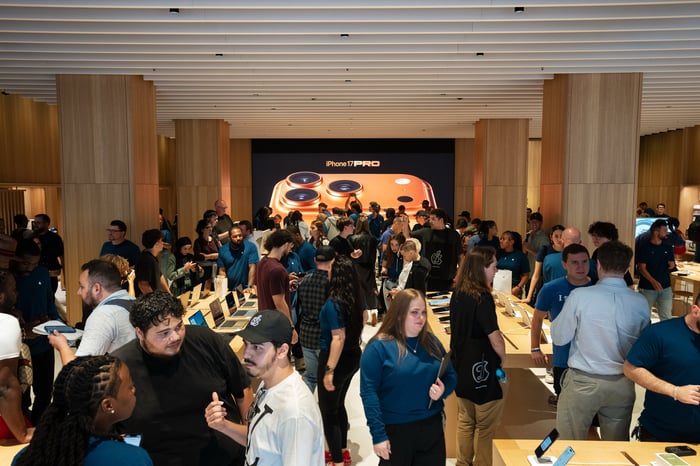
Image source: Apple.
Why the iPhone got a pass
There actually is one simple explanation as to why iPhone price increases may have been left out in this round: timing. Apple is expected to introduce new iPhone models this September, and this is a natural moment to reset pricing. Raising the price on phones already sitting on shelves, in the middle of a cycle, would be far more conspicuous than folding a higher number into a new lineup that buyers are weighing on its features anyway.
Additionally, the iPhone is also the entry point to nearly everything else Apple sells -- the services, the accessories, the next device -- so it may be the last product the company wants to disturb.
And it can afford to wait. Apple is taking on these costs from a position of unusual strength. In its fiscal second quarter (the period ended March 28, 2026), revenue rose 17% year over year to $111.2 billion, and earnings per share climbed 22% to $2.01. iPhone revenue set a March-quarter record, rising about 22%, and services reached an all-time high. Gross margin came in at a record 49.3%. A business running margins like that has room to absorb higher component costs for a while before it has to pass them along.
But the memory crisis may be getting harder to ignore. Conventional memory contract prices have soared this year -- up about 90% to 95% quarter over quarter in Q1 as supply shifts toward the high-bandwidth memory used in AI servers. And memory contract prices are expected to rise sharply in Q2, too.
How Apple could raise iPhone prices
Ultimately, I think an iPhone price increase this fall looks likely. The harder question, however, is how big the price increase will be and what it will do to demand.
Given that price increases for most of its products so far have largely ranged from $100 to $300, I think it's reasonable to assume that iPhone price hikes would come in at around $100 or higher.
But how would Apple go about raising prices on the iPhone? It's complicated because Apple has a number of levers. For example, it can raise the entry storage tier or lift the Pro phones while keeping the base model steady, rather than raising the price on every model.
Estimating how it may impact demand may be even harder. Apple boasts impressive customer loyalty. But could higher prices push customers to delay iPhone upgrades longer than they otherwise would?
On the positive side, a higher price protects Apple's gross margin, but only if it doesn't suppress upgraders too much. Push too hard, and a price increase meant to defend margins can end up shrinking unit sales too much, offsetting gains from margin protection.
So, what would iPhone price increases look like? My best guess is they occur this fall, and in a measured way -- largely concentrated on the Pro models, or tucked into versions with higher storage tiers rather than a blunt increase across the board.
With all of this said, raising prices on the iPhone isn't a given. With the stock trading at a price-to-earnings ratio of about 34, the valuation already leans on continued growth, giving the company every reason to defend its record margins. But it has just as much reason to protect the upgrade cycle that makes the iPhone its most valuable product. The new lineup is still a few months out, which leaves Apple time to decide how much of the memory squeeze its customers will end up paying for.
Should you buy stock in Apple right now?
Before you buy stock in Apple, consider this:
The Motley Fool Stock Advisor analyst team just identified what they believe are the 10 best stocks for investors to buy now… and Apple wasn’t one of them. The 10 stocks that made the cut could produce monster returns in the coming years.
Consider when Netflix made this list on December 17, 2004... if you invested $1,000 at the time of our recommendation, you’d have $398,052!* Or when Nvidia made this list on April 15, 2005... if you invested $1,000 at the time of our recommendation, you’d have $1,181,688!*
Now, it’s worth noting Stock Advisor’s total average return is 892% — a market-crushing outperformance compared to 205% for the S&P 500. Don't miss the latest top 10 list, available with Stock Advisor, and join an investing community built by individual investors for individual investors.
See the 10 stocks »
*Stock Advisor returns as of June 29, 2026.
Daniel Sparks and his clients have positions in Apple. The Motley Fool has positions in and recommends Apple. The Motley Fool has a disclosure policy.
Recommended Articles


