


SpaceX (SPCX) Falls 31% From Its High — Why $100B in Cash Isn't Stopping the Selloff
TradingKey - Shares of rocket firm SpaceX (NASDAQ: SPCX) closed Tuesday at $154.60, falling 16.4%, its worst day since its June 12 initial public offering, following a Securities and Exchange Commission filing for the company to issue senior unsecured notes to qualified institutional buyers and Bloomberg reports that the company aims to raise at least $20 billion in bonds. The shares have since slipped 31.4% from their record high of $225.64, just 14.5% above their $135 IPO pricing.
Why $100.8 Billion in Cash and a $20 Billion Bond Sale Happened on the Same Day
While it might seem odd for a company with $100.8 billion in cash and cash equivalents as of last Friday, that number sparked questions about why the company was issuing $20 billion in bonds, and understanding the reason behind the offering reveals more about what has been driving the selloff since June 16 than the shares’ current price. The $100.8 billion in cash SpaceX said it had as of last Friday was not cash in the same sense investors are thinking of.
In other words, the IPO raised $75 billion and is included in the number, as is the cash raised in previous private rounds. The $20 billion bonds are meant to pay off a bridge loan taken to partially finance the all-stock $60 billion purchase of Anysphere (Cursor). The bridge loan wasn’t intended to be long-term debt but rather temporary financing for the transaction. Now, a $20 billion bond issuance is allowing the bridge loan to be refinanced into a much larger, longer-term debt package at investment-grade interest rates afforded by the Baa1 rating from Moody’s and BBB+ ratings from Fitch and Standard & Poor’s. A $20 billion bond offering from a company with $100 billion in cash isn’t indicative of a liquidity issue but is indicative of a refinancing.
But the market wasn’t as focused on the bond offering. June 17 was the first day of trading after SPCX got investment-grade ratings, and also the first day SPCX options would be tradable. Before June 17, there was effectively no means to short SPCX, and institutional traders have a way to do so with hedging. With SPCX having only 4-5% of shares in public trading hands, short interest is incredibly expensive to maintain. And there’s really not a lot of liquidity available to short the stock. Options, which debuted on the first day SPCX could be traded on a public exchange, changed all of that for investors who previously couldn’t either hedge their long positions or take a bearish stake on the stock. The offering of the bonds is not the sole explanation of the 16.4% single-session drop on Tuesday, but rather the bonds and the first week of trading options together.
The xAI Disclosure Investors Largely Missed — All 11 Co-Founders Departed Pre-IPO
However, lost in the recent news of the massive selling in the past week is another important nugget: all of xAI’s 11 co-founders left the company in the months leading up to the IPO, a development that didn’t get much news in June but was very significant. Elon Musk said in March 2026 that xAI “was not built right first time around.” The loss xAI segment posted for 2025 was an operating loss of $6.355 billion. That includes the $4.423 billion operating profit that Starlink posted for the period and more. With $12.7 billion in capital expenditures in 2025, that resulted in the $4.937 billion consolidated net loss for the year. This is the business that Goldman Sachs needs to have 100-times its current revenue to justify the $474 billion projection for 2030, and thusly SpaceX, that supports the most bullish analyst price targets.
The same day as the bond sale SpaceX announced an arrangement to sell the use of its compute to open-source AI startup ReflectionAI. This is a relatively small but directionally significant data point that xAI is starting to generate third-party business and not only rely on Cursor for third-party revenue. This aligns with the $75 billion of third-party compute agreements with Anthropic and Google that Moody’s included in its rationale for the credit ratings. Separately, MSCI assigned SpaceX a CCC ESG rating on June 11, CCC being the lowest rating on its scale, with a controversies score of 1/10 and governance at 3.2/10, both reflecting a high concentration of votes. The ESG rating has no effect on SpaceX’s investment-grade credit rating but could be significant to certain investors who have ESG screens in their investment mandates.
SPCX Technical Setup — Ascending Trendline Breakout at $154.60, RSI 31.44, Target $172
On the 2H chart, SPCX just broke out of the ascending black trendline at $154.60 after that violent 16.4% drop. RSI is oversold at 31.44. Strong divergence: The RSI is forming higher highs while the price is making lower lows, which suggests selling momentum is beginning to exhaust. Volume has diminished on the latest few candles, suggesting that selling pressure is reduced at this price level where price action is confluence around the ascending trendline. $161.01 to $172 overhead from Fib and channel.
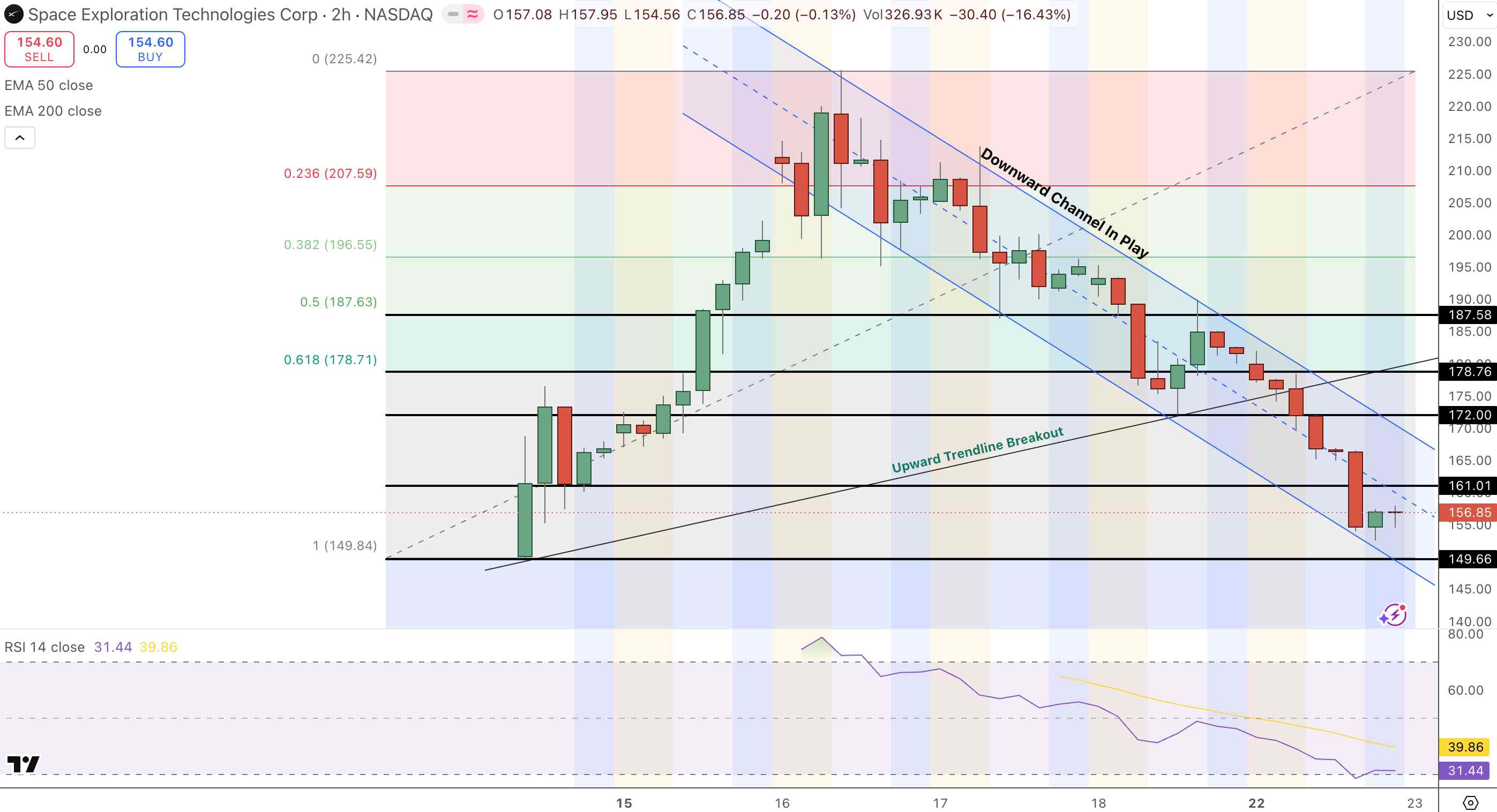
SpaceX (SPCX) Price Chart - Source: Tradingview
Hold the ascending trendline and breakout above $161.00 targets $172 on the trendline bounce. Stop at $149.70 where the 1.0 Fib and much lower support structure breaks.
- Entry: Long above $161.00, ascending trendline and Fib confluence out
- Target: $172.00, trendline bounce extension
- Support: $149.84, 1.0 Fib, the next key level below
- Stop Loss: Close below $149.70, deeper support structure fails
- Current: $154.60, 14.5% higher than $135 IPO price, down 31.4% from $225.64 ATH
- Next catalyst: August 6, 2026, first earnings report
So, why is SpaceX stock down 16% on June 22 when it has $100 billion in the bank?
SpaceX filed for $20 billion bonds alongside disclosing $100.8B in cash and equivalents on June 22. That cash number includes the $75B in the June 12 IPO, and the bond sale was designed to refinance the bridge loan on the $60B purchase of Cursor, not to raise capital for liquidity. The stock fell 16.4% also because the first week of trading on SPCX options started June 17, allowing short sellers to finally short the stock and hedge in a practical way. The bond news and start of the SPCX options market together drove the sell-off.
What's the xAI deal and why does it matter for SPCX valuation?
xAI, which SpaceX will absorb via a 100% share merger in February 2026, lost $6.355B in the operating line in 2025 and spent $12.7B in capex, wiping out Starlink's $4.423B operating profit and making an SPCX net loss of $4.937B. All of xAI's 11 original co-founders left before the IPO, and Musk told us in March 2026 that xAI "was not built right first time around." The bullish case for SPCX (Goldman expects $474B in SPCX in 2030) needs to believe xAI revenue will be about 100x the present. The recent xAI third party computing contracts (including with ReflectionAI, Anthropic, Google, for a total of $75B per Moody's) suggest that xAI has started to gain real customers, but it has a long way to go to catch up with competitors.
Should I buy SPCX at $154.60? That's only 14% more than the IPO price?
RSI (31.44) is very oversold and trending up (positive divergence), and the ascending trendline is a buy zone from a technical standpoint. A stop entry on SPCX above $161.00 targets $172.00, with a stop-loss under $149.70. Starlink's 12M customers and $4.4B OPL have not changed. The bond sale is for refinancing and is not a liquidity issue. The 95-96% of SPCX shares that will be unlocked in December 2026, xAI operating losses, the ability for shorts to maintain short positions in the options market, and the projection by S&P of negative FCF into 2029 are structural reasons why recovering from the $225 all-time-high from the $154.60 level is more difficult than from $135.
Bottom Line
SpaceX stocks crashed 16.4% on June 22 because SpaceX filed for $20B bonds, but it was worsened by the fact that shorts were able to enter into the SPCX options for the first time the first full week of SPCX options trading. The $100.8B in cash disclosed on June 22 is real, but it includes the money that came in during the June 12 IPO, and the bond sale is just for refinancing, not a liquidity signal. SPCX currently trades for $154.60, 14.5% above its $135 IPO price. The RSI of 31.44 is very oversold, and the ascending trendline is a buy zone. If you get above $161.00, SPCX should reach a high of $172.00. The exit of xAI co-founders, the expectation by S&P that SPCX will generate negative free cash flow into 2029, and the unlocking in December 2026 of 95-96% of all SPCX shares are the structural reasons between $154.60 and any sustained move toward the $225 all-time-high.
Recommended Articles


