

Fed Chair Kevin Warsh Dropped a Bombshell at the FOMC Meeting -- and It's What He Didn't Say That Matters Most

Source The Motley Fool

Key Points

  • Fed Chair Kevin Warsh oversaw his first FOMC meeting last week.

  • Though the central bank left interest rates unchanged (as expected), it's what was left out of the latest FOMC statement that holds the most weight.

  • Rate cuts appear to be firmly off the table, which is a potentially tough pill to swallow for an expensive stock market.

  • 10 stocks we like better than S&P 500 Index ›

Over the last three weeks, Wall Street has witnessed the Dow Jones Industrial Average (DJINDICES: ^DJI), S&P 500 (SNPINDEX: ^GSPC), and Nasdaq Composite (NASDAQINDEX: ^IXIC) catapult to new highs, the debut of the largest-ever initial public offering (IPO), and a new Fed chair take the podium for the Federal Open Market Committee (FOMC). The FOMC is the 12-person body responsible for setting the nation's monetary policy.

After more than a year of public feuding over interest rates between President Donald Trump and now-former Fed Chair Jerome Powell, Trump's chosen successor to Powell, Kevin Warsh, was sworn in on May 22. Warsh entered last week's FOMC meeting with big shoes to fill, amid a three-year high for U.S. inflation.

Where to invest $1,000 right now? Our analyst team just revealed what they believe are the 10 best stocks to buy right now, when you join Stock Advisor. See the stocks »

While some aspects of Warsh's inaugural meeting as Fed chair went as expected, something big was missing -- and it has massive implications for Wall Street.
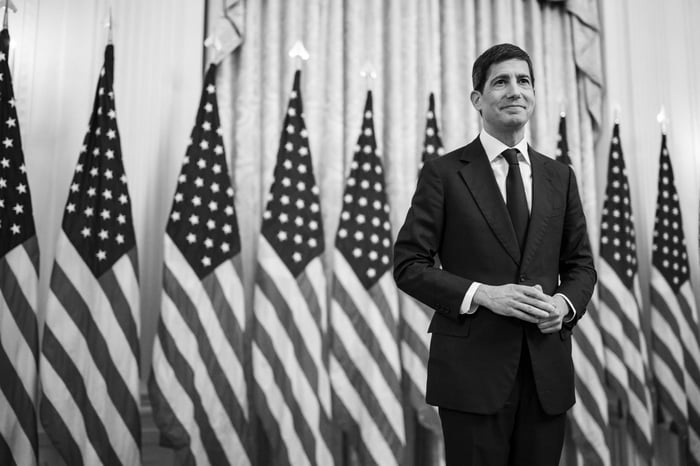
Kevin Warsh standing in front of a row of American flags in the East Room of the White House.

Fed Chair Kevin Warsh at his White House swearing-in ceremony. Image source: Official White House Photo by Daniel Torok.

It's what Fed Chair Warsh didn't say that holds the most weight

The headline of the FOMC's June statement is that all 12 voting members chose to leave the federal funds target rate unchanged at 3.5% to 3.75%. This was the first meeting in the last eight without a dissent.

But this headline misses what's arguably the biggest bombshell of Kevin Warsh's first FOMC meeting as Fed chair: the lack of an easing bias statement.

For well over a year, the FOMC's meeting statements have contained an easing bias -- i.e., a statement signaling that policymakers are more likely to cut interest rates as their next move. Between September 2024 and December 2025, the FOMC lowered the federal funds target rate six times.

But over the last 15 months, the U.S. economy has dealt with two price shocks. The first is President Trump's tariffs, which have added duties on select imported goods and pushed up prices for consumers.

However, the primary inflation catalyst is the Iran war. Iran's closure of the Strait of Hormuz shortly after U.S. military attacks began on Feb. 28 effectively halted the daily flow of 20 million barrels of petroleum liquids. The reaction in energy markets was swift, with fuel prices driving trailing 12-month inflation from 2.4% in February to 4.2% in May.

Perhaps unsurprisingly, three FOMC members dissented in Powell's final meeting in late April on the inclusion of the easing bias statement. In mid-May, the Fed meeting minutes showed a majority favored removing this statement.

Even though Warsh and the FOMC didn't officially shift to a neutral bias, the writing is on the wall that rate cuts are firmly off the table in the near term. It's a tough pill to swallow for Wall Street and investors, who were counting on a few rate cuts this year to fuel the debt-financed expansion of the artificial intelligence data center build-out.

Higher borrowing costs risk slowing this expansion and the otherworldly growth expectations attached to it. This is potentially problematic for a stock market that recently came within a stone's throw of its priciest valuation in 155 years.

What Fed Chair Kevin Warsh didn't say can completely reshape the stock market's outlook.

Should you buy stock in S&P 500 Index right now?

Before you buy stock in S&P 500 Index, consider this:

The Motley Fool Stock Advisor analyst team just identified what they believe are the 10 best stocks for investors to buy now… and S&P 500 Index wasn’t one of them. The 10 stocks that made the cut could produce monster returns in the coming years.

Consider when Netflix made this list on December 17, 2004... if you invested $1,000 at the time of our recommendation, you’d have $417,305!* Or when Nvidia made this list on April 15, 2005... if you invested $1,000 at the time of our recommendation, you’d have $1,293,148!*

Now, it’s worth noting Stock Advisor’s total average return is 936% — a market-crushing outperformance compared to 209% for the S&P 500. Don't miss the latest top 10 list, available with Stock Advisor, and join an investing community built by individual investors for individual investors.

See the 10 stocks »

*Stock Advisor returns as of June 23, 2026.

Sean Williams has no position in any of the stocks mentioned. The Motley Fool has no position in any of the stocks mentioned. The Motley Fool has a disclosure policy.

Disclaimer: For information purposes only. Past performance is not indicative of future results.
placeholder
Bitcoin CME gaps at $35,000, $27,000 and $21,000, which one gets filled first?Prioritize filling the $27,000 gap and even try higher.
Author  FXStreet
Aug 22, 2023
Prioritize filling the $27,000 gap and even try higher.
placeholder
Pinduoduo Earnings Incoming: Morgan Stanley Sees Long-Term Profit Potential​Insights – On November 21, Chinese e-commerce giant Pinduoduo (PDD) will release its Q3 2024 earnings.
Author  Mitrade
Nov 20, 2024
​Insights – On November 21, Chinese e-commerce giant Pinduoduo (PDD) will release its Q3 2024 earnings.
placeholder
Elon Musk’s xAI and Neuralink Launch New Funding Rounds​Billionaire Elon Musk recently raised funds for his two high-profile tech companies, xAI and Neuralink.
Author  Insights
Jun 03, 2025
​Billionaire Elon Musk recently raised funds for his two high-profile tech companies, xAI and Neuralink.
placeholder
Bitcoin briefly loses 2025 gains as crypto plunges over the weekend.Bitcoin experienced a sharp decline this weekend, briefly erasing its 2025 gains and dipping below its year-opening value of $93,507. The cryptocurrency fell to a low of $93,029 on Sunday, representing a 25% drop from its all-time high in October. Although it has rebounded slightly to around $94,209, the pressures on the market remain significant. The downturn occurred despite the reopening of the U.S. government on Thursday, which many had hoped would provide essential support for crypto markets. This year initially appeared promising for cryptocurrencies, particularly after the inauguration of President Donald Trump, who has established the most pro-crypto administration thus far. However, ongoing political tensions—including Trump's tariff strategies and the recent government shutdown, lasting a historic 43 days—have contributed to several rapid price pullbacks for Bitcoin throughout the year. Market dynamics are also being influenced by Bitcoin whales—investors holding large amounts of Bitcoin—who have been offloading portions of their assets, consequently stalling price rallies even as positive regulatory developments emerge. Despite these sell-offs, analysts from Glassnode argue that this behavior aligns with typical patterns seen among long-term investors during the concluding stages of bull markets, suggesting it is not indicative of a mass exodus. Notably, Bitcoin is not alone in its struggles, as Ethereum and Solana have also recorded declines of 7.95% and 28.3%, respectively, since the start of the year, while numerous altcoins have faced even steeper losses. Looking ahead, questions linger regarding the viability of the four-year cycle thesis, particularly given the increasing institutional support and regulatory frameworks now in place in the crypto landscape. Matt Hougan, chief investment officer at Bitwise, remains optimistic, suggesting a potential Bitcoin resurgence in 2026 driven by the “debasement trade” thesis and a broader trend toward increased adoption of stablecoins, tokenization, and decentralized finance. Hougan emphasized the soundness of the underlying fundamentals, pointing to a positive outlook for the sector in the longer term.
Author  Mitrade
Nov 17, 2025
Bitcoin experienced a sharp decline this weekend, briefly erasing its 2025 gains and dipping below its year-opening value of $93,507. The cryptocurrency fell to a low of $93,029 on Sunday, representing a 25% drop from its all-time high in October. Although it has rebounded slightly to around $94,209, the pressures on the market remain significant. The downturn occurred despite the reopening of the U.S. government on Thursday, which many had hoped would provide essential support for crypto markets. This year initially appeared promising for cryptocurrencies, particularly after the inauguration of President Donald Trump, who has established the most pro-crypto administration thus far. However, ongoing political tensions—including Trump's tariff strategies and the recent government shutdown, lasting a historic 43 days—have contributed to several rapid price pullbacks for Bitcoin throughout the year. Market dynamics are also being influenced by Bitcoin whales—investors holding large amounts of Bitcoin—who have been offloading portions of their assets, consequently stalling price rallies even as positive regulatory developments emerge. Despite these sell-offs, analysts from Glassnode argue that this behavior aligns with typical patterns seen among long-term investors during the concluding stages of bull markets, suggesting it is not indicative of a mass exodus. Notably, Bitcoin is not alone in its struggles, as Ethereum and Solana have also recorded declines of 7.95% and 28.3%, respectively, since the start of the year, while numerous altcoins have faced even steeper losses. Looking ahead, questions linger regarding the viability of the four-year cycle thesis, particularly given the increasing institutional support and regulatory frameworks now in place in the crypto landscape. Matt Hougan, chief investment officer at Bitwise, remains optimistic, suggesting a potential Bitcoin resurgence in 2026 driven by the “debasement trade” thesis and a broader trend toward increased adoption of stablecoins, tokenization, and decentralized finance. Hougan emphasized the soundness of the underlying fundamentals, pointing to a positive outlook for the sector in the longer term.
placeholder
Gold declines below $4,500 on stalled US-Iran ceasefire talks, US NFP data loomsGold price (XAU/USD) edges lower to near $4,470 during the early Asian session on Friday. The precious metal remains volatile amid ongoing geopolitical turmoil. Traders will closely monitor the developments surrounding the US-Iran peace deal and the US May employment report later on Friday. 
Author  FXStreet
Jun 05, Fri
Gold price (XAU/USD) edges lower to near $4,470 during the early Asian session on Friday. The precious metal remains volatile amid ongoing geopolitical turmoil. Traders will closely monitor the developments surrounding the US-Iran peace deal and the US May employment report later on Friday. 
goTop
quote