


Meet the Unstoppable Stock That Obliterated Nvidia, Broadcom, and Advanced Micro Devices (AMD) Over the Last 12 Months With a 670% Return
Key Points
Opendoor Technologies buys houses from willing sellers and attempts to flip them for a profit, which is a risky business model known as iBuying.
Opendoor stock rallied by 670% over the last 12 months, as retail investors sparked a buying frenzy on social media without much regard for the company's fundamentals.
Opendoor has outperformed many of the best stocks in the artificial intelligence space over the past year, but I wouldn't bet on that continuing.
- 10 stocks we like better than Opendoor Technologies ›
One year ago, Opendoor Technologies (NASDAQ: OPEN) stock was trading at just $0.51. However, retail investors sparked a buying frenzy through social media platforms like Reddit and X (formerly Twitter), which sent the stock to a 52-week high of $10.52. It has since lost some momentum and closed at $4.73 last Thursday, June 18, but that still represents a 12-month return of 670%.
That's right, this real estate stock has crushed artificial intelligence (AI) semiconductor giants like Nvidia, Broadcom, and Advanced Micro Devices, which have returned between 44% and 323% over the last 12 months. However, here's why investors probably shouldn't chase the rally in Opendoor stock.
Where to invest $1,000 right now? Our analyst team just revealed what they believe are the 10 best stocks to buy right now, when you join Stock Advisor. See the stocks »

Image source: Getty Images.
Opendoor has a risky business model
Selling a home is one of the biggest financial decisions most people will ever make, so they usually hire a professional agent to manage the process. But not even the best agent can guarantee a sale, especially in this tough market, which is why many vendors have turned to Opendoor.
A seller can enter a few details about their home on Opendoor's website, and the company will provide a cash offer with a short settlement period. Opendoor attempts to flip each home for a profit, which is a business model known as iBuying. It works great when the real estate market is strong, but when prices are falling, the company risks sitting on thousands of homes that are dropping in value.
The real estate market is in a very difficult place right now, as stubbornly high interest rates keep first-home buyers, upsizers, and even downsizers on the sidelines. According to Redfin, there were 47% more sellers than buyers in April, which was near a record high. U.S. existing home sales are also hovering near a multiyear low of 4.17 million annualized units, with no sign of a looming recovery.
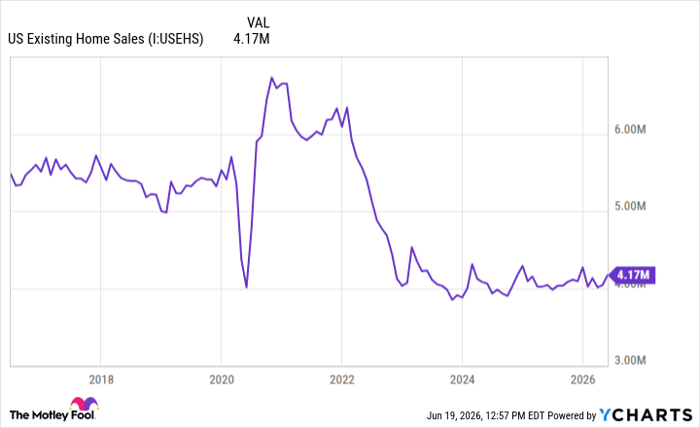
US Existing Home Sales data by YCharts
It's very difficult for vendors to achieve the price they want in this market, so it's extremely difficult for a high-volume seller like Opendoor to make money. The company must exercise discipline to avoid a similar fate to former competitors like Zillow and Redfin, which both shut down their iBuying businesses completely after suffering steep losses when the 2021 real estate boom ended.
Shrinking revenue and ballooning losses
Opendoor sold 1,921 homes during the first quarter of 2026, which was a 35% drop from the year-ago period. The sales brought in revenue of $720 million, which was down 37%. These results were a direct consequence of management's decision to slow the pace of home acquisitions last year amid the tough real estate market.
But Opendoor's new CEO, Kaz Nejatian, who took on the role last September, is now ramping up the rate of purchases again. With the help of technologies like artificial intelligence, his strategy is to buy homes more aggressively while reducing the amount of time Opendoor typically holds on to them. He thinks if the company can flip its inventory at a faster pace, it will be less susceptible to broader market forces that are outside its control.
As a result, Opendoor bought 2,474 homes in the first quarter. That was still down from the year-ago period, but it was up by 45% sequentially (compared to the fourth quarter of 2025).
It's too early to render a verdict on Nejatian's strategy, but it's worth noting Opendoor's generally accepted accounting principles (GAAP) net loss more than doubled to $173 million during Q1. He will have to get this under control, because it's no use buying more homes if it will just lead to higher losses.
In his Q1 remarks to investors, Nejatian did say that as of April 1, Opendoor was profitable on an adjusted (non-GAAP) 12-month go-forward EBITDA (earnings before interest, tax, depreciation, and amortization) basis. That is more of a projection than an achievement in my opinion, because a lot can change in the upcoming year.
Don't bank on further upside in Opendoor stock
Opendoor stock probably wouldn't have experienced such a fierce rally over the last 12 months if not for the social media-driven speculative buying frenzy among retail investors. Based on the financial results I highlighted above, the company simply hasn't made enough progress to warrant its meteoric rise in value.
To make matters worse, the Federal Reserve is now hinting at a potential interest rate hike before the end of 2026, which will only pile more pressure on the sluggish housing market. As a result, while Opendoor has obliterated some of the AI industry's best-performing stocks over the past year, I wouldn't bank on further upside from here.
Should you buy stock in Opendoor Technologies right now?
Before you buy stock in Opendoor Technologies, consider this:
The Motley Fool Stock Advisor analyst team just identified what they believe are the 10 best stocks for investors to buy now… and Opendoor Technologies wasn’t one of them. The 10 stocks that made the cut could produce monster returns in the coming years.
Consider when Netflix made this list on December 17, 2004... if you invested $1,000 at the time of our recommendation, you’d have $417,305!* Or when Nvidia made this list on April 15, 2005... if you invested $1,000 at the time of our recommendation, you’d have $1,293,148!*
Now, it’s worth noting Stock Advisor’s total average return is 936% — a market-crushing outperformance compared to 209% for the S&P 500. Don't miss the latest top 10 list, available with Stock Advisor, and join an investing community built by individual investors for individual investors.
See the 10 stocks »
*Stock Advisor returns as of June 23, 2026.
Anthony Di Pizio has no position in any of the stocks mentioned. The Motley Fool has positions in and recommends Advanced Micro Devices, Broadcom, Nvidia, Reddit, and Zillow Group. The Motley Fool has a disclosure policy.
Recommended Articles


