


Ignoring Geopolitical Gloom: US Equity ETF Inflows Near $1 Trillion in First Half as Buying Surges Against the Trend
TradingKey - Under the multi-faceted pressures of high inflation, escalating geopolitical conflicts in the Middle East, and intensifying global market volatility, the US exchange-traded fund (ETF) market has shown remarkable resilience. It has attracted nearly $1 trillion in inflows so far this year—a milestone reached before the end of June, a full four months ahead of last year's pace and twice as fast as in 2024.
Bloomberg Intelligence data shows that at the current pace, full-year inflows are on track to easily surpass last year's record of $1.5 trillion, which itself significantly exceeded the 2024 peak of $1.1 trillion.
Behind this boom is US household investors' steadfast commitment to the "buy-and-hold" strategy. Despite the highly uncertain external environment, ETFs are increasingly becoming the vehicle of choice for investors, thanks to their unique advantages of trading flexibility, low costs, and coverage of nearly all asset classes.
Roxanna Islam, head of industry research at TMX VettaFi, noted: "Every year, more investors recognize the value of ETFs. Not only are traditional investment strategies efficiently executed through ETFs, but an increasing number of innovative strategies are also being wrapped into the ETF structure, continuously drawing market attention."
VOO surpasses $1 trillion mark as AI theme surges
In terms of fund flows, equity funds are undoubtedly the main magnet for inflows, attracting over $660 billion year-to-date. Among them, Vanguard's S&P 500 ETF (VOO) leads the pack with $110 billion in net inflows, and became the world's first ETF to surpass $1 trillion in assets a few weeks ago.
State Street's SPYM—a low-cost version of its flagship SPY fund—followed closely behind, drawing in approximately $41 billion; Vanguard's Total Stock Market ETF (VTI) ranked third with $31 billion in net inflows.
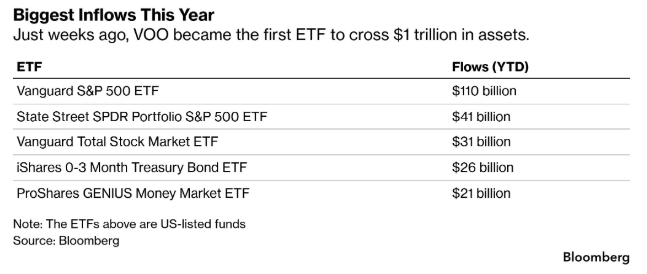
Source: Bloomberg
Meanwhile, the performance of emerging thematic ETFs is equally striking. Roundhill's memory chip thematic fund (ticker: DRAM) has attracted over $15 billion in inflows since its launch in April, making it the fastest-growing ETF product this year.
Christian Magoon, founder and CEO of Amplify ETFs, commented: "This is not blind frenzy, but rather the continued strong performance of ETFs as the investment vehicle of choice, which is helping investors capture market opportunities that were previously difficult to reach."
Capital pours in against the trend
Notably, despite the escalating conflict between the U.S. and Iran, recent inflows into U.S. equity ETFs have actually accelerated.
Athanasios Psarofagis, an analyst at Bloomberg Intelligence, believes this phenomenon indicates that investors view the U.S. market as a "safe haven" for risk capital. Amid intensifying global geopolitical uncertainty, the stability and liquidity of the U.S. market have become key factors attracting capital.
Beyond record-breaking inflows, product innovation in the ETF industry is also accelerating. Since the beginning of this year, more than 600 new ETFs have launched, marking the fastest pace of issuance in history.
These new products span multiple emerging sectors, from artificial intelligence and clean energy to ESG, providing investors with more diversified options. This rapid innovation not only enriches the market ecosystem but also further solidifies the central role of ETFs in the investment landscape.
For investors, the appeal of ETFs lies not only in their convenience and low costs, but also in their resilience during market volatility.
Compared with individual stocks, ETFs mitigate the risk of single-asset volatility through diversification. And compared with mutual funds, ETFs offer higher trading flexibility and transparency, allowing investors to buy and sell throughout the trading day to better capture market opportunities. In today's uncertain market environment, such an investment vehicle—combining both stability and flexibility—is naturally favored by investors.
Recommended Articles


