


Should You Buy Tesla Stock Before July 2?
Key Points
Many investors are excited about Tesla's new product platforms, inculding he Cybercab robotaxi and the Optimus humanoid robot, but electric vehicle (EV) sales still account for over 70% of the company's total revenue.
Tesla's EV sales declined in both 2024 and 2025, but the company could report its second-straight quarter of growth on July 2.
However, even if Tesla's EV business is truly turning around, its stock might struggle to mount a meaningful rally.
- These 10 stocks could mint the next wave of millionaires ›
Despite positive returns across all major U.S. stock market indexes this year, Tesla (NASDAQ: TSLA) has suffered an 8% decline. The company is coming off two consecutive years of falling electric-vehicle (EV) sales, which is weighing on sentiment.
That's why July 2 could be a very important date for the stock. It's when Tesla will report its EV deliveries for the second quarter of 2026 (ended June 30), and Wall Street is looking for a number in the ballpark of 400,000 cars. If the company meets that estimate, it would mark the second straight quarter of growth, which could suggest sales are finally turning around.
Where to invest $1,000 right now? Our analyst team just revealed what they believe are the 10 best stocks to buy right now, when you join Stock Advisor. See the stocks »
Should investors buy Tesla stock ahead of the upcoming release?
Image source: Tesla.
Tesla is facing fierce competition in the EV industry
Tesla delivered 1.79 million cars in 2024, a 1% decline from the prior year. But sales shrank at an even faster pace of 9% in 2025, with just 1.63 million deliveries. Although the company is investing more and more resources into future product platforms including the Cybercab autonomous robotaxi and the Optimus humanoid robot, EV sales still account for more than 70% of its total revenue. Therefore, the sales declines have been a big headwind for its financial results.
Tesla's automotive revenue sank by 10% in 2025, which led to a 3% decline in its overall revenue. Plus, since the company was aggressively cutting EV prices to attract more customers, its profit margin contracted, leading to a 47% decline in its earnings.
Fortunately, some green shoots are starting to appear. Tesla's 358,023 EV deliveries during the first quarter of 2026 represented a 6% increase from the year-ago period. And if the company delivers 400,000 cars in the second quarter per Wall Street's consensus forecast, that would be a 4% year-over-year jump.
But two positive quarters won't alleviate concerns about the long-term trajectory of Tesla's EV business, given how competitive the industry has become. China-based Geely Automotive Group said its New Energy Vehicle sales (which include battery EVs and plug-in hybrids) soared by 90% to almost 1.7 million units in 2025, and further growth is expected this year. In fact, the company is planning an aggressive expansion in Europe, which is one of Tesla's biggest markets.
China's BYD outsold Tesla directly in the EV category last year, delivering more than 2.2 million cars worldwide. It's off to a sluggish start to 2026, but it still dominates the affordable end of the market because it sells EVs at prices that Tesla simply can't match.
Should you buy Tesla stock ahead of July 2?
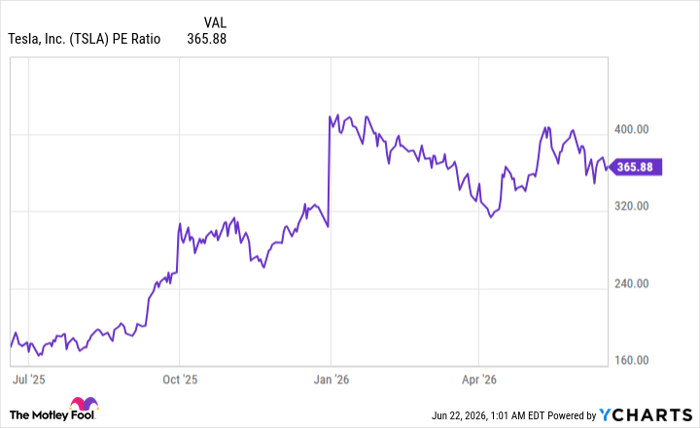
Even if Tesla's EV deliveries beat Wall Street's forecast on July 2, I'm not convinced it will lead to upside in its stock. Based on the company's trailing-12-month earnings of $1.09 per share, its stock is trading at a sky-high price-to-earnings (P/E) ratio of 366, which is already more than 10 times higher than the Nasdaq-100 index's P/E of 34.4.
From that perspective, investing in Tesla right now probably isn't the right move.
TSLA PE Ratio data by YCharts
With that said, many existing shareholders are sticking around despite Tesla's elevated P/E ratio, because they believe products such as the Cybercab and Optimus have incredible long-term potential. According to the most recent guidance from CEO Elon Musk, the Cybercab entered production in April. However, the company is still awaiting widespread regulatory approval for its full self-driving (FSD) software, so the robotaxi won't immediately be ready to provide fully autonomous ride-hailing services.
Musk believes FSD can win approval in around a dozen U.S. states by the end of 2026, but he is likely to provide some fresh guidance on July 2. He will almost certainly update investors on Optimus, too, which he has previously said could generate $10 trillion in revenue for Tesla over the long term. The humanoid robot is scheduled to enter mass production at the end of this year, starting in the company's Fremont, California, factory, which will have the capacity to make 1 million units annually.
In summary, while I certainly won't be a buyer of Tesla stock ahead of July 2, I can understand why some investors are holding on despite its sky-high valuation. However, it's important to remember that expensive stocks tend to have more downside risk than fairly valued stocks. Tesla could suffer a sharp decline in value if products like the Cybercab and Optimus don't come to market as soon as expected.
Don’t miss this second chance at a potentially lucrative opportunity
Ever feel like you missed the boat in buying the most successful stocks? Then you’ll want to hear this.
On rare occasions, our expert team of analysts issues a “Double Down” stock recommendation for companies that they think are about to pop. If you’re worried you’ve already missed your chance to invest, now is the best time to buy before it’s too late. And the numbers speak for themselves:
- Nvidia: if you invested $1,000 when we doubled down in 2009, you’d have $547,138!*
- Apple: if you invested $1,000 when we doubled down in 2008, you’d have $56,799!*
- Netflix: if you invested $1,000 when we doubled down in 2004, you’d have $417,305!*
Right now, we’re issuing “Double Down” alerts for three incredible companies, available when you join Stock Advisor, and there may not be another chance like this anytime soon.
See the 3 stocks »
*Stock Advisor returns as of June 22, 2026.
Anthony Di Pizio has no position in any of the stocks mentioned. The Motley Fool has positions in and recommends Tesla. The Motley Fool recommends BYD Company. The Motley Fool has a disclosure policy.
Recommended Articles


