


This Homebuilder's Average Selling Price Just Hit a 9-Year Low. Here's Why That's Great News for Home Depot
Key Points
A major homebuilder reported lower prices to boost demand.
Increased homebuying should lead to more major renovations.
That'll benefit Home Depot, the largest home-improvement retailer.
- 10 stocks we like better than Home Depot ›
Lennar (NYSE: LEN) saw fiscal second-quarter home deliveries increase 2% to 20,519. However, the homebuilder reported a lower average sales price of $371,000, including nearly 13% in incentives and base-price "adjustments" designed to boost demand amid affordability issues. It's the lowest price reported in several years. The results were for the period ended March 31.
However, while that suggests a tough economy, making homes more affordable should carry over to existing homes and boost unit sales across the board. In May, the National Association of Realtors' Housing Affordability Index registered 105.6, an improvement from 97.5 in the year-ago period (higher numbers indicate greater affordability). The index measures the affordability of existing home sales.
Where to invest $1,000 right now? Our analyst team just revealed what they believe are the 10 best stocks to buy right now, when you join Stock Advisor. See the stocks »
While it may play out over time, reduced home prices will benefit the home improvement sector, and its leading retailer, Home Depot (NYSE: HD).
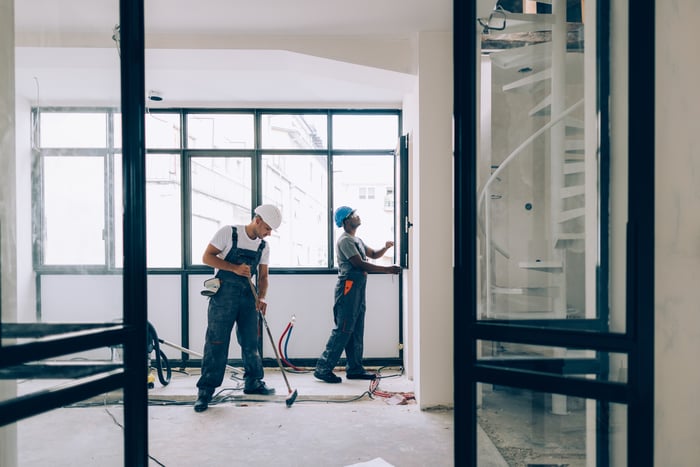
Image source: Getty Images.
Spurring home sales
Lower prices should boost existing home sales, although no one can predict the exact timing. That's good for Home Depot.
When people buy homes, they tend to take on projects, including major renovations. After all, they want the house to suit their tastes.
Sluggish home sales and the lack of big projects have hurt Home Depot's sales. The company's fiscal first-quarter same-store sales increased by a tepid 0.4% and were flat globally after removing foreign-currency translation effects. The results were for the period that ended on May 3. Management expects just flat to 2% comps growth for the year.
CEO Ted Decker cited consumer uncertainty and housing affordability as factors influencing home improvements. Management noted that homeowners took on smaller projects rather than major renovations.
Borrowing costs
High interest rates have also tempered homebuying and home improvement demand. In the wake of the Iran war and spike in oil prices, long-term interest rates increased, affecting mortgage rates.
The 30-year fixed-rate mortgage rate was 6.47% for the week ending on June 18, according to Freddie Mac data. At the end of February, before hostilities broke out, the average mortgage rate was 5.9%.
All else equal, and assuming home prices don't increase, this trend should boost homebuying demand. That's because lower mortgage rates translate into a lower monthly payment. That's another component that would make buying a house more affordable.
Patient investing approach
Of course, lower home prices won't immediately boost homebuying demand. It takes time to work through the process. But it remains basic economics: lower prices equate to higher demand. In turn, people take on major home improvement projects, as they've always done.
Why will that benefit Home Depot? After all, people who do their own work or hire professional contractors have many choices.
Home Depot remains the largest home-improvement retailer, providing shoppers with attractive prices, a wide range of products and services, and convenience. Its $165 billion in annual sales dwarf those of its nearest competitor, Lowe's (NYSE: LOW).
Management has also taken steps to broaden its reach among professional contractors. This includes acquiring SRS Distribution for $18.3 billion in 2024 and subsequently purchasing GMS for $5.5 billion.
Meanwhile, investors have sent the share price down, but this has been due to short-term economic concerns. Home Depot's stock dropped 2.9% this year through June 18 compared to the S&P 500 index's 9.6% gain.
This presents a buying opportunity for those patient enough to wait out the economic situation, which shows positive initial signs for Home Depot. The shares trade at a price-to-earnings (P/E) ratio of 24 compared to 28 earlier this year. Large-cap stocks, measured by the S&P 500, have a P/E ratio of 32.
With an attractive valuation and a more favorable economic outlook, Home Depot shares should rebound, rewarding patient investors.
Should you buy stock in Home Depot right now?
Before you buy stock in Home Depot, consider this:
The Motley Fool Stock Advisor analyst team just identified what they believe are the 10 best stocks for investors to buy now… and Home Depot wasn’t one of them. The 10 stocks that made the cut could produce monster returns in the coming years.
Consider when Netflix made this list on December 17, 2004... if you invested $1,000 at the time of our recommendation, you’d have $417,305!* Or when Nvidia made this list on April 15, 2005... if you invested $1,000 at the time of our recommendation, you’d have $1,293,148!*
Now, it’s worth noting Stock Advisor’s total average return is 936% — a market-crushing outperformance compared to 209% for the S&P 500. Don't miss the latest top 10 list, available with Stock Advisor, and join an investing community built by individual investors for individual investors.
See the 10 stocks »
*Stock Advisor returns as of June 22, 2026.
Lawrence Rothman, CFA has no position in any of the stocks mentioned. The Motley Fool has positions in and recommends Home Depot and Lennar. The Motley Fool recommends Lowe's Companies. The Motley Fool has a disclosure policy.
Recommended Articles


