


Elon Musk Just Lifted His Tesla Voting Stake to Nearly 20%. Could a SpaceX Merger Be Next?
Key Points
Elon Musk exercised about 304 million Tesla options last week, lifting his voting power to nearly 20%.
SpaceX completed the largest initial public offering ever this month, giving it public stock to use as merger currency.
One analyst puts the odds of a Tesla-SpaceX combination at about 80% within a year.
- These 10 stocks could mint the next wave of millionaires ›
Elon Musk now controls nearly 20% of the vote at Tesla (NASDAQ: TSLA). In a Form 4 filed with the Securities and Exchange Commission last week, the electric-car maker's CEO exercised the entire 2018 compensation award -- 303,960,630 options at a split-adjusted strike of $23.34, against a stock that closed near $405 the day of the transaction. He didn't sell any shares on the open market to do it. A separate filing the same day put his stake at 19.9% of the company.
Notably, Musk could have waited until August, the default exercise date under his agreement with Tesla. Instead, he locked in the votes days after SpaceX (NASDAQ: SPCX) began trading publicly -- a sequence that makes the long-running question of a Tesla-SpaceX merger sound less hypothetical.
Where to invest $1,000 right now? Our analyst team just revealed what they believe are the 10 best stocks to buy right now, when you join Stock Advisor. See the stocks »
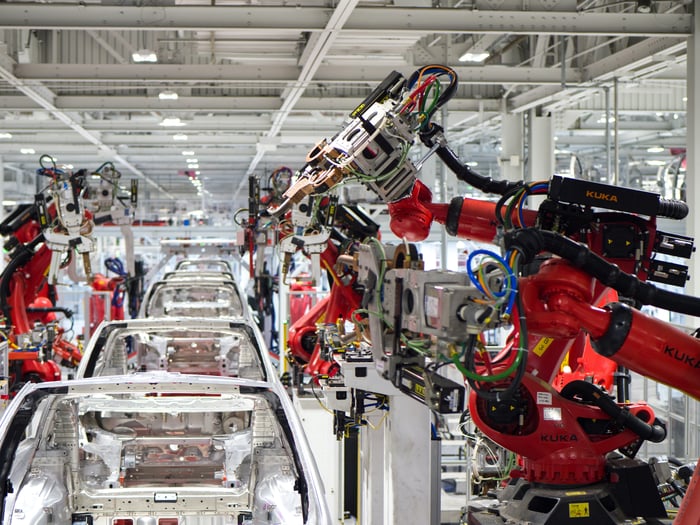
Image source: The Motley Fool.
Why Musk wants more power
For years, Musk has tied his control of Tesla to its ambitions beyond cars. In January 2024, with his stake near 13%, he posted on X that he was uncomfortable growing the company into an artificial intelligence (AI) and robotics leader without about 25% voting power.
"Enough to be influential, but not so much that I can't be overturned," he explained in his post on X.
Last week's exercise is a long stride toward that figure. The shares don't vest until 2028, so Musk can't sell them for years -- but he holds the votes now. Tesla's board has built his pay around exactly that, structuring the April implementation agreement to give the restricted shares voting rights immediately after exercise rather than when he can cash out.
But why merge the two companies?
The Tesla that Musk often describes -- self-driving software and the Optimus humanoid robot -- is an AI-driven one. It's easy to see how it could intersect with SpaceX, which absorbed Musk's xAI start-up this year and is building a chip plant alongside Tesla in Austin.
The path to a deal
A merger between Tesla and SpaceX would arguably be easier now than ever, and not just because of Musk's boosted voting rights at Tesla. This is because SpaceX completed the largest initial public offering (IPO) in history at a valuation near $1.8 trillion. The rocket company now has a market price -- and public shares it could hand to Tesla's owners in a stock-for-stock deal.
And for what it's worth, Wedbush analyst Dan Ives recently put the odds of a tie-up within a year at about 80%. Prediction-market traders are more cautious, pricing a deal before May 2027 closer to even.
The catch for Tesla shareholders is in the structure. Musk controls about 85% of the vote at SpaceX through a supervoting share class, against his nearly 20% at Tesla. Additionally, SpaceX's market capitalization has crossed $2 trillion, and Tesla's is $1.5 trillion.
Whatever the case, I wouldn't rush to buy Tesla even if the odds of a Tesla-SpaceX merger were higher than even. Tesla's core business is still strained. First-quarter revenue rose 16% year over year to about $22.4 billion, but the company built about 50,000 more vehicles than it sold. And Tesla's net income of $477 million was up 17% from a year earlier (though that follows a 2025 in which annual revenue fell for the first time and fourth-quarter profit dropped 61%). Even more, that's minuscule net income in comparison to the company's market capitalization of about $1.5 trillion. Indeed, Tesla trades at about 370 times earnings.
Of course, a valuation like this is a bet on far more than the car business; it's the market paying for autonomy and robots that haven't arrived at scale. And while a merger could bring some synergies for these more speculative parts of Tesla's business, the stock's valuation arguably already prices in a near-miraculous improvement in profitability.
So, could a Tesla-SpaceX merger be next?
It's a possibility, and Musk's recent move to boost his voting power at Tesla makes this outcome a bit more workable. But even if it does happen, investors can only speculate about the terms and timing, or about how Tesla's or SpaceX's businesses fare over the long term anyway.
Don’t miss this second chance at a potentially lucrative opportunity
Ever feel like you missed the boat in buying the most successful stocks? Then you’ll want to hear this.
On rare occasions, our expert team of analysts issues a “Double Down” stock recommendation for companies that they think are about to pop. If you’re worried you’ve already missed your chance to invest, now is the best time to buy before it’s too late. And the numbers speak for themselves:
- Nvidia: if you invested $1,000 when we doubled down in 2009, you’d have $547,138!*
- Apple: if you invested $1,000 when we doubled down in 2008, you’d have $56,799!*
- Netflix: if you invested $1,000 when we doubled down in 2004, you’d have $417,305!*
Right now, we’re issuing “Double Down” alerts for three incredible companies, available when you join Stock Advisor, and there may not be another chance like this anytime soon.
See the 3 stocks »
*Stock Advisor returns as of June 22, 2026.
Daniel Sparks and his clients have positions in Tesla. The Motley Fool has positions in and recommends Tesla. The Motley Fool has a disclosure policy.
Recommended Articles


