


SpaceX IPO: Here's Why Another $20 Billion Capital Raise Is on the Way
Key Points
SpaceX raised $85.7 billion during its public debut.
The space stock will need significantly more capital for growth.
- 10 stocks we like better than Space Exploration Technologies ›
You've likely seen the headlines about Space Exploration Technologies (NASDAQ: SPCX) raising $75 billion during its June IPO. The true figure, however, is even higher.
When investment banks underwrite an IPO, they typically secure a "greenshoe" option that allows them to sell even more stock than planned should the IPO price surge on opening day. That was the case with the SpaceX IPO. In the end, the company ended up raising an impressive $85.7 billion from its public debut.
Where to invest $1,000 right now? Our analyst team just revealed what they believe are the 10 best stocks to buy right now, when you join Stock Advisor. See the stocks »
"The additional money raised in the SpaceX overallotment is bigger than almost all tech IPOs on record," observes a CNBC report.
Despite the huge IPO proceeds, I anticipate SpaceX returning to capital markets rather quickly to support its growth efforts. "With its market cap soaring, I wouldn't be surprised to see SpaceX sell even more shares at a richer valuation sooner rather than later," I predicted last week.
I still expect the company to sell more stock on a continual basis. But the company is moving even faster than I projected. On June 18, Reuters reported that "SpaceX's bankers are preparing to meet investors as early as next week to discuss a bond offering of at least $20 billion."
Why is SpaceX raising even more cash just days after its blockbuster IPO? The answer is obvious if you paid close attention to the company's IPO prospectus.
Here's why SpaceX needs an additional $20 billion
SpaceX is an extremely unique IPO stock. It currently has a $2.4 trillion valuation despite being a money-losing business. It wasn't always this way. The company's Starlink internet service is already posting an impressive gross margin and generally producing positive cash flow. The company's rocket division is also generating a positive adjusted EBITDA (earnings before interest, taxes, depreciation, and amortization) margin.
Why, then, is the company still losing money? The profit drag is related to one segment: AI.
SpaceX's AI business segment lumps together xAI -- Musk's AI start-up that the company merged with earlier this year -- and X, the social media platform formerly named Twitter.
"In 2024, xAI recorded a loss of $1.56 billion on $2.62 billion in revenue," reports TechCrunch. "By 2025, losses had ballooned to $6.4 billion on $3.2 billion, meaning the gap between what xAI earns and spends is widening. Meanwhile, competitor (and customer) Anthropic reportedly expects a 130% revenue jump to $10.9 billion in the second quarter, leading to its first operating profit."
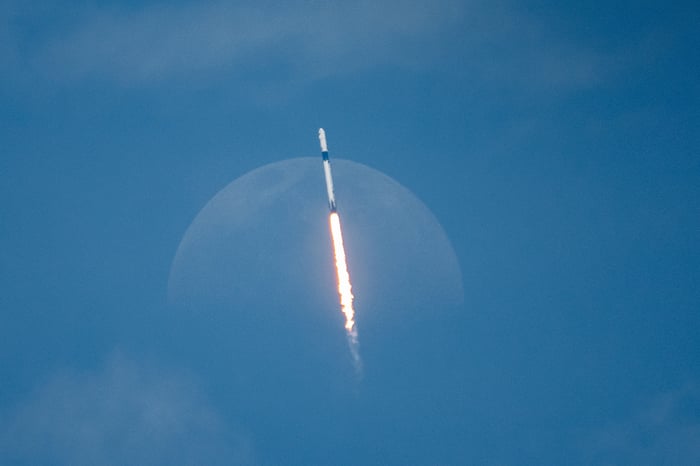
Image source: Getty Images.
Experts don't expect SpaceX's AI business to be profitable over the short term due to the massive capital expenditures planned for growth. This leaves SpaceX in an odd situation. The company needs $60 billion to close on its acquisition of Cursor, an AI tooling company. That doesn't leave much extra to fund growth across three capital-intensive business segments: rockets, satellites, and AI. That's doubly true when you remember the company is still losing money overall.
The rumored $20 billion bond sale by SpaceX should be the first of many. As Morningstar concludes, "It's no secret that SpaceX is a capital-intensive business." Raising more capital will likely be a regular occurrence for SpaceX for years to come.
Should you buy stock in Space Exploration Technologies right now?
Before you buy stock in Space Exploration Technologies, consider this:
The Motley Fool Stock Advisor analyst team just identified what they believe are the 10 best stocks for investors to buy now… and Space Exploration Technologies wasn’t one of them. The 10 stocks that made the cut could produce monster returns in the coming years.
Consider when Netflix made this list on December 17, 2004... if you invested $1,000 at the time of our recommendation, you’d have $417,305!* Or when Nvidia made this list on April 15, 2005... if you invested $1,000 at the time of our recommendation, you’d have $1,293,148!*
Now, it’s worth noting Stock Advisor’s total average return is 936% — a market-crushing outperformance compared to 209% for the S&P 500. Don't miss the latest top 10 list, available with Stock Advisor, and join an investing community built by individual investors for individual investors.
See the 10 stocks »
*Stock Advisor returns as of June 21, 2026.
Ryan Vanzo has no position in any of the stocks mentioned. The Motley Fool has no position in any of the stocks mentioned. The Motley Fool has a disclosure policy.
Recommended Articles


