


4 Nuclear Energy Stocks to Buy and Hold for the Next Two Decades
Key Points
Companies like Microsoft and Meta are signing 20-year agreements directly with nuclear operators, creating a new demand source for reliable, carbon-free electricity.
Constellation and Vistra own the power plants, Cameco supplies the uranium and reactor technology through Westinghouse, and Oklo offers exposure to next-generation reactors.
Constellation, Cameco, and Vistra are established leaders with existing cash-generating assets, while Oklo is smaller and offers outsized upside potential.
- 10 stocks we like better than Oklo ›
Nuclear energy doesn't move at the pace of a software company. Nuclear projects take years, sometimes decades, and the regulatory processes are slow by design. But that same friction is also what makes the best nuclear energy stocks worth owning for the long haul. Once a company earns its position in this industry, it becomes extraordinarily difficult to displace. Here are four companies building that kind of durable advantage right now.
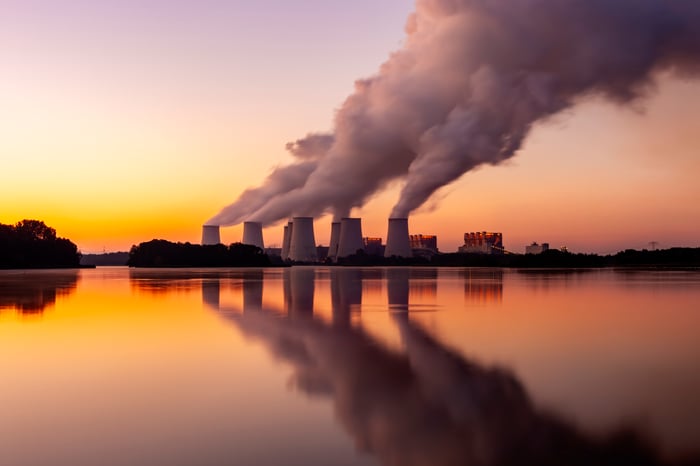
Image source: Getty Images.
Where to invest $1,000 right now? Our analyst team just revealed what they believe are the 10 best stocks to buy right now, when you join Stock Advisor. See the stocks »
1. Constellation Energy
Constellation Energy (NASDAQ: CEG) is the largest nuclear fleet operator in the United States, and it has spent the last two years turning that position into something that looks more like a hyperscaler power utility than a traditional energy company.
The story starts with Three Mile Island. In 2024, Constellation signed a 20-year power purchase agreement (PPA) with Microsoft to restart the plant -- now rebranded as the Crane Clean Energy Center -- and deliver over 800 megawatts of carbon-free power to Microsoft's data centers in the PJM region. That deal established a new template: tech companies with near-infinite AI power demand, signing multi-decade contracts directly with nuclear operators to secure clean baseload power that solar and wind can't reliably provide.
Since then, Constellation signed a 20-year power purchase agreement (PPA) with Meta Platforms, extended operating licenses at its Illinois fleet through 2047 and beyond, and closed its $26.6 billion acquisition of Calpine -- making it the largest power producer in the country. Three Mile Island is expected back online in 2027. The federal regulatory waiver that cleared the way for the restart arrived earlier than expected. Constellation is an easy, safe buy and hold for the next decade.
2. Cameco
Cameco (NYSE: CCJ) is the simplest way to own the fuel powering the nuclear renaissance. It is one of the world's largest uranium producers -- with over 433 million pounds of proven and probable reserves -- and it owns 49% of Westinghouse Electric, the company that built the world's first commercial pressurized water reactor and still services most of the global nuclear fleet.
The Westinghouse stake is the piece that makes Cameco more than a miner. Westinghouse is in front of essentially every reactor that comes online globally, both as a services provider to existing plants and as the manufacturer of the AP1000 -- the reactor design currently being deployed in Poland, Bulgaria, and other countries looking to build new nuclear capacity.
Westinghouse has also submitted regulatory plans and begun construction of its AP300 small modular reactor, designed for industrial sites, remote communities, and defense facilities.
In 2025, Cameco and Brookfield signed a binding term sheet with the U.S. Department of Commerce to accelerate Westinghouse reactor deployments globally, with an aggregate investment value of at least $80 billion. The U.S. government is now an active partner in scaling Westinghouse's production. If nuclear expands globally over the next two decades, and all evidence points that way, the fuel and the reactor technology both run through Cameco.
3. Vistra
Vistra (NYSE: VST) doesn't get the same headlines as Constellation, but it is building the same kind of direct hyperscaler relationships with less fanfare. In January 2026, Vistra and Meta announced 20-year PPAs supporting three of Vistra's nuclear plants in the PJM region while also adding new nuclear capacity.
The company operates a fleet of nuclear, natural gas, and energy storage assets, and has been growing its zero-carbon portfolio with discipline and without the kind of transformational acquisition risk that comes with deals like Calpine.
Vistra's thesis over the next 20 years is that firm, dispatchable, carbon-free power becomes one of the most valuable commodities in the economy -- and that whoever owns the plants that produce it at scale will have pricing power that grows alongside AI infrastructure spending. Vistra owns those plants.
4. Oklo
Oklo (NYSE: OKLO) is the highest-risk, highest-reward name on this list, and the only reason I put it here is that the milestones are starting to come in.
Oklo's Aurora powerhouse -- a small modular reactor designed to run on recycled nuclear fuel -- broke ground at the Idaho National Laboratory in September 2025. In March 2026, the company secured a Preliminary Documented Safety Analysis approval from the U.S. Department of Energy, a key step in the reactor authorization process.
Also in January 2026, Meta signed a landmark agreement for Oklo to develop a 1.2 gigawatt nuclear campus in Pike County, Ohio, with Meta providing upfront funding to advance the project.
Beyond Meta, Oklo has a 12 gigawatt master power agreement with data center developer Switch, pre-agreements with Equinix and Prometheus Hyperscale, and a total order book north of 14 gigawatts. The company will develop, own, and operate its power plants, which means the business model scales with every new facility that comes online.
The other three names on this list have already earned their positions. Oklo is still earning its position. Own it accordingly.
Should you buy stock in Oklo right now?
Before you buy stock in Oklo, consider this:
The Motley Fool Stock Advisor analyst team just identified what they believe are the 10 best stocks for investors to buy now… and Oklo wasn’t one of them. The 10 stocks that made the cut could produce monster returns in the coming years.
Consider when Netflix made this list on December 17, 2004... if you invested $1,000 at the time of our recommendation, you’d have $415,040!* Or when Nvidia made this list on April 15, 2005... if you invested $1,000 at the time of our recommendation, you’d have $1,256,076!*
Now, it’s worth noting Stock Advisor’s total average return is 923% — a market-crushing outperformance compared to 207% for the S&P 500. Don't miss the latest top 10 list, available with Stock Advisor, and join an investing community built by individual investors for individual investors.
See the 10 stocks »
*Stock Advisor returns as of June 18, 2026.
Micah Zimmerman has no position in any of the stocks mentioned. The Motley Fool has positions in and recommends Cameco, Constellation Energy, Meta Platforms, and Microsoft. The Motley Fool recommends Vistra. The Motley Fool has a disclosure policy.
Recommended Articles


