


Prediction: This Quantum Computing Stock Is Going to Plummet in the Second Half of 2026
Key Points
The U.S. government recently announced plans to invest $100 million in Rigetti Computing, which will be spread over the next three years.
Rigetti is a leader in the quantum computing industry, but even its best systems still make too many errors to solve complex real-world problems.
Rigetti stock is trading at a sky-high valuation, which could result in significant downside in its stock in the second half of 2026.
- 10 stocks we like better than Rigetti Computing ›
Last month, the U.S. government announced plans to acquire equity stakes in nine different quantum computing companies, providing $2 billion in total funding to help America build a leadership position in this important industry. Rigetti Computing (NASDAQ: RGTI) will receive a $100 million investment over three years, and its stock has jumped by 20% since the news broke.
Quantum computers can use a concept called superposition to simulate multiple solutions to a given problem at once, so they are more efficient at processing specific workloads compared to traditional computers, especially in areas like science and cryptography. Rigetti makes some of the industry's best quantum systems, but they still make far too many errors to solve most real-world problems.
Where to invest $1,000 right now? Our analyst team just revealed what they believe are the 10 best stocks to buy right now, when you join Stock Advisor. See the stocks »
While the U.S. government's backing is great news, Rigetti still generates a very small amount of revenue relative to its market capitalization. Here's why I predict its elevated valuation will lead to a 50% (or more) decline in its stock price during the second half of this year.

Image source: Getty Images.
It could be decades before quantum computers are truly useful
Rigetti is uniquely positioned to lead the quantum industry because it has built its own supply chain, which means it can bring new computers to market much faster than its competitors. It operates its own fabrication facility, developed its own quantum programming language called Quil, and it has also built a cloud platform where it rents quantum computing capacity to other businesses for a fee.
Rigetti's flagship Cepheus-1-108Q quantum computer is the industry's largest multichip system. With 108 qubits, it delivers three times the scale of the company's previous Cepheus-1-36Q system, while boasting a median single-qubit gate fidelity of 99.9%. That means it makes just one error per every 1,000 quantum operations. But its two-qubit gate fidelity is 99.1%, implying nine errors per 1,000 operations, so it's still impractical for solving many real-world problems.
Making multiple qubits work together in harmony is one of the biggest challenges in quantum computing, because they are highly sensitive to noise and interference. Rigetti believes it can upgrade Cepheus-1-108Q to achieve a two-qubit fidelity of 99.5% this year, but the company says a system with a two-qubit fidelity of 99.9% could be three years away.
According to an estimate by Ark Investment Management, it could take somewhere between 20 and 40 years before quantum systems are accurate enough to disrupt areas like cryptography, so even as one of the industry leaders, Rigetti still has a long way to go.
Inconsistent revenue growth and steep losses
Rigetti's revenue soared by 198% year over year in the first quarter to reach $4.4 million. The company intends to deliver an $8.4 million order for Cepheus-1-108Q to India's Center for Development of Advanced Computing later this year, so that alone would result in revenue growth for 2026 relative to the prior year.
However, Rigetti's revenue declined in 2025, so there isn't a sustained upward trend just yet. This is a common trait of companies in the start-up phase, but that only makes Rigetti's $7 billion market capitalization all the more problematic in my opinion (more on that in a moment).
The company's bottom line is the main concern right now because it isn't generating anywhere near enough sales to cover all of its costs. Its operating expenses totaled $27.3 million in the first quarter, resulting in a generally accepted accounting principles (GAAP) net loss of $20.5 million. That followed a $216 million net loss in 2025.
Based on these numbers, the government's $100 million investment over three years won't stretch very far. Fortunately, Rigetti had $569 million in cash, equivalents, and short-term investments on hand as of March 31, so it can sustain its losses for now. But I think a capital raise is likely within the next couple of years, which would dilute existing shareholders and hurt their future returns.
Rigetti's sky-high valuation opens the door to downside
Elon Musk's space transportation and satellite internet company, Space Exploration Technologies (NASDAQ: SPCX), went public last Friday, and its stock currently trades at a price-to-sales (P/S) ratio of 137.8. It's wildly expensive when you consider the Nasdaq-100 index trades at a P/S ratio of just 6.9.
But brace yourself, because Rigetti's P/S ratio is currently an eye-popping 663. Even if we value Rigetti based on Wall Street's consensus 2026 revenue estimate of $23.6 million (provided by Yahoo! Finance), its forward P/S ratio is still almost 300.
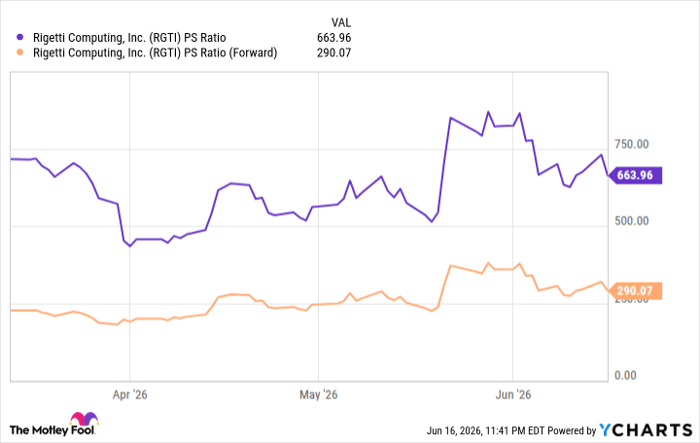
RGTI PS Ratio data by YCharts
That means even if Rigetti's stock plummeted by 50% in the second half of 2026, it would still be more expensive than SpaceX is today. I think a loss of that magnitude is entirely possible given the company's lumpy revenue growth and steep losses. In fact, if it doesn't hit Wall Street's revenue target, its stock might fall even more sharply.
In summary, despite the long-term potential of quantum computing, Rigetti stock probably isn't a great buy at the current price.
Should you buy stock in Rigetti Computing right now?
Before you buy stock in Rigetti Computing, consider this:
The Motley Fool Stock Advisor analyst team just identified what they believe are the 10 best stocks for investors to buy now… and Rigetti Computing wasn’t one of them. The 10 stocks that made the cut could produce monster returns in the coming years.
Consider when Netflix made this list on December 17, 2004... if you invested $1,000 at the time of our recommendation, you’d have $424,531!* Or when Nvidia made this list on April 15, 2005... if you invested $1,000 at the time of our recommendation, you’d have $1,273,016!*
Now, it’s worth noting Stock Advisor’s total average return is 940% — a market-crushing outperformance compared to 209% for the S&P 500. Don't miss the latest top 10 list, available with Stock Advisor, and join an investing community built by individual investors for individual investors.
See the 10 stocks »
*Stock Advisor returns as of June 18, 2026.
Anthony Di Pizio has no position in any of the stocks mentioned. The Motley Fool has no position in any of the stocks mentioned. The Motley Fool has a disclosure policy.
Recommended Articles


