


Prediction: Sandisk Stock Will Soar to $5,000 in 2 Years
Key Points
The favorable demand-supply conditions supporting Sandisk's terrific growth are sustainable.
Wall Street analysts have been raising their price targets on Sandisk, but they may be underestimating its growth potential.
The company's outstanding earnings growth trajectory suggests substantial gains over the next two years.
- 10 stocks we like better than Sandisk ›
Sandisk (NASDAQ: SNDK) stock has been on fire in 2026. An investment of $1,000 in the shares of this memory specialist at the beginning of the year is now worth more than $7,200.
You may be wondering if Sandisk remains worth buying after the phenomenal multibagger returns it has already delivered so far this year. Wall Street analysts definitely think so, as they have been raising their price targets on this semiconductor stock amid favorable conditions in the memory market.
Will AI create the world's first trillionaire? Our team just released a report on the one little-known company, called an "Indispensable Monopoly" providing the critical technology Nvidia and Intel both need. Continue »
The artificial intelligence (AI)-fueled demand for flash storage in data centers has supercharged Sandisk's growth, and the good news is that the primary catalyst behind the company's growth is sustainable. In fact, I won't be surprised to see Sandisk crushing analysts' expectations and delivering sizzling gains over the next couple of years.
Let's look at the reasons why.
Image source: The Motley Fool.
The decline in NAND flash supply will be a tailwind for Sandisk
Sandisk designs and makes NAND flash memory products, such as solid-state drives (SSDs) and memory cards. Its products are used in personal computers (PCs), gaming consoles, wearables, automotive applications, and in data centers.
The data center-fueled storage demand has been a massive catalyst for Sandisk's revenue and earnings growth over the past year. Traditionally, data centers have relied on hard disk drives (HDDs) to store data owing to low costs. Storage giant Seagate Technology noted a couple of years ago that over 90% of the data stored in data centers is on HDDs.
However, the advent of AI has fueled a significant increase in the need for data storage. That's because training AI models and running inference applications requires huge volumes of data, fueling the need for more data storage. Additionally, AI accelerator chips, such as graphics cards, need to be fed large data volumes quickly, creating a need for faster compute memory, known as high-bandwidth memory (HBM).
These factors have led to a significant jump in NAND flash prices for two reasons.
First, the lead times for enterprise HDDs used in AI data centers reportedly run until at least the end of 2027. HDD giant Western Digital has already started allocating its 2028 capacity, while Seagate noted earlier this year that it will soon start accepting orders for 2027. As a result, AI data centers have been buying SSDs to meet their storage requirements.
Second, there isn't enough NAND flash capacity coming online. That's because major memory manufacturers are focused on adding more compute-oriented HBM capacity by converting their existing NAND capacity. They are doing this to capitalize on HBM's higher profit margins. According to one estimate, NAND flash production capacity could drop by 40% in 2027 as compared to the peak seen in 2022.
All this bodes well for a pure-play NAND flash specialist like Sandisk, especially considering that the demand for enterprise SSDs is estimated to increase at an annual rate of 35% through 2030, according to McKinsey. AI training and inference will be the primary drivers of this robust growth.
So, there is a good chance that the strong NAND flash pricing environment will persist going forward. This is precisely why Wall Street analysts are bullish about Sandisk's prospects.
Wall Street expects more upside from this red-hot stock, but it could significantly exceed expectations
Mizuho Securities and BofA Securities recently raised their price targets on this AI stock, citing terrific memory demand and tight supply. The firms believe that Sandisk is on track to see further margin expansion, as supply constraints will lead to higher NAND flash pricing.
Mizuho, which has a $2,200 price target on Sandisk, doesn't see any meaningful NAND flash supply coming online until 2028, while demand will continue to increase at a solid clip. BofA Securities also points toward further price improvements, which is why it raised its price target to $2,100. However, these Wall Street firms may be underestimating Sandisk's upside potential.
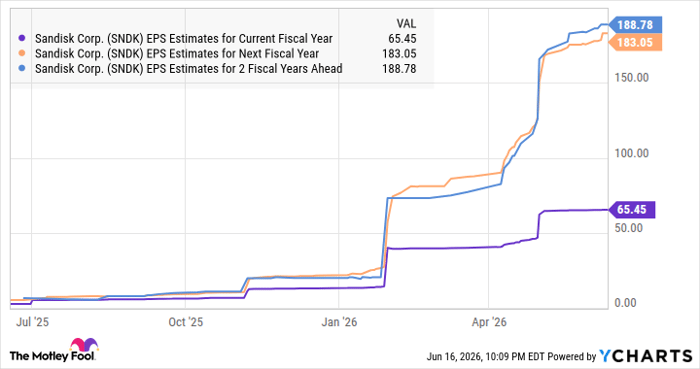
That's because the company is poised for phenomenal earnings growth over the next couple of years. Sandisk is about to complete its fiscal 2026 this month, and its earnings per share are poised to grow exponentially from last year's reading of $2.99.
Data by YCharts
What's more, Sandisk's forward earnings multiple is quite attractive at 30x, a slight premium to the tech-focused Nasdaq-100 index's forward earnings multiple of 27. This growth stock should ideally trade at a significant premium in the future, considering its red-hot earnings growth potential. But even if Sandisk trades in line with the Nasdaq-100 index's forward earnings multiple after two years and its fiscal 2028 earnings reach the consensus estimate of $188.78 per share (as seen in the chart above), the stock could jump to $5,098.
That's 156% higher than Sandisk's current stock price, suggesting that it isn't too late for investors to buy it yet.
Should you buy stock in Sandisk right now?
Before you buy stock in Sandisk, consider this:
The Motley Fool Stock Advisor analyst team just identified what they believe are the 10 best stocks for investors to buy now… and Sandisk wasn’t one of them. The 10 stocks that made the cut could produce monster returns in the coming years.
Consider when Netflix made this list on December 17, 2004... if you invested $1,000 at the time of our recommendation, you’d have $424,531!* Or when Nvidia made this list on April 15, 2005... if you invested $1,000 at the time of our recommendation, you’d have $1,273,016!*
Now, it’s worth noting Stock Advisor’s total average return is 940% — a market-crushing outperformance compared to 209% for the S&P 500. Don't miss the latest top 10 list, available with Stock Advisor, and join an investing community built by individual investors for individual investors.
See the 10 stocks »
*Stock Advisor returns as of June 17, 2026.
Harsh Chauhan has no position in any of the stocks mentioned. The Motley Fool has no position in any of the stocks mentioned. The Motley Fool has a disclosure policy.
Recommended Articles


