


Down Nearly 40% From Its Highs, Is Palantir Stock a Once-in-a-Decade Buying Opportunity?
Key Points
Palantir's growth is still accelerating.
Palantir's stock price has far too many years' worth of growth priced into it.
- 10 stocks we like better than Palantir Technologies ›
Palantir (NASDAQ: PLTR) was once the hottest artificial intelligence (AI) stock on Wall Street. Investors were enjoying monster gains, and the company's growth rate kept accelerating. Now, only one of those is true. Palantir is down nearly 40% from its all-time high, but the company's growth rate hasn't slowed.
Those two items aren't normally correlated with each other, leaving investors wondering whether it's time to buy the dip or if this initial major sell-off is a sign of more pain to come. The answer may surprise you, as some of Palantir's impressive gains weren't tied to business performance.
Will AI create the world's first trillionaire? Our team just released a report on the one little-known company, called an "Indispensable Monopoly" providing the critical technology Nvidia and Intel both need. Continue »
Image source: The Motley Fool.
Palantir's stock still has a premium price tag
Palantir was one of the first companies to have a practical and useful application of AI. Originally, Palantir sold its AI-powered analytics software to various government entities, which remain huge clients for Palantir. Now, Palantir has a thriving commercial segment and has shown several companies the benefits of incorporating AI technology into their internal systems.
This has clearly been successful, as Palantir delivered impressive revenue growth over the past few years. In the first quarter, its overall revenue rose 85% year over year, with particular strength coming from the U.S. side of its business. U.S. commercial revenue rose 133% year over year, and U.S. government revenue rose 84% year over year. There's absolutely nothing to complain about with those results, especially since Palantir is this profitable. In Q1, it posted a 53% net income margin, putting it among the most profitable companies in the market.
Palantir has high profitability and huge growth. What more can investors ask for?
All of this comes at a price. And for Palantir, that price was too high for many to pay. Even with Palantir dropping nearly 40% from its all-time highs, it still trades for 87 times forward earnings.
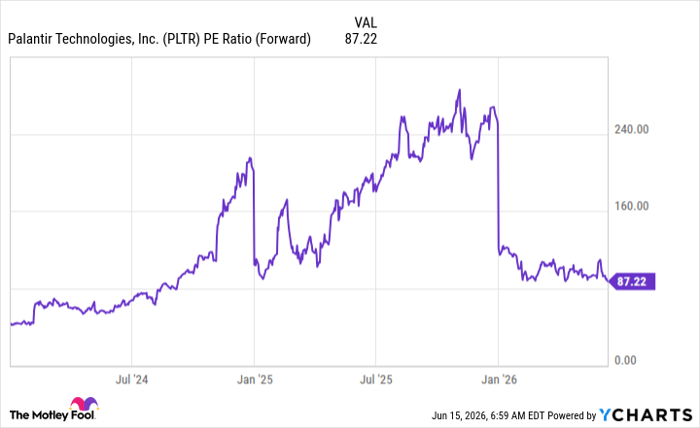
PLTR PE Ratio (Forward) data by YCharts
So, even after 2026's strong growth is priced in, it's one of the more expensive stocks in the market. For Palantir to trade at a more reasonable 30 times earnings, it must nearly triple its earnings beyond what it will do in 2026. That's a problem, because Wall Street analysts only expect Palantir's earnings per share (EPS) to rise from $1.47 in 2026 to $2.08 in 2027 -- a 42% gain. If Palantir can maintain that 40% or so growth rate, it will take more than three years to triple its earnings.
So, despite the sell-off, Palantir has about four years' worth of growth already priced into the stock. That's a steep price to pay, and more and more investors are unwilling to pay it. I think this sell-off could extend for some time, and I think Palantir is a stock to avoid rather than buy on the dip.
Should you buy stock in Palantir Technologies right now?
Before you buy stock in Palantir Technologies, consider this:
The Motley Fool Stock Advisor analyst team just identified what they believe are the 10 best stocks for investors to buy now… and Palantir Technologies wasn’t one of them. The 10 stocks that made the cut could produce monster returns in the coming years.
Consider when Netflix made this list on December 17, 2004... if you invested $1,000 at the time of our recommendation, you’d have $440,440!* Or when Nvidia made this list on April 15, 2005... if you invested $1,000 at the time of our recommendation, you’d have $1,303,950!*
Now, it’s worth noting Stock Advisor’s total average return is 959% — a market-crushing outperformance compared to 211% for the S&P 500. Don't miss the latest top 10 list, available with Stock Advisor, and join an investing community built by individual investors for individual investors.
See the 10 stocks »
*Stock Advisor returns as of June 17, 2026.
Keithen Drury has no position in any of the stocks mentioned. The Motley Fool has positions in and recommends Palantir Technologies. The Motley Fool has a disclosure policy.
Recommended Articles


