


1 Unstoppable Stock to Buy Before It Joins Broadcom in the $1 Trillion Club
Key Points
Oracle stock has rallied impressively over the past couple of months, and its upcoming earnings report could give it a nice boost.
The stock's valuation, massive backlog, and earnings growth potential indicate that it could very well become a member of the $1 trillion club.
- 10 stocks we like better than Oracle ›
Broadcom is one of the leading players in the artificial intelligence (AI) infrastructure space, as it designs custom AI chips in high demand from hyperscalers.
Broadcom stock has jumped by 388% over the past three years, and it has a market capitalization of well over $1 trillion. The good part is that investors can still buy it as it has terrific room for growth. However, there's another AI infrastructure stock that has been witnessing a phenomenal surge in its stock price of late and has the potential to reach a market cap of $1 trillion.
Will AI create the world's first trillionaire? Our team just released a report on the one little-known company, called an "Indispensable Monopoly" providing the critical technology Nvidia and Intel both need. Continue »
The company I'm talking about here is Oracle (NYSE: ORCL), which currently has a market cap of $614 billion. Let's see why Oracle could soon join Broadcom in the $1 trillion market cap club.
Image source: The Motley Fool.
Oracle's valuation, strong earnings growth potential, and improving backlog point toward more upside
Oracle is scheduled to release its fiscal 2026 fourth-quarter results after the market closes on June 10. The stock jumped impressively three months ago after reporting its fiscal Q3 results, driven by a beat-and-raise report.
Oracle's revenue and earnings exceeded expectations, and it also raised its full-year guidance for fiscal 2027. It is worth noting that Oracle stock has found some momentum lately. It has jumped by 47% since the beginning of April, and the good part is that it still trades at an attractive 27 times forward earnings, while the tech-focused Nasdaq Composite index has an average earnings multiple of 40.
Buying Oracle at this valuation, ahead of its quarterly report, could be a smart move. That's because the company can exceed Wall Street's expectations and boost its guidance once again. After all, Oracle was sitting on a massive $553 billion in remaining performance obligations (RPO) at the end of fiscal Q3.
The metric grew by 325% year over year, suggesting that the demand for its cloud computing infrastructure remains solid. Moreover, Oracle's strategy of allowing customers to bring their own hardware and accepting advance payments should positively impact its bottom line and help ease cash flow pressure.
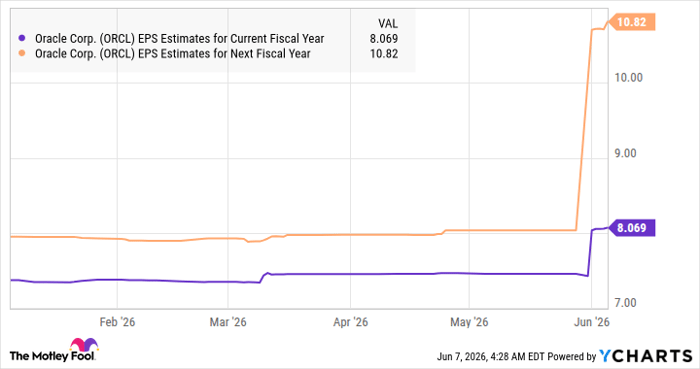
So, it is easy to see why analysts anticipate Oracle's earnings growth will pick up.
Data by YCharts
Why a trillion-dollar market cap seems quite achievable
Oracle stock needs to jump another 63% from current levels to achieve a $1 trillion market cap. According to the chart in the previous section, its earnings per share could reach $10.82 in fiscal 2028. For comparison, Oracle is estimated to have finished fiscal 2026 with $7.42 in earnings per share.
The company's earnings are estimated to increase at an annual rate of 21% over the next two years, based on the consensus estimates shown in the chart. Assuming Oracle trades at even 35 forward earnings after a couple of years -- a premium to its current forward price-to-earnings ratio on account of a potential pick-up in its revenue growth that could translate into a stronger earnings jump -- its stock price could reach $379 within the next two years.
That suggests a potential jump of 77% in Oracle's stock price, which should be sufficient for it to enter the trillion-dollar club. However, it could achieve that milestone much sooner, as we have seen the market rewarding AI infrastructure stocks, such as Dell Technologies, handsomely of late for delivering significant growth acceleration and raising their guidance.
Should you buy stock in Oracle right now?
Before you buy stock in Oracle, consider this:
The Motley Fool Stock Advisor analyst team just identified what they believe are the 10 best stocks for investors to buy now… and Oracle wasn’t one of them. The 10 stocks that made the cut could produce monster returns in the coming years.
Consider when Netflix made this list on December 17, 2004... if you invested $1,000 at the time of our recommendation, you’d have $443,191!* Or when Nvidia made this list on April 15, 2005... if you invested $1,000 at the time of our recommendation, you’d have $1,258,838!*
Now, it’s worth noting Stock Advisor’s total average return is 941% — a market-crushing outperformance compared to 206% for the S&P 500. Don't miss the latest top 10 list, available with Stock Advisor, and join an investing community built by individual investors for individual investors.
See the 10 stocks »
*Stock Advisor returns as of June 7, 2026.
Harsh Chauhan has no position in any of the stocks mentioned. The Motley Fool has positions in and recommends Broadcom and Oracle. The Motley Fool has a disclosure policy.
Recommended Articles


