


President Trump Wants a 355-Ship Navy -- and $306 Billion to Build It
Key Points
The U.S. Navy is growing, but slowly, and the Pentagon wants to speed that up.
A new 30-year shipbuilding plan shows the Battle Force rising to 355 ships by 2040, and nearly 400 ships by 2056.
- 10 stocks we like better than General Dynamics ›
President Trump came into office (the first time) calling for the construction of a 355-ship battle force for the U.S. Navy. A decade later, the actual "battle force" strength is just 291 ships. That's an improvement from the 275 ships in the fleet when he entered office in 2016.
But it's not good enough.
Will AI create the world's first trillionaire? Our team just released a report on the one little-known company, called an "Indispensable Monopoly" providing the critical technology Nvidia and Intel both need. Continue »
It's not even technically legal, as the just-released U.S. Navy 30-Year Shipbuilding Plan points out. By law, the Navy requires a fleet of 355 ships. What's more, the plan laments: "Over the past two decades, the shipbuilding budget has doubled, yet we have no more ships now than in 2003. This is a persistent problem."
But as part of the president's call for a $1.5 trillion defense budget, this plan proposes to fix it.

Image source: Getty Images.
A high-low mix for the high seas
Over the course of 60 pages, the plan describes how the Navy will rebuild itself, slowly, toward the goal of a 355-ship fleet, spending heavily on the high end for robust weapons platforms such as aircraft carriers, submarines, and battleships, while expanding its global presence at the low end with less capable but more numerous and budget-friendly frigates and littoral combat ships -- and supplementing all this with unmanned vehicles -- i.e., sea drones.
Aiming to curb cost overruns and prevent construction delays, the Navy proposes a whole-of-industry approach to boosting ship production rates. Rising from 10% today, 50% of future shipbuilding will be done not just at a handful of legacy shipyards, but distributed among sites all around the country. These sites will build modules for later assembly into whole ships at the big shipyards.
Facilities will be upgraded, production increased, and new workforces trained in shipbuilding. "Cutting-edge AI tools" will be leveraged to accelerate construction through more efficient scheduling.
Working on the assumption these efforts will succeed, the Navy has laid out a 30-year plan describing not only the battle fleet ships (i.e., warships) it intends to build but also auxiliary ships and unmanned vessels of medium size or above, yielding what is now called the "combined total naval vessel force."
What's the plan?
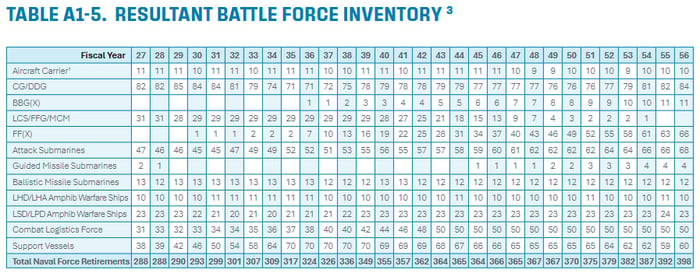
Looking out 30 years, it's immediately clear that there are issues with the Navy's plan -- first and foremost, the fact that, because of scheduled ship retirements, the battle force won't reach 355 ships before 2040!
Indeed, today's battle force will actually shrink a bit next year and not start growing before 2029.
Data source: U.S. Navy.
The good news is that once the build-up is under way and gaining momentum, the Navy should chart a course to far more than 355 ships. Ultimately, the goal is to approach 400 ships by the end of the 30-year plan.
This goal seems realistic, too. Although a sizable 37% increase over 30 years, the Navy's only looking to build about a dozen ships per year, which seems manageable.
Who will build all these ships?
Which companies are most likely to benefit from this expansion of the combined total naval vessel force? That's hard to say.
A lot can change in 30 years, and today's forecasts for fleet needs in 2056 could be obsolete as technologies evolve and sea drones or even entire drone aircraft carriers, for example, become increasingly important in defense. In future decades, we could see one or more of these crewed ship types replaced by uncrewed surface and uncrewed underwater vessels (USVs and UUVs).
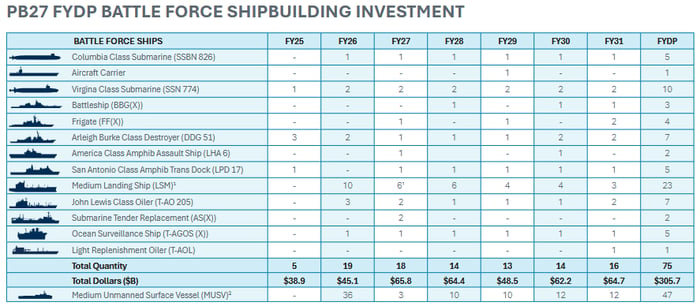
It's easier to forecast near-future trends. So let's take a quick look at the Navy's shipbuilding plans for just the next five years:
Data source: U.S. Navy.
A couple of points demand clarification here. First, you may notice that if you add the numbers up left to right, they... don't seem to tally correctly in the final "FYDP" column. That's because FYDP refers to "future years" of shipbuilding, as in 2027 and beyond. Add up only the 2027-through-2031 numbers, and the tally is 75 crewed warships and 47 uncrewed vessels.
The second point, less important to investors but still important for context: As new vessels are added to the fleet, older vessels are constantly aging out and being retired. So the Navy Battle Force will grow a little over the next five years -- just not by 122 ships.
Now, how much will this all cost, and which defense contractors should you invest in to profit from it? Here's the Navy's official estimate for these same five years:

Data source: U.S. Navy.
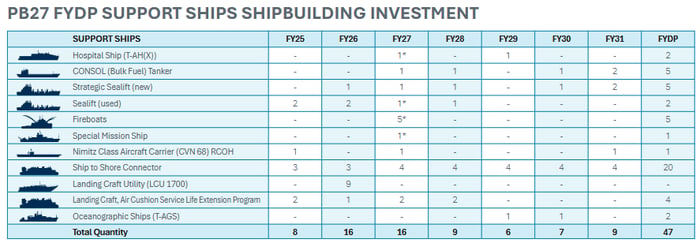
Again, focus on the FYDP column for total Navy shipbuilding spending on the Battle Force over the next five years. What you see here is $268.1 billion in spending. That covers just the Battle Force ships, for which General Dynamics (NYSE: GD) and Huntington Ingalls (NYSE: HII) are the primary builders.
A few vessels -- AS(X) submarine tenders and T-AGOS spy ships, for example -- may be built by smaller shipyards, and I'd expect that a fair number of the MUSVs mentioned in the above chart will as well. Likewise, 47 support ships, including hospital ships, fireboats, tankers, and landing craft, are planned, raising the Navy's investment to $305.7 billion over the next five years.
Data source: U.S. Navy.
That figure represents a huge windfall of future business for U.S. shipbuilders. Even if General Dynamics and Huntington Ingalls don't build literally all the ships the Navy is asking for, I still think they're your best bet to invest in a bigger U.S. Navy.
Should you buy stock in General Dynamics right now?
Before you buy stock in General Dynamics, consider this:
The Motley Fool Stock Advisor analyst team just identified what they believe are the 10 best stocks for investors to buy now… and General Dynamics wasn’t one of them. The 10 stocks that made the cut could produce monster returns in the coming years.
Consider when Netflix made this list on December 17, 2004... if you invested $1,000 at the time of our recommendation, you’d have $443,191!* Or when Nvidia made this list on April 15, 2005... if you invested $1,000 at the time of our recommendation, you’d have $1,258,838!*
Now, it’s worth noting Stock Advisor’s total average return is 941% — a market-crushing outperformance compared to 211% for the S&P 500. Don't miss the latest top 10 list, available with Stock Advisor, and join an investing community built by individual investors for individual investors.
See the 10 stocks »
*Stock Advisor returns as of June 7, 2026.
Rich Smith has no position in any of the stocks mentioned. The Motley Fool has no position in any of the stocks mentioned. The Motley Fool has a disclosure policy.
Recommended Articles


