


Could Nvidia Reach a $10 Trillion Market Cap? I Think So. And It Will Happen Faster Than You Think.
Key Points
Demand for Nvidia's GPUs appears insatiable.
Nvidia's valuation is in line with those of its peers.
- 10 stocks we like better than Nvidia ›
Nvidia (NASDAQ: NVDA) is the only company ever to reach a $5 trillion market cap. While there are a few milestones between its current price and a $10 trillion valuation, that one may be the next major milestone investors will be looking toward. But just how quickly could Nvidia essentially double in size again (if it can do that at all)?
Image source: The Motley Fool.
Will AI create the world's first trillionaire? Our team just released a report on the one little-known company, called an "Indispensable Monopoly" providing the critical technology Nvidia and Intel both need. Continue »
Nvidia's GPUs continue to be in high demand
Nvidia makes graphics processing units (GPUs), which have been the primary artificial intelligence (AI) computing unit of choice thus far. Because they are parallel processors, they are ideally suited for handling certain types of highly complex tasks that can be broken down into a host of smaller problems that can be solved independently and simultaneously. Those happen to be exactly the sorts of workloads that are most common in AI training. The benefits are amplified when thousands of GPUs are connected in a computing cluster. Gigantic data centers can house hundreds of thousands of GPUs, and that is now the amount of power required to train and run the latest AI models.
So whenever you hear an AI hyperscaler discuss how much money they're spending on data center capital expenditures, your mind should immediately shift to considering what chunk of that money is flowing to Nvidia. For 2026, the four major AI hyperscalers forecast that their combined capital expenditure bill will total $650 billion. That reflects a massive buildup, and the total figure actually ticked up a bit after their Q1 earnings reports.
During its conference call last month, Nvidia noted that analysts predicted the hyperscaler capex would top $1 trillion in 2027. That's a major increase, but how much of that will wind up in Nvidia's coffers?
For Nvidia's fiscal 2027 (which ends in January 2027), Wall Street analysts estimate Nvidia will generate $391 billion in revenue. Not all of that will come from data centers, and other AI companies outside the big four hyperscalers are also buying Nvidia GPUs. Still, it's safe to say that Nvidia tends to capture a large chunk of hyperscalers' planned spending. That trend should persist into its fiscal 2028, with the average analyst estimating revenue of $548 billion.
So growth will continue for Nvidia, but will it rise to a $10 trillion market cap?
Determining a fair valuation for Nvidia is key
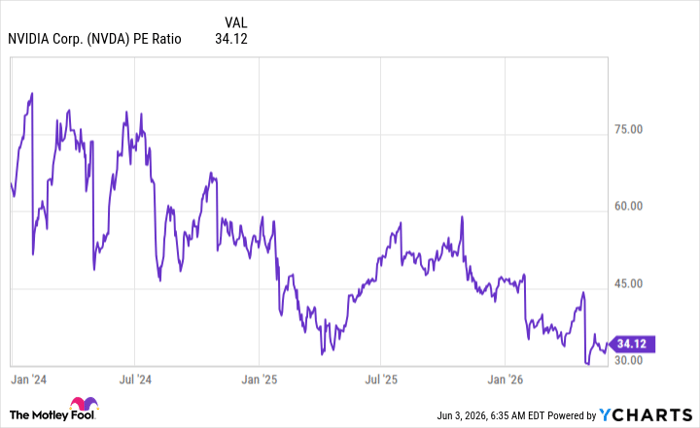
Any company could become a $10 trillion company if investors were willing to pay any price for the stock. Currently, Nvidia trades for about 34 times trailing earnings, which isn't an unreasonable valuation. Indeed, it has traded at higher ones for most of the past couple of years.
NVDA PE Ratio data by YCharts
Some of its big tech peers, like Apple, Amazon, and Alphabet, trade at similar price-to-earnings ratios: Apple's P/E is 38, Amazon's is 31, and Alphabet's is 27. Considering Nvidia's dominance in its space and its growth rate, I think 34 times earnings is a fair price for the stock.
With Nvidia valued at $5.4 trillion, it would have to rise by 85% to reach $10 trillion. Over the past 12 months, Nvidia's earnings per share (EPS) have totaled $6.53. In its fiscal 2028 (which ends in January 2028), Wall Street analysts estimate Nvidia will deliver EPS of $12.66.That would be a 94% increase in EPS, so if Nvidia hits that estimate and keeps trading at 34 times earnings, that would give it a valuation greater than $10 trillion.
With all that in mind, I think Nvidia is headed straight for the $10 trillion milestone, and could reach it within a year and a half. Under normal conditions, a market-average stock takes about seven years to double. Nvidia's top- and bottom-line growth rates look likely to remain far better than average, especially given how AI hyperscalers are spending. That makes Nvidia a no-brainer buy. I can think of few stocks that offer this kind of return potential with such relatively low risk.
Should you buy stock in Nvidia right now?
Before you buy stock in Nvidia, consider this:
The Motley Fool Stock Advisor analyst team just identified what they believe are the 10 best stocks for investors to buy now… and Nvidia wasn’t one of them. The 10 stocks that made the cut could produce monster returns in the coming years.
Consider when Netflix made this list on December 17, 2004... if you invested $1,000 at the time of our recommendation, you’d have $443,191!* Or when Nvidia made this list on April 15, 2005... if you invested $1,000 at the time of our recommendation, you’d have $1,258,838!*
Now, it’s worth noting Stock Advisor’s total average return is 941% — a market-crushing outperformance compared to 211% for the S&P 500. Don't miss the latest top 10 list, available with Stock Advisor, and join an investing community built by individual investors for individual investors.
See the 10 stocks »
*Stock Advisor returns as of June 6, 2026.
Keithen Drury has positions in Alphabet, Amazon, and Nvidia. The Motley Fool has positions in and recommends Alphabet, Amazon, Apple, and Nvidia. The Motley Fool has a disclosure policy.
Recommended Articles


