


Nvidia Wants to Sell AI Factories, Not Chips
Key Points
Nvidia's ambitions extend far beyond chips.
AI factories could unlock a much larger opportunity for the company.
While competitors can design rival chips, Nvidia's ecosystem extends well beyond hardware.
- 10 stocks we like better than Nvidia ›
For years, investors viewed Nvidia (NASDAQ: NVDA) as a semiconductor company. The company designed graphics processing units (GPUs), sold them to gamers and data centers, and generated profits from each chip shipped.
That description is becoming increasingly outdated. Today, Nvidia is pursuing a much bigger opportunity. The company no longer wants customers to buy individual chips. Instead, it wants to sell them entire artificial intelligence factories.
Will AI create the world's first trillionaire? Our team just released a report on the one little-known company, called an "Indispensable Monopoly" providing the critical technology Nvidia and Intel both need. Continue »
This shift may help explain why Nvidia continues to dominate the AI boom and why its long-term opportunity could be larger than many investors realize.
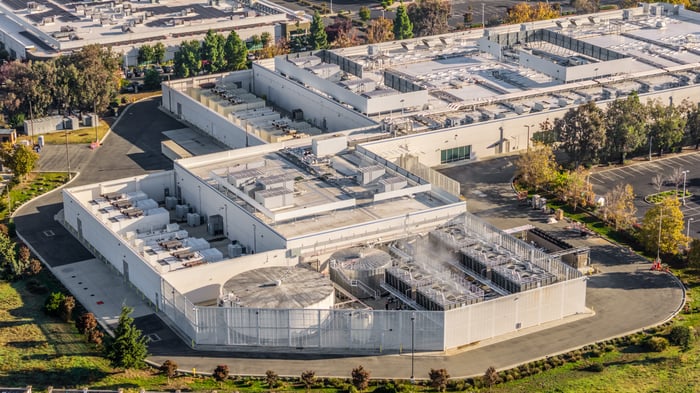
Image source: Getty Images.
From selling components to selling complete systems
Traditionally, technology companies sold individual components. Intel sold CPUs. Cisco sold networking equipment. Nvidia sold GPUs. Customers then assembled those pieces into functioning systems.
But the AI megatrend is changing the formula. Building advanced AI models now requires far more than powerful chips. Companies need to combine networking equipment, software tools, cooling systems, storage infrastructure, and thousands of GPUs into what is essentially one vast machine. That type of coordination is necessary to meet the ever-growing computing power demands of AI applications.
Nvidia recognized this challenge early. Instead of simply selling chips, the company has spent years building a complete ecosystem that includes GPUs, CPUs, networking hardware, software platforms, and integrated systems designed specifically for AI workloads.
As a result, customers are increasingly purchasing entire AI infrastructure solutions rather than individual components. In other words, Nvidia is quietly moving up the value chain.
The rise of the AI factory
Nvidia frequently describes modern AI data centers as "AI factories."
The idea is simple. Traditional factories take raw materials and convert them into physical products. AI factories take data and convert it into intelligence. These facilities train large language models, power AI applications, and generate the outputs that businesses and consumers increasingly rely on.
To build an AI factory, companies need far more than a collection of chips. They need computing systems capable of coordinating thousands of processors, moving enormous amounts of data, and operating efficiently at scale. That plays directly into Nvidia's strengths.
By bundling everything into a single package and offering it to customers, Nvidia helps them implement their complex AI projects. In return, it gets the opportunity to capture a larger share of every dollar spent on AI infrastructure.
The hidden advantage that investors may be overlooking
Many investors focus on Nvidia's hardware leadership in GPUs. That's not wrong. But hardware may not be the company's most important advantage.
The company's real moat increasingly comes from its ecosystem. Over the past two decades, Nvidia has built CUDA, a software platform that allows developers to optimize their applications for Nvidia hardware. Millions of developers now use these tools to develop AI applications.
As AI adoption expands, companies aren't just buying Nvidia chips. They are building workflows, software stacks, and expertise around its ecosystem. That creates higher switching costs.
A competing GPU from AMD, for example, may offer comparable performance. But replacing an entire software and infrastructure stack is much harder than switching providers for one type of processor. This dynamic helps explain why Nvidia continues to maintain such a strong position even as competitors invest heavily in developing their own AI hardware.
What does it mean for investors?
Investors often describe Nvidia as the world's leading AI chipmaker. While that's true, it's also incomplete.
Nvidia is quietly transforming from a component supplier into a company that helps build the infrastructure of the AI economy. The chips may have started the story. But the future opportunity could come from everything Nvidia sells around them.
If AI becomes a foundational technology across industries, spending may increasingly shift toward integrated infrastructure rather than stand-alone hardware. In that scenario, Nvidia could benefit not only from demand for its chips but also from demand for the broader systems, software, and networking technologies that enable AI.
And that's the most important point for investors to focus on when considering Nvidia's stock.
Should you buy stock in Nvidia right now?
Before you buy stock in Nvidia, consider this:
The Motley Fool Stock Advisor analyst team just identified what they believe are the 10 best stocks for investors to buy now… and Nvidia wasn’t one of them. The 10 stocks that made the cut could produce monster returns in the coming years.
Consider when Netflix made this list on December 17, 2004... if you invested $1,000 at the time of our recommendation, you’d have $439,847!* Or when Nvidia made this list on April 15, 2005... if you invested $1,000 at the time of our recommendation, you’d have $1,342,065!*
Now, it’s worth noting Stock Advisor’s total average return is 968% — a market-crushing outperformance compared to 211% for the S&P 500. Don't miss the latest top 10 list, available with Stock Advisor, and join an investing community built by individual investors for individual investors.
See the 10 stocks »
*Stock Advisor returns as of June 6, 2026.
Lawrence Nga has no position in any of the stocks mentioned. The Motley Fool has positions in and recommends Advanced Micro Devices, Cisco Systems, Intel, and Nvidia. The Motley Fool has a disclosure policy.
Recommended Articles


