


Fed Chair Kevin Warsh Will Face 2 Key Tests in His First 100 Days -- Trump and Inflation -- and He's Virtually Certain to Fail One of Them
Key Points
Donald Trump's handpicked successor to Fed Chair Jerome Powell, Kevin Warsh, was officially sworn in on May 22.
Although the Federal Reserve acts independent of political pressure, this hasn't stopped President Trump from repeatedly calling on the Federal Open Market Committee (FOMC) to slash interest rates.
A historic energy supply shock caused by the Iran war has driven U.S. inflation to a three-year high, leaving the new Fed chair in quite a predicament.
- 10 stocks we like better than S&P 500 Index ›
History is being made at a breathtaking pace on Wall Street over the last few weeks. In addition to watching the ageless Dow Jones Industrial Average (DJINDICES: ^DJI), benchmark S&P 500 (SNPINDEX: ^GSPC), and technology-driven Nasdaq Composite (NASDAQINDEX: ^IXIC) all soar to record highs, investors witnessed a rare shift at the Federal Reserve.
May 15 marked the final day of Jerome Powell's second term as Fed chair. Given the public feud between President Donald Trump and Powell over interest rates, it became clear a while ago that a third term wasn't in the cards for the now-former Fed chair.
Will AI create the world's first trillionaire? Our team just released a report on the one little-known company, called an "Indispensable Monopoly" providing the critical technology Nvidia and Intel both need. Continue »

Kevin Warsh was officially sworn in as Fed chair on May 22. Image source: Official White House Photo by Daniel Torok.
On May 22, Trump's handpicked successor to Powell, Kevin Warsh, was officially sworn in. Warsh previously served on the Board of Governors and was a voting member of the Federal Open Market Committee (FOMC) from Feb. 24, 2006, to March 31, 2011. The FOMC is the 12-person body responsible for setting the nation's monetary policy.
But experience won't save the new Fed chair from two monstrous challenges during his first 100 days as head of the Fed. Kevin Warsh has two tests to tackle -- President Trump and inflation -- and he's all but assured to fail one of them.
Donald Trump wants interest rates slashed to 1% (or lower)
Although the Federal Reserve is an independent entity operating within the U.S. government (i.e., free to adjust monetary policy as FOMC members see fit), this hasn't stopped Donald Trump from interjecting his view on what policymakers should do with interest rates.
Powell's final year as Fed chair was marked by repeated calls by Trump to aggressively slash interest rates to 1% or lower. For context, the FOMC lowered the federal funds target rate six times from September 2024 to December 2025. However, the current federal funds target rate of 3.5% to 3.75% is well above the president's desired target.
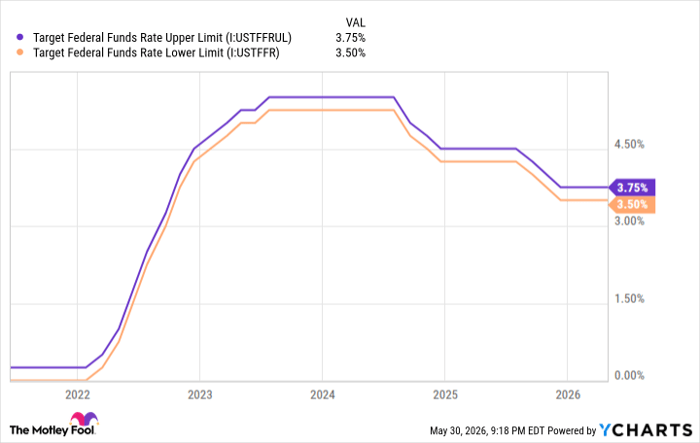
Target Federal Funds Rate Upper Limit data by YCharts.
There are likely several catalysts behind Trump's calls for lower interest rates. For starters, reducing lending rates should spur corporate hiring and spending on innovation. Lower borrowing costs could reverse a modest uptrend in the unemployment rate over the last three years.
A drastic reduction in interest rates should also lead to lower Treasury bond yields. The 10-year T-bond indirectly influences mortgage rates. Lower mortgage rates would make housing more affordable.
Lastly, slashing interest rates would make it significantly easier for the U.S. to service more than $39 trillion in outstanding debt. Persistent federal government deficits are raising red flags, and lower interest rates would essentially make it easier for the U.S. government to make its interest payments.

Image source: Getty Images.
Inflation is hitting a three-year high
Meanwhile, inflationary pressures are pulling Warsh and the other FOMC members in the opposite direction.
Though Trump's tariffs continue to apply modest upward pressure on prices in the goods sector, the bulk of the inflationary pressure at the moment stems from the Iran war.
Shortly after President Trump gave the order to attack on Feb. 28, Iran shut down the Strait of Hormuz to virtually all commercial vessels. This halted the flow of approximately 20 million barrels of petroleum liquids per day, or roughly 20% of global demand. Crude oil and fuel prices have soared over the last three months, which is reflected in monthly inflation reports.
US inflation is red hot.
-- The Kobeissi Letter (@KobeissiLetter) May 28, 2026
1. CPI Inflation: 3.8%, highest since May 2023
2. PCE Inflation: 3.8%, highest since May 2023
3. PPI Inflation: 6%, highest since March 2023
4. Services Inflation: 3.4%, highest since Sept 2025
5. Shelter Inflation: 3.3%, highest since Sept 2025
6.... pic.twitter.com/u8kaSN54G3
Trailing 12-month (TTM) inflation in February was a modest 2.4%. By April, TTM inflation had jumped to 3.8%. According to the Federal Reserve Bank of Cleveland's Inflation Nowcasting tool, TTM inflation for May is projected to climb to 4.18%. An estimated three-month, 178-basis-point increase in TTM inflation isn't something that Kevin Warsh or the FOMC will be able to sweep under the rug.
To make matters worse, the adverse impacts of energy price shocks tend to lag by a few months for businesses. Once the effects of higher transportation and production costs are reflected in economic data, there's a good chance we'll see TTM inflation rise further.
Fed Chair Kevin Warsh is going to fail one of these challenges
Within Warsh's first 100 days as Fed chair, he's going to learn the hard truth that it's impossible to appease President Trump and wrangle above-average inflation at the same time.
Given that the central bank acts independently of political pressure, Warsh and the FOMC are almost certain to focus their efforts on stabilizing prices -- even if that means drawing the ire of the president.
During the Fed chair's previous five years on the FOMC, he helped navigate the U.S. economy through the financial crisis. However, Warsh's FOMC voting record earned him the label of monetary hawk. He frequently cautioned against lower interest rates, even as the unemployment rate jumped, fearing that artificially low interest rates would spark a resurgence of inflation. In other words, there's a historic precedent for Warsh favoring higher rates to stabilize prices.
"If Trump wants someone easy on inflation, he got the wrong guy in Kevin Warsh."@AnnaEconomist pic.twitter.com/FGMfeSqHpU
-- Daily Chartbook (@dailychartbook) January 31, 2026
We also have an FOMC that appears to be leaning away from its easing bias statement. While three members officially opposed the inclusion of the easing bias statement at Powell's final meeting as Fed chair on April 29, the Fed meeting minutes, released three weeks later, suggested that a majority of FOMC members opposed the easing bias. It would appear that a major monetary policy shift is imminent.
Should Warsh and the FOMC tackle Iran war-driven inflation head-on, they risk being publicly chastised by President Trump and may upend Wall Street's historic bull market rally. The second-priciest stock market over the last 155 years is unlikely to be pleased with higher lending rates amid a costly artificial intelligence data center build-out.
Meanwhile, appeasing Trump with rate cuts could threaten the central bank's credibility in the eyes of investors as TTM inflation soars.
Fed Chair Kevin Warsh will fail one of his two key challenges within the first 100 days. The all-important question is: Which one?
Should you buy stock in S&P 500 Index right now?
Before you buy stock in S&P 500 Index, consider this:
The Motley Fool Stock Advisor analyst team just identified what they believe are the 10 best stocks for investors to buy now… and S&P 500 Index wasn’t one of them. The 10 stocks that made the cut could produce monster returns in the coming years.
Consider when Netflix made this list on December 17, 2004... if you invested $1,000 at the time of our recommendation, you’d have $439,847!* Or when Nvidia made this list on April 15, 2005... if you invested $1,000 at the time of our recommendation, you’d have $1,342,065!*
Now, it’s worth noting Stock Advisor’s total average return is 968% — a market-crushing outperformance compared to 211% for the S&P 500. Don't miss the latest top 10 list, available with Stock Advisor, and join an investing community built by individual investors for individual investors.
See the 10 stocks »
*Stock Advisor returns as of June 6, 2026.
Sean Williams has no position in any of the stocks mentioned. The Motley Fool has no position in any of the stocks mentioned. The Motley Fool has a disclosure policy.
Recommended Articles


