


Alphabet Will Soon Be Berkshire Hathaway's Fourth-Biggest Holding. I've Got a Problem With How and Why.
Key Points
Alphabet is issuing shares to raise the money it needs to invest in its artificial intelligence offerings.
Berkshire Hathaway is participating in this fundraiser by buying discounted shares and adding to its already sizeable position in the company.
Berkshire CEO Greg Abel’s decision is arguably undisciplined, adding to an existing stake that doesn’t necessarily need to be expanded while other, similar options are available at a better price.
- 10 stocks we like better than Berkshire Hathaway ›
Berkshire Hathaway's (NYSE: BRKA) (NYSE: BRKB) sizable stake in Alphabet (NASDAQ: GOOG) (NASDAQ: GOOGL) is about to grow considerably. On Monday, the technology giant announced it's raising $80 billion to fund continued investments in artificial intelligence (AI). Of that, $10 billion will come directly from Berkshire through a private placement of discounted shares.
There's nothing particularly unusual about any of it -- private fundraising is often cheaper and easier for both parties. And, AI remains a compelling opportunity.
Will AI create the world's first trillionaire? Our team just released a report on the one little-known company, called an "Indispensable Monopoly" providing the critical technology Nvidia and Intel both need. Continue »
How and when it all took shape, however, concerns me. Abel and his lieutenants may not be as disciplined in their picks as their predecessor, Warren Buffett, was.
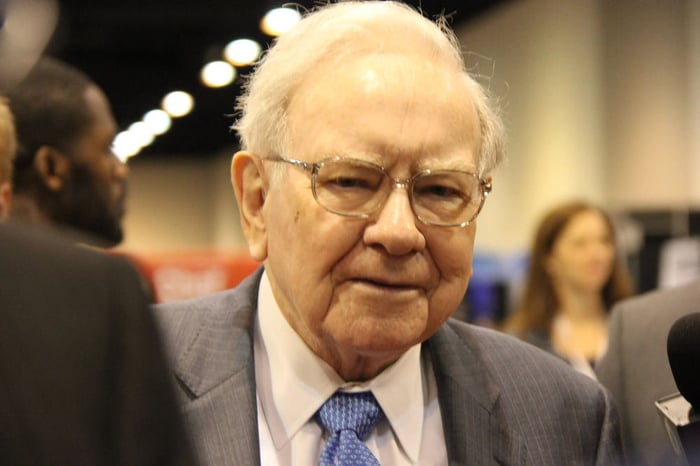
Image source: The Motley Fool.
Two concerns about the Alphabet deal
Don't misread the message. Even overvalued Alphabet shares are arguably a better bet than most other tickers at any price. The company is, after all, a major gateway to the internet.
This is still a little concerning for a couple of philosophical reasons, though.
The first of these reasons is the price Abel was willing to pay. Although the price of $351.81 for $5 billion worth of A shares and $348.20 apiece for $5 billion worth of C (non-voting) shares is roughly a 7% discount to Monday's pre-announcement prices, it's also more than a 20% premium to Q1's closing prices, when Berkshire essentially tripled its Alphabet stake first established in the third quarter of last year.
Although even Buffett would agree that you should be willing to pay for quality, it doesn't appear that Abel is interested in even trying to hold out for a better price that most investors understand will materialize sooner or later.
Did Berkshire have to move quickly to take advantage of the discounted offer? Maybe. But given that the private placement agreement between Berkshire Hathaway and Alphabet is part of a broader fundraising effort, this deal seems to be more on Alphabet's terms and timing than Abel's.
That's my second concern. Berkshire is handing over very real cash in exchange for greater exposure to a plan that may or may not pay off as hoped, with no clear time frame for when this next round of AI capital expenditures will add to the top or bottom lines. If Abel wanted some more exposure to the artificial intelligence revolution, there are plenty of other stocks other than Alphabet's -- and at a better price -- that would bring just as much upside to the table. Berkshire didn't buy any of them.
Berkshire's deal with Alphabet is worth questioning
It's not catastrophic, to be clear. It is concerning, though, not because Alphabet is a bad stock to own, but because Greg Abel seems to be thinking reactively rather than proactively, buying stocks or adding to existing positions without a clear strategic purpose or the patience to hold out for a better price.
It's not like he's gaining much more control over Alphabet, either. Again, half of the aforementioned private placement is of shares without any voting rights. With a little more patience and/or a few dollars more, Abel could have bought just as many A shares in the open market.
Only time will tell whether this is a one-off. Let's hope it is.
Should you buy stock in Berkshire Hathaway right now?
Before you buy stock in Berkshire Hathaway, consider this:
The Motley Fool Stock Advisor analyst team just identified what they believe are the 10 best stocks for investors to buy now… and Berkshire Hathaway wasn’t one of them. The 10 stocks that made the cut could produce monster returns in the coming years.
Consider when Netflix made this list on December 17, 2004... if you invested $1,000 at the time of our recommendation, you’d have $439,632!* Or when Nvidia made this list on April 15, 2005... if you invested $1,000 at the time of our recommendation, you’d have $1,316,532!*
Now, it’s worth noting Stock Advisor’s total average return is 959% — a market-crushing outperformance compared to 210% for the S&P 500. Don't miss the latest top 10 list, available with Stock Advisor, and join an investing community built by individual investors for individual investors.
See the 10 stocks »
*Stock Advisor returns as of June 4, 2026.
James Brumley has positions in Alphabet. The Motley Fool has positions in and recommends Alphabet and Berkshire Hathaway. The Motley Fool has a disclosure policy.
Recommended Articles


