


Did Nvidia Just Say "Checkmate" to Intel and AMD?
Key Points
Nvidia is known for its dominance in the graphics processing unit (GPU) sector.
But now the company is getting involved in another critical area of artificial intelligence.
Intel and AMD are already deeply involved in this area, and the emergence of Nvidia could potentially threaten their market share or runway.
- 10 stocks we like better than Nvidia ›
As has become the norm, the artificial intelligence (AI) chip giant Nvidia (NASDAQ: NVDA) recently reported strong earnings for the first quarter of its fiscal 2027.
The company reported adjusted earnings and revenue ahead of Wall Street estimates and also provided a current-quarter revenue outlook well ahead of analysts' expectations.
Will AI create the world's first trillionaire? Our team just released a report on the one little-known company, called an "Indispensable Monopoly" providing the critical technology Nvidia and Intel both need. Continue »
However, the unexpected part of the quarter came when Nvidia Chief Executive Officer Jensen Huang, on the earnings conference call, announced that the company is making a big move in central processing units (CPU) and is expecting a strong year of revenue from the division, as well as a new total addressable market.
Did Nvidia just say "checkmate" to Intel and Advanced Micro Devices?

Image source: Nvidia.
CPUs are now a big part of the AI story, and Nvidia isn't sitting on its laurels
In recent years, one of the big parts of the AI story, particularly as it relates to Nvidia, has been graphics processing units (GPUs), chips that are vital for training large language models (LLMs) and which are deployed in data centers specifically designed to run AI solutions.
GPUs have parallel processing capabilities and can therefore process much more data and consider many more solutions to a problem than CPUs. Nobody makes GPUs better than Nvidia, which has at least 80% of the market.
Furthermore, Nvidia's software layer for its GPUs, called CUDA (compute unified device architecture), was released in 2006, and Nvidia has built a strong ecosystem many companies and developers have become accustomed to. This makes switching away from this operating system difficult and is part of the reason Nvidia currently has such a strong competitive moat.
CPUs are the chips that are usually used in older, more common devices like desk top computers and mobile phones, and, until recently, were not viewed as a big part of the AI story.
However, the rise of agentic AI, autonomous systems that can complete a range of tasks without human intervention, has led to soaring CPU demand. Companies have found that CPUs are the most efficient at orchestrating the specific workflows that enable AI agents to perform tasks.
One example Huang gave on the company's earnings call is that if an agent wanted to do a task that involved fetching data from an internet browser, that task would run on a CPU.
Nvidia's foray into the CPU market
Nvidia has long specialized in GPUs, and dominance in this market has led the company to a more than $5.2 trillion market cap, making it the largest publicly traded company by market cap in the world.
However, surging demand for CPUs for agentic AI has driven tremendous gains this year alone for some of the leaders in the industry, such as Intel and AMD.
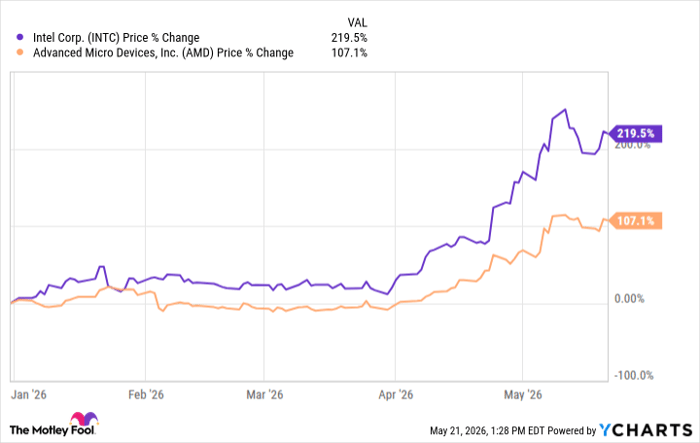
INTC data by YCharts
The opportunity only seems to be growing, too, according to Intel CEO Lip-Bu Tan.
"On the inference side, in terms of orchestration, control plane, and also managing all the different agents with data, CPU is much more efficient," Tan said on Intel's most recent earnings conference call. "The ratio of CPU to GPUs used to be 1-to-8, and now it is 1-to-4, and I think it could move toward parity or even better."
On Nvidia's conference call, management surprised Wall Street analysts by announcing that it is now in the data center CPU market, specifically making ones for agentic AI use.
Nvidia Chief Financial Officer Collette Kress said the company is rolling out its new Vera CPU, which is reportedly up to 1.5 times faster than comparable alternatives.
Kress also said that the Vera CPU creates a brand-new $200 billion opportunity for Nvidia and that the company expects nearly $20 billion in total CPU revenue in the current fiscal year alone.
Is it checkmate?
In the first quarter of 2026, Intel delivered more than $5 billion of revenue in its data center and AI division, which includes its CPU product business. Annualized, that's slightly more than Nvidia's $20 billion CPU projection.
AMD reported nearly $5.8 billion in data center revenue in the first quarter of this year. However, this includes both GPU and CPU sales, which the company does not break out.
So if Nvidia were to hit $20 billion in CPU sales this year, it could very well be in line with Intel and larger than AMD's business right away.
Is it an immediate checkmate?
I suspect there are likely enough opportunities for Intel, AMD, and Nvidia to all do well in the agentic AI CPU market. But make no mistake, Nvidia's move likely makes it an immediate leader in the industry, and a big challenger to Intel and AMD.
Should you buy stock in Nvidia right now?
Before you buy stock in Nvidia, consider this:
The Motley Fool Stock Advisor analyst team just identified what they believe are the 10 best stocks for investors to buy now… and Nvidia wasn’t one of them. The 10 stocks that made the cut could produce monster returns in the coming years.
Consider when Netflix made this list on December 17, 2004... if you invested $1,000 at the time of our recommendation, you’d have $477,813!* Or when Nvidia made this list on April 15, 2005... if you invested $1,000 at the time of our recommendation, you’d have $1,320,088!*
Now, it’s worth noting Stock Advisor’s total average return is 986% — a market-crushing outperformance compared to 208% for the S&P 500. Don't miss the latest top 10 list, available with Stock Advisor, and join an investing community built by individual investors for individual investors.
See the 10 stocks »
*Stock Advisor returns as of May 26, 2026.
Bram Berkowitz has no position in any of the stocks mentioned. The Motley Fool has positions in and recommends Advanced Micro Devices, Intel, and Nvidia. The Motley Fool has a disclosure policy.
Recommended Articles


