


The Latest Fed May Inflation Update Is In -- and It's a Good News-Bad News Scenario for Wall Street
Key Points
Inflationary pressures are calling Wall Street's bull market rally into question.
The Iran war is taking its toll, with gas prices rising faster than they have in three decades.
While the Cleveland Fed's Inflation Nowcasting tool offers a silver lining, it also points to growing risk of Federal Open Market Committee (FOMC) interest rate hikes.
- 10 stocks we like better than S&P 500 Index ›
Within the last two weeks, we've witnessed the iconic Dow Jones Industrial Average (DJINDICES: ^DJI), benchmark S&P 500 (SNPINDEX: ^GSPC), and artificial intelligence (AI)-driven Nasdaq Composite (NASDAQINDEX: ^IXIC) reach all-time highs. But the sustainability of this bull market rally is being firmly called into question by rapidly rising inflation.
While the latest May inflation update from the Federal Reserve offered the first glimmer of hope in weeks, the bad news continues to handily outweigh any silver linings for Wall Street.
Will AI create the world's first trillionaire? Our team just released a report on the one little-known company, called an "Indispensable Monopoly" providing the critical technology Nvidia and Intel both need. Continue »

Now-former Fed Chair Jerome Powell often pointed to Trump's tariffs and the Iran war as reasons inflation is elevated. Image source: Official Federal Reserve Photo.
The Iran war is taking its toll
Although now-former Fed Chair Jerome Powell repeatedly called out President Donald Trump's tariffs and their price stickiness in the goods sector for elevated inflation, the bulk of the inflationary pressures right now trace back to the Iran war.
Since Trump gave the order for the U.S. military to attack Iran on Feb. 28, the latter has shut down the Strait of Hormuz to most commercial traffic. This includes halting the movement of approximately 20 million barrels of petroleum liquids per day (about 20% of worldwide demand).
⛽ Average U.S. gas prices per gallon on May 6, per AAA:
-- NBC News (@NBCNews) May 6, 2026
• Regular: $4.54 (⬆️ $1.56 since war in Iran began on Feb. 28)
• Premium: $5.39 (⬆️ $1.85 since war began)
• Diesel: $5.67 (⬆️ $1.81 since war began)
The largest energy supply disruption in modern history has sent crude oil prices soaring. Consumers are feeling the pinch every time they fuel up their cars, trucks, or SUVs, as gas prices have risen at the fastest pace in over three decades.
But pain at the pump is just the first phase of an energy price shock. We're starting to see evidence of non-energy-driven inflation taking hold. Once the delayed inflationary effects of the Iran war hit businesses through higher transportation and production costs, the inflation rate can take another leg up.

Image source: Getty Images.
The Fed's newest May inflation forecast is a mixed bag for Wall Street
If there's good news to share in the latest update from the Federal Reserve Bank of Cleveland's Inflation Nowcasting tool, it's that May's projected trailing 12-month (TTM) inflation rate is unchanged at 4.18%. While this would still be 38 basis points higher than reported TTM inflation in April, recent economic data hasn't worsened this forecast.
On the other hand, Core Personal Consumption Expenditures, arguably the favorite measure of inflation used by the Federal Open Market Committee (FOMC) when setting the nation's monetary policy, is inching higher. Additionally, the annualized inflation rate based solely on second-quarter data is a staggering 6.85%!
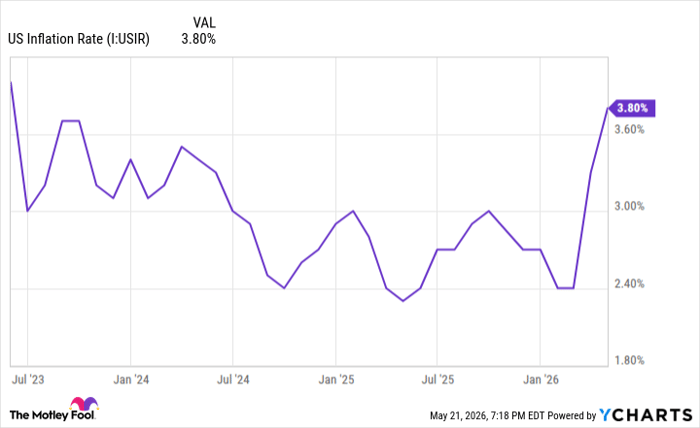
US Inflation Rate data by YCharts.
The FOMC's meeting minutes from April (Powell's final meeting as Fed chair) also made clear that several members favored removing the easing bias statement. This points to a possible shift to a neutral bias as early as the mid-June meeting.
For Wall Street, the latest May inflation update is more bad than good. While the Cleveland Fed's inflation forecast didn't worsen, the risks of higher, persistent inflation (beyond May) are firmly in place. The Fed shifting to a hiking bias or raising rates to stabilize prices may be a death knell for the Dow, S&P 500, and Nasdaq Composite -- especially given investors' expectations of several rate cuts in 2026-2027.
Furthermore, stocks are historically expensive and are being driven by the AI revolution. Raising interest rates threatens to stymie the AI spending that's been foundational to Wall Street's bull market rally.
Should you buy stock in S&P 500 Index right now?
Before you buy stock in S&P 500 Index, consider this:
The Motley Fool Stock Advisor analyst team just identified what they believe are the 10 best stocks for investors to buy now… and S&P 500 Index wasn’t one of them. The 10 stocks that made the cut could produce monster returns in the coming years.
Consider when Netflix made this list on December 17, 2004... if you invested $1,000 at the time of our recommendation, you’d have $477,813!* Or when Nvidia made this list on April 15, 2005... if you invested $1,000 at the time of our recommendation, you’d have $1,320,088!*
Now, it’s worth noting Stock Advisor’s total average return is 986% — a market-crushing outperformance compared to 208% for the S&P 500. Don't miss the latest top 10 list, available with Stock Advisor, and join an investing community built by individual investors for individual investors.
See the 10 stocks »
*Stock Advisor returns as of May 26, 2026.
Sean Williams has no position in any of the stocks mentioned. The Motley Fool has no position in any of the stocks mentioned. The Motley Fool has a disclosure policy.
Recommended Articles


