


Best 2 Blue Chip Stocks to Buy After Last Week's Market Pullback
Key Points
Lockheed Martin and Deere & Company are two industrial stalwarts with proven track records of success.
War in the Middle East could add to Lockheed Martin's already healthy backlog.
Now is a good time to buy cyclical Deere & Co, while business is slow.
- 10 stocks we like better than Lockheed Martin ›
The stock market simply isn't going to go up all the time. Even during the best of times, the broader market will have an off week or month; you just never know. Volatility isn't fun for anyone, but it's how long-term investors can get a leg up on the market.
You see, when the tide goes out and the broader market declines, blue chip stocks, the best companies on Earth, often go down, too. That's a huge opportunity for investors because there may not be anything wrong with the business itself -- it's just the market doing what the market does.
Will AI create the world's first trillionaire? Our team just released a report on the one little-known company, called an "Indispensable Monopoly" providing the critical technology Nvidia and Intel both need. Continue »
The recent pullback has created some solid buying opportunities. Here are two blue chip industrial stocks that currently look like two of the best buys you can make.
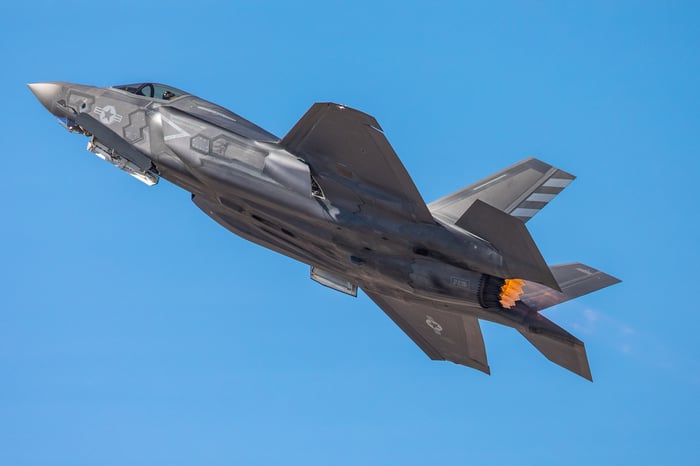
Image source: Getty Images.
1. Lockheed Martin
The world's largest defense manufacturer, Lockheed Martin (NYSE: LMT), isn't a get-rich-quick stock, but it's a blue chip company in every sense of the term. History has shown that the world seldom remains peaceful for long. As unfortunate as that is, it creates a steady demand for the various weapons, vehicles, aircraft, and other technologies Lockheed Martin sells to the U.S. and its military allies.
The ongoing war in the Middle East has depleted arsenals, prompting the U.S. Department of Defense to sign a multi-year agreement to triple and quadruple production of various missiles. Lockheed Martin also produces the F-35 Lightning II fighter jet, the most expensive aircraft program in modern history, and a core revenue driver going forward as it continues to bring new aircraft into service and rack up maintenance and repair services.
While Lockheed Martin's backlog did shrink slightly from the prior quarter, it remains very healthy at $186 billion after the first quarter of 2026. The Trump Administration has made it clear that the government aims to continue spending heavily on defense over the next few years, so it wouldn't be a surprise to see the backlog grow again in the near future.
Analysts estimate the company will grow its earnings by an average of 18% annually over the next three to five years, which should translate to capital gains and healthy dividend increases. Lockheed Martin stock currently trades well below its 52-week high, which, in this case, has priced shares at an attractive valuation at under 18 times 2026 earnings estimates. Plus, investors get a solid 2.6% dividend yield at the current share price.
2. Deere & Co
Farming is the backbone of a growing global population. Deere & Co (NYSE: DE) is an industry titan known primarily for its famous John Deere machinery brand. Today, Deere designs and manufactures machines for farming, forestry, and construction. It also sells complementary products and services, such as software and aftermarket support. Its financial segment, which finances machinery purchases for customers, has also become a tremendous profit center.
Tractors and other machines are expensive purchases, so Deere's business fluctuates with farmers' financial health. Deere's business is in a somewhat in-between place right now. Forestry and construction have been relatively resilient, driven by commercial construction activity. However, the agricultural business has struggled as farmers grapple with lower commodity prices, higher input costs, and higher interest rates, which have reduced income and increased financing costs.
Deere's top and bottom lines are lower than during the agriculture boom a few years ago. This weakness has weighed on the stock as well. Yet, Deere trades at a price-to-earnings ratio of 29 times 2026 earnings estimates. That might seem high, but this often happens with cyclical stocks, where depressed earnings, the denominator in the P/E ratio, drive the stock's valuation higher.
Often, it's smart to buy cyclical companies during industry downturns, because their stocks tend to recover when business picks up again. There are still many growth opportunities in the artificial intelligence age, including increasingly autonomous and intelligent machinery that can help increase farm output with fewer people. Analysts see Deere growing earnings by an average of more than 15% annually over the next three to five years, making Deere a blue chip stock to buy on its current weakness.
Should you buy stock in Lockheed Martin right now?
Before you buy stock in Lockheed Martin, consider this:
The Motley Fool Stock Advisor analyst team just identified what they believe are the 10 best stocks for investors to buy now… and Lockheed Martin wasn’t one of them. The 10 stocks that made the cut could produce monster returns in the coming years.
Consider when Netflix made this list on December 17, 2004... if you invested $1,000 at the time of our recommendation, you’d have $477,813!* Or when Nvidia made this list on April 15, 2005... if you invested $1,000 at the time of our recommendation, you’d have $1,320,088!*
Now, it’s worth noting Stock Advisor’s total average return is 986% — a market-crushing outperformance compared to 208% for the S&P 500. Don't miss the latest top 10 list, available with Stock Advisor, and join an investing community built by individual investors for individual investors.
See the 10 stocks »
*Stock Advisor returns as of May 26, 2026.
Justin Pope has no position in any of the stocks mentioned. The Motley Fool has positions in and recommends Deere & Company. The Motley Fool recommends Lockheed Martin. The Motley Fool has a disclosure policy.
Recommended Articles


