


3 Industrial Stocks to Buy Before the Next Wave of Spending Hits
Key Points
The cyclical tide is finally turning back in farm machinery maker Deere & Company’s favor.
The stronger the economy and the greater the industrial activity, the more waste is produced.
Illinois Tool Works’ longer-term strategy is why it consistently outperforms the overall market.
- 10 stocks we like better than Deere & Company ›
After posting solid Q1 earnings reports, artificial intelligence (AI) stocks remain the market's must-have darlings.
There's something else happening, however, that too many investors are overlooking. That's a ramp-up of the nation's industrial activity. Seemingly against the odds, the Federal Reserve's measure of domestic industrial production hit a six-year high in April, while the Institute of Supply Management's manufacturing activity index remains in the positive territory it entered at the beginning of this year. Like it or not, the United States' factories are revving their engines, with at least some of the domestic output that had been lost of late rematerializing.
Will AI create the world's first trillionaire? Our team just released a report on the one little-known company, called an "Indispensable Monopoly" providing the critical technology Nvidia and Intel both need. Continue »
This is likely only the beginning of a prolonged secular shift, though, giving American companies greater control over their production and leaving them less subject to geopolitical turmoil.
With that as the backdrop, here's a rundown of three industrial sector stocks you might want to step into sooner than later, before any more capital is invested in the business, spurring economic growth that workers/consumers currently feel may never be coming.

Image source: Getty Images.
Deere & Company
It seems a little counterintuitive (at first). But, farms don't invest aggressively in their own output when times are hard, and profits are thin. They hunker down. The industry actually spends the most when commodity prices are high and profit margins are wide, in an effort to squeeze out as much profitability as possible while it's possible to do so.
And it's now very possible to do so. While operating costs like feed and fuel are high for farmers right now, just like they are for everybody else, the market prices of farm-food products continue to inch higher as well. Indeed, the USDA's Economic Research Service now predicts the country's farms' combined profits will be $153.4 billion in 2026, which will more or less be in line with 2025's figure, stabilizing above 2024's lousy figure following 2022's unsustainable peak in profitability. After years of postponed equipment replacements, this stability could mean the farm-machinery industry is ripe for a cyclical turnaround.
That's what Deere & Company's (NYSE: DE) -- formerly John Deere -- communications manager Christopher Seibert suggested during February's fiscal Q1 earnings conference call anyway, saying "the developments over the course of the past 3 months have strengthened our belief that 2026 marks the bottom of the current cycle as we project mid-single-digit net sales growth for the equipment operations this fiscal year." The stock has still underperformed since then, weighed down by disappointing results.
If you're waiting for a crystal clear sign that Deere's headwind is entirely in the rearview mirror, however, you're going to be giving up a lot of the early gains that take shape when investors start to sense a turnaround is already underway.
WM
It's a clichéd observation that the world never stops producing trash. That doesn't make it wrong, though. According to the EPA, in fact, every person living in the U.S. creates about 5 pounds of garbage every single day. If the economy cranks up and spurs consumer demand for more domestically made goods and services, don't be surprised to see that figure ramp up.
Enter WM (NYSE: WM), or as it used to be known, Waste Management. The company operates over 260 landfills across the United States (plus a few in the U.K.) in addition to more than 500 transfer facilities, over 100 recycling centers, and a handful of medical waste incinerators. The company did $25.2 billion worth of business last year, up 14%, turning $3.0 billion of that into net income.
It's not a sexy investment by any stretch of the imagination, particularly compared to nearly any AI stock. It's a fairly slow-moving company in a fairly slow-growing business. It's also, well, garbage. The simple industry's been around forever and hasn't exactly been improved by technological developments.
Don't dismiss the near- and long-term growth potential of America's waste-disposal industry, though. With the nation's and the world's population still growing, resulting in a growing amount of annual waste with a decreasing number of places to put it, the World Bank believes the global municipal waste management business is poised to grow from $250 billion now to $426 billion by 2050. WM is positioned to capture at least its fair share of this growth simply because the country and the planet are soon going to be relying on it and its peers to solve an underestimated problem that few people fully appreciate is brewing.
Illinois Tool Works
Last but not least, add Illinois Tool Works (NYSE: ITW) to your list of industrial stocks to buy before corporations start making bigger, must-have investments in capacity driven by an unexpected swell in demand.
Contrary to a common assumption, Illinois Tool Works actually makes very few hand tools. Automobile parts, restaurant dishwashing equipment, plastic packaging solutions, electronics testing machines, and a range of glues, coatings, and lubricants are all in its well-diversified wheelhouse. It's so diversified, in fact, that it's seemingly complex to the point of being difficult to manage.
The company's been smart about sidestepping this potential problem, though, by proactively letting each of these arms manage their own affairs and operate largely independently of one another. The chief reason ITW has outperformed the S&P 500 in the long run, though, is that it's focused on making smart, bigger-picture decisions even if that means short-term disappointment.
And it's still doing it. While most other companies spent a great deal of time talking about the year ahead during their most recent quarterly earnings conference calls, Illinois Tool Works was telling investors about its plans to evolve its business through 2030, driven by a combination of innovation and reliable execution.
This long-term mindset hasn't prevented a near-term setback for the stock. Indeed, ITW shares are down 17% from their mid-February peak due to a combination of modest organic growth in Q4, rising costs, geopolitical tensions, and interest rate worries, just to name a few.
Curiously, though, analysts aren't deterred. They're still looking for the same steady single-digit revenue growth they've seen over the past several years to continue for the next several years, accompanied by even faster profit growth.
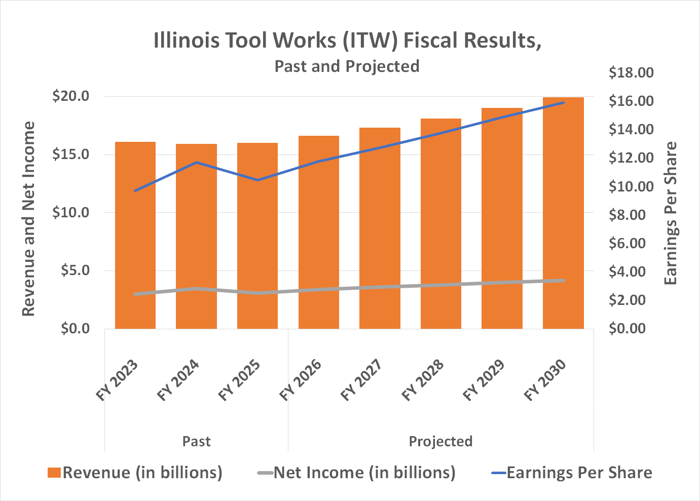
Data source: Morningstar. Chart by author.
More importantly to interested investors, Illinois Tool Works' low-capital-cost product lineup positions it as one of the first beneficiaries of any uptick in industrial investments, or, for that matter, any rekindled, sustained growth in consumer spending.
Should you buy stock in Deere & Company right now?
Before you buy stock in Deere & Company, consider this:
The Motley Fool Stock Advisor analyst team just identified what they believe are the 10 best stocks for investors to buy now… and Deere & Company wasn’t one of them. The 10 stocks that made the cut could produce monster returns in the coming years.
Consider when Netflix made this list on December 17, 2004... if you invested $1,000 at the time of our recommendation, you’d have $475,063!* Or when Nvidia made this list on April 15, 2005... if you invested $1,000 at the time of our recommendation, you’d have $1,369,991!*
Now, it’s worth noting Stock Advisor’s total average return is 994% — a market-crushing outperformance compared to 207% for the S&P 500. Don't miss the latest top 10 list, available with Stock Advisor, and join an investing community built by individual investors for individual investors.
See the 10 stocks »
*Stock Advisor returns as of May 22, 2026.
James Brumley has no position in any of the stocks mentioned. The Motley Fool has positions in and recommends Deere & Company. The Motley Fool recommends Illinois Tool Works and WM. The Motley Fool has a disclosure policy.
Recommended Articles


