


Investors Might Be "Playing With Fire," According to Warren Buffett. Here's What to Do.
Key Points
The Buffett indicator has reached a record high, sending a warning sign to investors.
Warren Buffett has previously noted that when this metric surges, it could be a risky time to buy.
The right investment strategy is more important than ever now.
- These 10 stocks could mint the next wave of millionaires ›
Stocks have been seemingly unstoppable lately, with the market remaining resilient through volatility and quickly recovering from short-lived downturns.
It's also been a lucrative few years for investors. If you'd invested in an S&P 500 index fund just three years ago, you'd have nearly doubled your money by today. But the higher prices climb, the more likely it is that the market is overvalued and perhaps due for a pullback.
Will AI create the world's first trillionaire? Our team just released a report on the one little-known company, called an "Indispensable Monopoly" providing the critical technology Nvidia and Intel both need. Continue »
While nobody can say exactly where the market's headed in the near term, Warren Buffett has warned that in times like these, investors might be "playing with fire." Here's why.
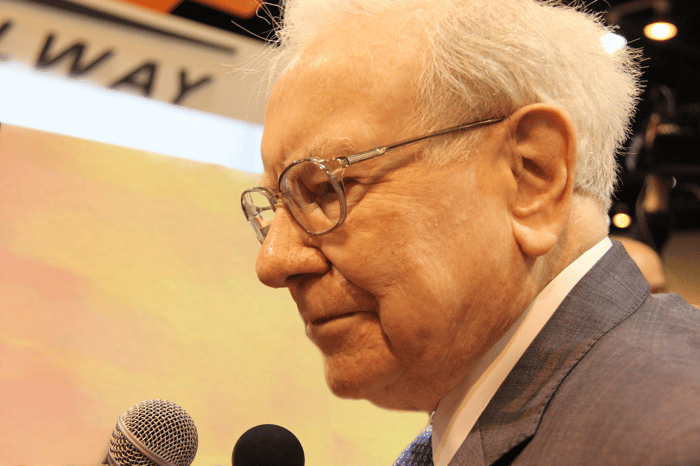
Image source: The Motley Fool.
Is a stock market crash coming in 2026?
Even Buffett can't predict the future, but he has successfully used valuation tools to gauge whether the market is overheating. One of these metrics is the ratio between U.S. GDP and the total value of all U.S. stocks, nicknamed the Buffett indicator.
Buffett used this indicator to forecast the tech bubble's burst in the early 2000s, as valuations soared amid excitement over dot-com companies. The metric spiked from around 60% in late 1994 to roughly 138% in early 2000, and after it peaked, stocks fell into a bear market that would last more than two years.
In a 2001 interview with Fortune magazine, Buffett explained how he used this indicator to predict a looming downturn.
"For me, the message of that chart is this: If the percentage relationship falls to the 70% or 80% area, buying stocks is likely to work very well for you," he said. "If the ratio approaches 200% -- as it did in 1999 and a part of 2000 -- you are playing with fire."
For most of the past two decades, the Buffett indicator has been steadily climbing. But it's now at a record high, surpassing 230% as of this writing.
How investors can prepare
To be clear, this doesn't necessarily mean that a market crash or recession is around the corner. The Buffett indicator has been consistently near or above 150% since 2018, and it's been over 200% for close to a year now.
If you had stopped investing as soon as the indicator started to climb into risky territory, you'd have missed out on tremendous growth over the past few years. The rise of the tech sector has also led to higher valuations in the past couple of decades, so it's tough to say whether Buffett's 200% benchmark still holds up in today's market landscape.
That said, it's wise to exercise caution when choosing investments. Many stocks are overvalued right now, and some may have uncertain futures if the market stumbles. A stock's price can still soar even if the company itself is on shaky foundations, and businesses that are more hype than substance may crumble under the pressure of a recession.
Now more than ever, it's crucial to ensure you're investing in quality stocks from healthy companies that can stand the test of time. If we do face a recession or bear market in 2026, these stocks are the most likely to not only survive, but thrive over time.
Where to invest $1,000 right now
When our analyst team has a stock tip, it can pay to listen. After all, Stock Advisor’s total average return is 990%* — a market-crushing outperformance compared to 206% for the S&P 500.
They just revealed what they believe are the 10 best stocks for investors to buy right now, available when you join Stock Advisor.
See the stocks »
*Stock Advisor returns as of May 21, 2026.
The Motley Fool has a disclosure policy.
Recommended Articles


