


Today’s Market Recap: U.S. Stocks Retreat Under Pressure of Surging Treasury Yields
Track the Market Trend
TradingKey - The S&P 500 (GSPC) fell 0.67% to 7,353.61, the Nasdaq Composite (IXIC) slid 0.84% to 25,870.71, and the Dow Jones Industrial Average (DJI) lost 0.65% to 49,363.88 as surging Treasury yields put pressure on markets.
Micron Technology (MU) and Sandisk (SNDK) gained despite a wider chip stock sell-off. Micron popped as key analysts increased their price targets for the stock. Nvidia (NVDA) and Advanced Micro Devices (AMD) slipped, weighing on tech benchmarks. Home Depot (HD) edged upwards on solid Q1 earnings. Walmart and Target both rose ahead of earnings due this week.
SoFi Technologies (SOFI), a digital financial services company that offers lending, investing, and banking, closed at $15.23, down 3.06%. The stock declined, along with major U.S. indexes, on concerns of conflict-related inflation and high Treasury yields.
Poet Technologies (POET) stock is pulling back again in Tuesday's trading. The company's share price fell 8% in the session and had been down as much as 16.8%. At the same point in the daily session, the S&P 500 was down 0.7%, and the Nasdaq Composite was down 0.9%.
Bond markets took center stage today as 10-year Treasury yields hit a 16-month high and the 30-year yield spiked to over 5.19%, the highest they’ve been in almost two decades. Oil prices fell slightly but remained around $100. Tightening financial conditions weighed on major indexes, pulling them back from recent highs.
Market Headline
Russian President Vladimir Putin arrived in Beijing on the evening of May 19. At the invitation of the Chinese President, Putin is conducting a state visit to China from May 19 to 20. The Ministry of Foreign Affairs stated that China welcomes President Putin's state visit, noting that China and Russia are comprehensive strategic partners of coordination for a new era.
The Ministry of Foreign Affairs announced that China and the U.S. have agreed to establish an intergovernmental dialogue on artificial intelligence. Foreign Ministry Spokesperson Guo Jiakun stated that as two major AI powers, China and the U.S. should work together to promote the development and governance of artificial intelligence, advancing AI to better serve human civilization and the common well-being of the international community. During President Trump's visit to China, the two heads of state held constructive exchanges on AI issues and agreed to initiate an intergovernmental dialogue on the matter.
Trump stated that the U.S. might "heavily strike" Iran again, noting he was once "only one hour away" from ordering an attack, while Iran declared its readiness to counter any military aggression. Trump said that whether a strike will happen remains uncertain, and he has given Iran a "limited time" of about two to three days, or potentially extended into early next week, to reach an agreement. Iran's Deputy Foreign Minister stated that surrender makes no sense for the Iranian side — they will either win or become martyrs. The Iranian military warned that if the enemy makes another miscalculation and launches another attack, Iran will utilize new tools and methods to open up new front lines.
The U.S. Vice President noted that "significant progress" has been made in U.S.-Iran negotiations. Vance stated that the U.S. negotiation team had previously engaged in long-term contact with the Iranian side, primarily focused on two goals: first, rebuilding direct communication channels between the two countries that had been disrupted for a long time; and second, establishing a foundation for subsequent formal negotiations. At the time, the negotiation team was not "highly confident" that an agreement could be reached quickly, but they believed they could take "a crucial step toward a deal," an objective that has now been achieved.
Bessent "admonished" Japan, stating that while Japan's economic fundamentals are strong, excessive currency volatility is undesirable. Bessent indicated that he held a dialogue with Bank of Japan Governor Kazuo Ueda earlier that day and expressed clear confidence in Ueda's successful guidance of Japan's monetary policy.
Google's I/O conference went "All in AI": introducing updates to its Gemini models, the largest redesign of its search bar in 25 years, the return of AI glasses, and the debut of the Spark agent. The AI glasses, developed in partnership with Samsung, will hit the market this autumn. Google also introduced a developer subscription plan priced at $100 per month and lowered the monthly fee for AI Ultra from $250 to $200.
Goldman Sachs' preview of Nvidia's earnings indicates a high probability that results will exceed expectations, though the market is focusing more on incremental growth opportunities beyond the "$1 trillion" guidance. Goldman Sachs expects Nvidia to deliver a "beat and raise" for the first quarter, upgrading its EPS forecasts for the next two years by approximately 12%. However, market focus has shifted from the earnings beat to incremental upside: whether the $100 billion data center revenue guidance will continue to be revised upward, whether Agentic AI can unlock a new growth curve for CPUs, and the release of demand from non-traditional clients. Goldman Sachs believes that improving cloud vendor profitability, Agentic AI penetration, and the onboarding of new clients will serve as key catalysts for valuation rerating.
Samsung Electronics shares briefly turned positive following reports that the labor union has softened its stance, raising the possibility of an agreement. The chairman of the National Labor Relations Commission of Korea stated that although a significant gap remains between the two sides, it has narrowed compared to Monday, and the possibility of reaching an agreement still exists. The Prime Minister of South Korea issued a warning over the weekend that if no progress is made in the negotiations, the government will initiate emergency arbitration procedures to legally halt the strike. Samsung Electronics shares wiped out an early session decline of 5.3% at one point before ultimately closing down nearly 2%.
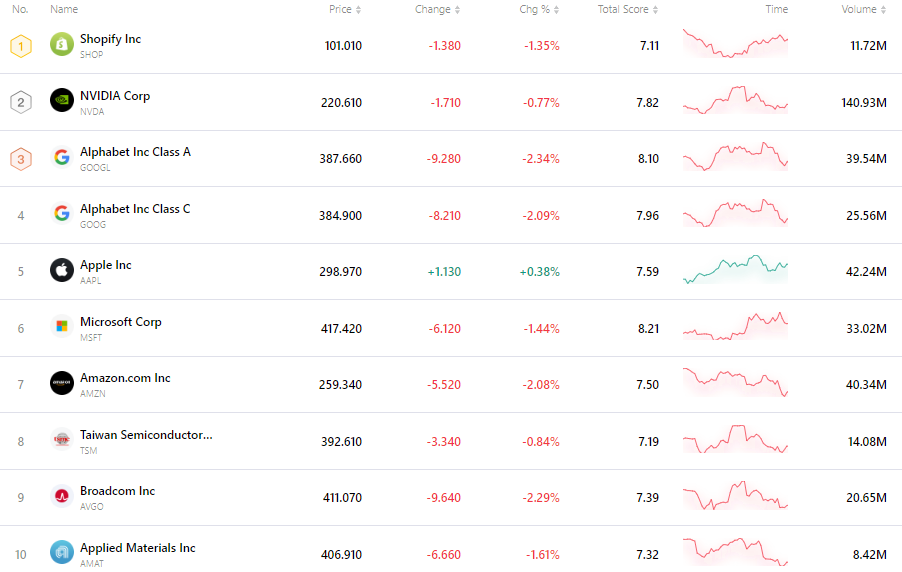
Top 10 Most Traded Stocks
The chart below lists the ten most actively traded stocks in the market last Friday. Bolstered by massive trading volume and exceptional liquidity, these assets have become key benchmarks for tracking global market dynamics.
Recommended Articles


