


Prediction: This Will Be Rigetti Computing's Stock Price in 1 Year
Key Points
Rigetti Computing makes some of the most capable quantum computers in the world, with its latest Cepheus-1-108Q system achieving a gate fidelity of 99.9%.
Nevertheless, even the best quantum computers on the market still make too many errors to reliably solve real-world problems, so commercialization is a huge challenge.
Wall Street expects Rigetti's revenue to soar in 2026, but its stock is so expensive that it appears vulnerable to a sharp decline.
- 10 stocks we like better than Rigetti Computing ›
Rigetti Computing (NASDAQ: RGTI) has built some of the most capable quantum computers on the market today. The company is unique because it does almost everything in-house, from fabricating its own quantum chips to developing its own quantum programming language, which means it can innovate faster than most of its competitors.
However, Rigetti stock is currently down 74% from its all-time high from last October. Unfortunately, while quantum computers hold a lot of promise in areas like science and cryptography, even the best systems still make too many errors to solve real-world problems. As a result, Rigetti's revenue hasn't grown as quickly as investors expected, which is why its stock is under so much pressure.
Will AI create the world's first trillionaire? Our team just released a report on the one little-known company, called an "Indispensable Monopoly" providing the critical technology Nvidia and Intel both need. Continue »
I think there might be even more downside ahead for this stock, because it remains incredibly expensive by one widely used valuation metric. Here's where I predict it will be one year from now.

Image source: Getty Images.
Commercialization is a long and tricky journey
Even the most powerful classical computers can only perform a limited number of operations at once. That's why developing advanced technologies like artificial intelligence (AI) requires enormous data centers filled with thousands of individual chips. Quantum computers, on the other hand, use a concept called superposition to simulate several solutions to a problem at the same time, making them better suited for data-intensive workloads.
Superposition is when a quantum bit (qubit) assumes a state of both 0 and 1 simultaneously, whereas classical computing bits are always in a state of either 0 or 1. When a quantum computer has multiple qubits in superposition, its ability to process more data than a classical computer grows exponentially.
But qubits are extremely unstable, so in most cases they can only maintain superposition for a matter of microseconds, and they are also prone to errors. Gate fidelity measures the accuracy of each quantum operation, with a higher reading translating to fewer errors.
Rigetti recently launched the industry's largest multichip quantum computer -- called Cepheus-1-108Q -- which boasts 108 qubits, tripling the scale of the company's previous Cepheus-1-36Q system. It has achieved a gate fidelity of 99.9% which sounds excellent, but it means the computer will still make one error in every 1,000 operations.
In most cases, that simply isn't good enough when trying to solve complex problems, so the company still has a lot of work to do.
Rigetti's revenue declined last year
Rigetti sells quantum computers directly to other companies, but it also leases quantum computing capacity to developers through its own cloud platform, and through third parties like Amazon Braket, which is the quantum division of Amazon Web Services.
Overall, Rigetti generated just $7.1 million in revenue during 2025, which was a 34% drop from the previous year. That isn't a lot of income for a company valued at $4.7 billion, but on a positive note, Wall Street expects Rigetti's revenue to more than triple to $22.5 million during 2026 (according to Yahoo! Finance). That still leaves the company with an extremely expensive valuation, but I'll explore this further in a moment.
Besides Rigetti's lumpy revenue, investors are also concerned about its steep losses. The company had $86.7 million in total operating expenses during 2025, with $61.3 million taken up by research and development alone. After factoring in non-operating liabilities, Rigetti's generally accepted accounting principles (GAAP) net loss came in at a whopping $216.2 million.
Large losses make investors uneasy, because it means the company will eventually need a cash infusion to fund its operations. That could mean debt financing (which comes with interest costs), or it could mean raising money from investors, which will dilute every existing shareholder and impact their long-term returns.
Rigetti ended 2025 with $589.8 million in cash and equivalents on its balance sheet, so fortunately it has plenty of time to either find more revenue or cut costs before it has to seek new sources of funding.
Rigetti stock could fall by over 50% in the next 12 months
Based on Rigetti's 2025 revenue of $7.1 million, and its market capitalization of $4.7 billion, its stock trades at a ludicrous price-to-sales (P/S) ratio of over 600. Even if we value the stock using Wall Street's 2026 revenue estimate of $22.5 million, its forward P/S ratio is still an eye-watering 210.
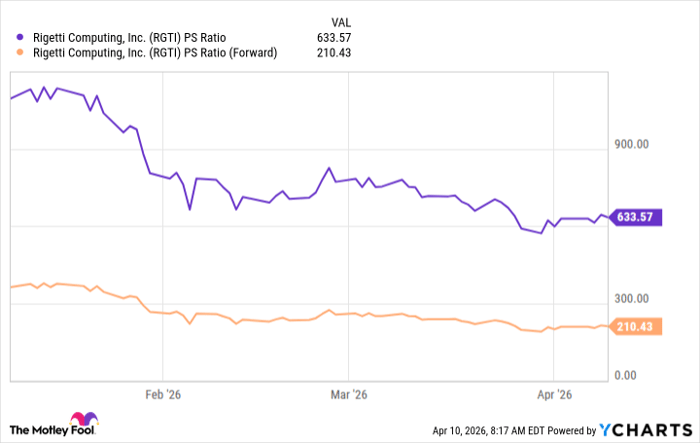
RGTI PS Ratio data by YCharts
For some perspective, Nvidia trades at a P/S ratio of 21.1, and it's one of the highest-quality companies in the entire world. Alphabet, which is developing quantum computers of its own, is even cheaper than Nvidia with a P/S ratio of just 9.7.
Mathematically speaking, Rigetti stock would have to plummet by 96% from here just to match Nvidia's P/S ratio. That would take the stock from its current price of $14.31 down to just $0.57.
I'm not suggesting that will happen, because there is still plenty of hype surrounding the quantum industry, and many investors truly believe Rigetti can capitalize its leadership position in the long run. But given its valuation, I think a decline of at least 50% would be justified over the next 12 months, which would take the stock to around $7 (or less).
Should you buy stock in Rigetti Computing right now?
Before you buy stock in Rigetti Computing, consider this:
The Motley Fool Stock Advisor analyst team just identified what they believe are the 10 best stocks for investors to buy now… and Rigetti Computing wasn’t one of them. The 10 stocks that made the cut could produce monster returns in the coming years.
Consider when Netflix made this list on December 17, 2004... if you invested $1,000 at the time of our recommendation, you’d have $555,526!* Or when Nvidia made this list on April 15, 2005... if you invested $1,000 at the time of our recommendation, you’d have $1,156,403!*
Now, it’s worth noting Stock Advisor’s total average return is 968% — a market-crushing outperformance compared to 191% for the S&P 500. Don't miss the latest top 10 list, available with Stock Advisor, and join an investing community built by individual investors for individual investors.
See the 10 stocks »
*Stock Advisor returns as of April 13, 2026.
Anthony Di Pizio has no position in any of the stocks mentioned. The Motley Fool has positions in and recommends Alphabet, Amazon, and Nvidia. The Motley Fool has a disclosure policy.
Recommended Articles


