


Best 2 Blue Chip Stocks to Buy After Last Week's Market Pullback
Key Points
Apple shares have slid by more than 5% since the Iran War began.
After an initial rise on Monday, Williams Companies shares have dropped.
Both companies have solid financials and plenty of cash to help them weather any periods of economic turmoil.
- 10 stocks we like better than Williams Companies ›
The Iran war set the markets back this past week, sending stocks in most sectors plummeting. In situations such as these, many investors sell first and ask questions later.
The conflict will likely have an impact on businesses, besides the obvious reactions such as oil price increases, a rush to safe-haven assets such as gold and silver, and a boost for defense industry stocks. However, many of the companies that saw their shares drop in the past week aren't likely to be that affected by the conflict. As a research report from Morgan Stanley pointed out, in the wake of similar geopolitical shocks, on average, the S&P 500 has been up by approximately 2% after one month, up 6% after six months, and up 8% after 12 months.
Will AI create the world's first trillionaire? Our team just released a report on the one little-known company, called an "Indispensable Monopoly" providing the critical technology Nvidia and Intel both need. Continue »
At moments like these, then, it makes sense to look at blue chip stocks -- such as Apple (NASDAQ: AAPL) and Williams Companies (NYSE: WMB) -- and see if the dip is worth buying. In my view, both of these stocks' recent downturns were likely overreactions.

Image source: Getty Images.
Why Apple is a blue chip stock
Apple, though it has only been a public company since 1980, is the ultimate blue chip stock. With a market cap of $3.85 trillion, it is the second-largest company in the world, behind only Nvidia. It has ample stability, with more than $35.9 billion in cash and short-term investments on its books, giving it enough of a cushion to weather any economic setback. While it is a growth stock, it has shown a commitment to dividend hikes and share buybacks. It has raised its dividend for 11 consecutive years, and it repurchased $24.7 billion worth of its stock in the first quarter of its fiscal 2026 alone.
Why Apple's recent setback is an overreaction
As of the close of trading Friday, Apple stock had fallen by almost 6% since Feb 26, compared to the S&P 500's fall of a little over 2.4% in that same period.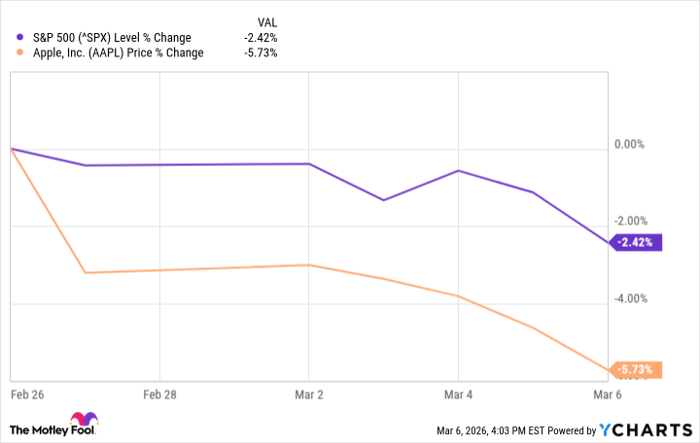
^SPX data by YCharts.
Obviously, as a vertically integrated technology lifestyle brand, Apple isn't that affected by oil prices, though a sustained downturn in the economy would hit its business, as it would nearly any consumer company.
In its fiscal 2026 first quarter, which ended Dec. 27, Apple delivered record revenue of $143.8 billion, up 16% year over year, while earnings per share (EPS) grew 19% to a record $2.84.
Apple has been criticized for its weak efforts in the artificial intelligence (AI) race, and particularly for its delays in rolling out AI enhancements to Siri, its virtual assistant. However, some are now thinking the company has been smart to not spend too much yet on AI.
Its flagship product, the iPhone, continues to defy expectations. During Apple's latest earnings call, CEO Tim Cook said that global demand for the iPhone remained "staggering," an assertion supported by its 23% year-over-year revenue growth and all-time sales records across every geographic region. Sales of the devices, driven by the successful rollout of the iPhone 17 family, accounted for 59% of Apple's total revenue.
The company is also working to expand its customer base by delivering some less-expensive products (at least, by Apple's standards), including the MacBook Neo, and the iPhone 17e, both of which are priced at $599.
Why Williams Companies is a blue chip stock
Though its market cap of $93 billion makes it far smaller than Apple, Williams Companies has a much deeper history, having been founded in 1908. It certainly is a blue chip within the energy and infrastructure sector, and has raised its dividends for eight consecutive years, including a 6% increase this year. At the current share price, it has a yield of around 2.7%.
Its natural gas infrastructure gives it stability because it leases its services through long-term, fee-based contracts. This gives it predictable cash flows, and because it is a midstream player, its profits are not particularly sensitive to changing oil prices.
Why its recent pullback is an overreaction
The Williams Companies' stock, after rising to $76.75 per share on Monday, closed at $74.22 on Friday. That 3.3% drop, though small, seems silly considering the company's long-term strength.
Williams Companies currently handles approximately one-third of the natural gas consumed in the United States. Its 33,000-mile pipeline network operates entirely within domestic borders, providing it with a natural hedge against President Donald Trump's tariffs. This geographic focus, paired with long-term service contracts, ensures a steady and dependable stream of cash flow that has supported 13 consecutive years of growth in adjusted earnings before interest, taxes, depreciation, and amortization (EBITDA).
The company's 2025 performance was particularly robust, with adjusted EBITDA rising 9% to $7.8 billion and total revenue climbing 13.7% to $11.9 billion. This financial strength translated to a 17.5% increase in EPS to $2.14, while the stock price is up by more than 23% so far this year. Much of this momentum was fueled by the rapid buildout of new data centers, which increasingly rely on natural gas power plants for electricity. Demand was further bolstered by a colder-than-usual winter across the eastern half of the U.S., which drove a significant spike in natural gas consumption for heating.
Williams continues to prioritize shareholder returns. It has paid out dividends for 52 consecutive years, and its distributions are covered 2.4 times by its adjusted funds from operations. This healthy coverage ratio not only underscores the safety of the current payout but also provides management with significant flexibility for future increases.
Should you buy stock in Williams Companies right now?
Before you buy stock in Williams Companies, consider this:
The Motley Fool Stock Advisor analyst team just identified what they believe are the 10 best stocks for investors to buy now… and Williams Companies wasn’t one of them. The 10 stocks that made the cut could produce monster returns in the coming years.
Consider when Netflix made this list on December 17, 2004... if you invested $1,000 at the time of our recommendation, you’d have $534,817!* Or when Nvidia made this list on April 15, 2005... if you invested $1,000 at the time of our recommendation, you’d have $1,123,912!*
Now, it’s worth noting Stock Advisor’s total average return is 964% — a market-crushing outperformance compared to 192% for the S&P 500. Don't miss the latest top 10 list, available with Stock Advisor, and join an investing community built by individual investors for individual investors.
See the 10 stocks »
*Stock Advisor returns as of March 7, 2026.
James Halley has positions in Apple, Nvidia, and Williams Companies. The Motley Fool has positions in and recommends Apple and Nvidia and is short shares of Apple. The Motley Fool has a disclosure policy.
Recommended Articles


