

Pi Network Price Forecast: Demand remains muted despite mainnet upgrade, weighing on price

Source Fxstreet
  • Pi Network extends losses on Tuesday, although it still holds above a descending support trendline. 
  • Pi Core Team announced the mainnet upgrade to the Stellar protocol version 21.
  • PiScan data shows a net outflow of over 600,000 PI tokens from exchanges in the past 24 hours, signaling reduced downside pressure.

Pi Network (PI) extends losses in its downside-leaning consolidation phase at press time on Tuesday, suggesting a persistent bearish pressure on the token. The Pi Core Team has announced the mainnet upgrade to the Stellar Protocol version 21, a step towards the planned version 22, although price has failed to react positively to the news. While on-chain data signals that downside pressure may be waning, the technical outlook remains bearish as the gradual but continued downtrend threats a key support trendline.

Selling pressure eases amid Pi mainnet upgrade 

The Pi Core Team announced the successful mainnet upgrade to Stellar protocol version 21, the underlying blockchain. The team also said that version 22, which is under development, will enable smart contract functionality on Pi Network and potentially expand its use cases.

https://x.com/PiCoreTeam/status/2043893104306971133

The selling pressure on Centralized Exchanges (CEXs) has eased amid the announcement of the mainnet upgrade and the broader market recovery. PiScan data shows CEXs recorded an outflow of 619,617 PI tokens over the last 24 hours, after an inflow of 1.92 million PI tokens on Monday. While this hasn't significantly impacted prices, consistent outflows could reduce the available supplyand ease easing the downside pressure. 
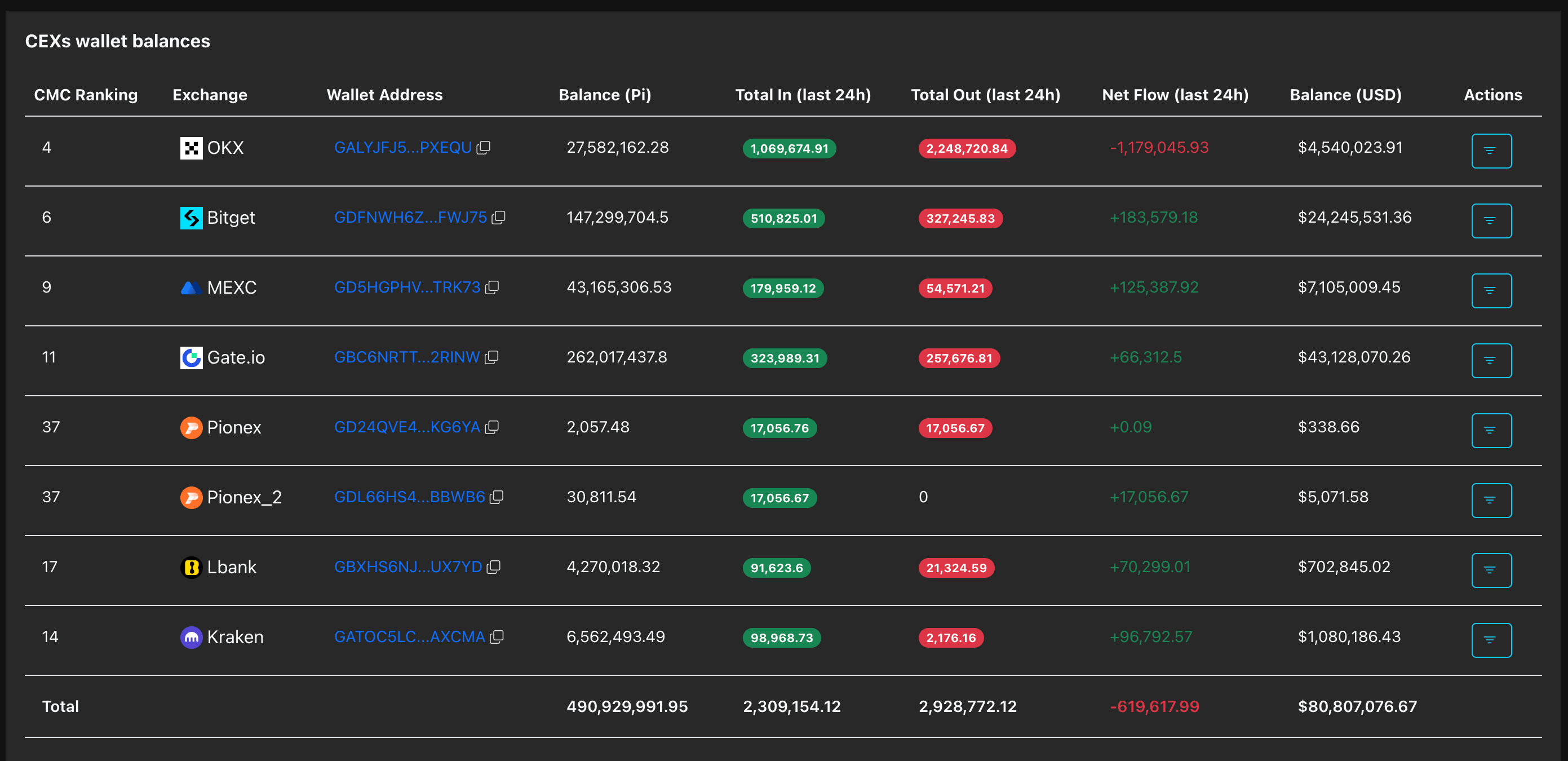
CEXs wallet balances data. Source: PiScan.

Technical outlook: Will Pi Network hold its ground?

Pi Network maintains a muted downside-tapering trend below the main 50-day Exponential Moving Average (EMA) at $0.1794, keeping a clear bearish near-term bias. The immediate support for PI lies at the descending trendline, which connects the March 18 and April 2 lows, near Monday's low at $0.1633. A decisive close below this level could boost the near-term decline toward the February 23 low at $0.1556.

Momentum indicators reinforce the broader bearish tone, as the Relative Strength Index (RSI) on the daily chart is at 39 and descending toward the oversold zone. Meanwhile, the Moving Average Convergence Divergence (MACD) histogram bars are contracting as average lines converge, suggesting the trend remains marginally bearish.

Chart Analysis PI/USD (baha Crypto)
PI/USD daily price chart.

On the topside, initial resistance aligns with the 50-day EMA at $0.1794, which guards a stronger barrier at the 100-day EMA around $0.1893.

(The technical analysis of this story was written with the help of an AI tool.)

Disclaimer: For information purposes only. Past performance is not indicative of future results.
placeholder
Bitcoin CME gaps at $35,000, $27,000 and $21,000, which one gets filled first?Prioritize filling the $27,000 gap and even try higher.
Author  FXStreet
Aug 22, 2023
Prioritize filling the $27,000 gap and even try higher.
placeholder
Pinduoduo Earnings Incoming: Morgan Stanley Sees Long-Term Profit Potential​Insights – On November 21, Chinese e-commerce giant Pinduoduo (PDD) will release its Q3 2024 earnings.
Author  Mitrade
Nov 20, 2024
​Insights – On November 21, Chinese e-commerce giant Pinduoduo (PDD) will release its Q3 2024 earnings.
placeholder
Elon Musk’s xAI and Neuralink Launch New Funding Rounds​Billionaire Elon Musk recently raised funds for his two high-profile tech companies, xAI and Neuralink.
Author  Insights
Jun 03, 2025
​Billionaire Elon Musk recently raised funds for his two high-profile tech companies, xAI and Neuralink.
placeholder
Bitcoin briefly loses 2025 gains as crypto plunges over the weekend.Bitcoin experienced a sharp decline this weekend, briefly erasing its 2025 gains and dipping below its year-opening value of $93,507. The cryptocurrency fell to a low of $93,029 on Sunday, representing a 25% drop from its all-time high in October. Although it has rebounded slightly to around $94,209, the pressures on the market remain significant. The downturn occurred despite the reopening of the U.S. government on Thursday, which many had hoped would provide essential support for crypto markets. This year initially appeared promising for cryptocurrencies, particularly after the inauguration of President Donald Trump, who has established the most pro-crypto administration thus far. However, ongoing political tensions—including Trump's tariff strategies and the recent government shutdown, lasting a historic 43 days—have contributed to several rapid price pullbacks for Bitcoin throughout the year. Market dynamics are also being influenced by Bitcoin whales—investors holding large amounts of Bitcoin—who have been offloading portions of their assets, consequently stalling price rallies even as positive regulatory developments emerge. Despite these sell-offs, analysts from Glassnode argue that this behavior aligns with typical patterns seen among long-term investors during the concluding stages of bull markets, suggesting it is not indicative of a mass exodus. Notably, Bitcoin is not alone in its struggles, as Ethereum and Solana have also recorded declines of 7.95% and 28.3%, respectively, since the start of the year, while numerous altcoins have faced even steeper losses. Looking ahead, questions linger regarding the viability of the four-year cycle thesis, particularly given the increasing institutional support and regulatory frameworks now in place in the crypto landscape. Matt Hougan, chief investment officer at Bitwise, remains optimistic, suggesting a potential Bitcoin resurgence in 2026 driven by the “debasement trade” thesis and a broader trend toward increased adoption of stablecoins, tokenization, and decentralized finance. Hougan emphasized the soundness of the underlying fundamentals, pointing to a positive outlook for the sector in the longer term.
Author  Mitrade
Nov 17, 2025
Bitcoin experienced a sharp decline this weekend, briefly erasing its 2025 gains and dipping below its year-opening value of $93,507. The cryptocurrency fell to a low of $93,029 on Sunday, representing a 25% drop from its all-time high in October. Although it has rebounded slightly to around $94,209, the pressures on the market remain significant. The downturn occurred despite the reopening of the U.S. government on Thursday, which many had hoped would provide essential support for crypto markets. This year initially appeared promising for cryptocurrencies, particularly after the inauguration of President Donald Trump, who has established the most pro-crypto administration thus far. However, ongoing political tensions—including Trump's tariff strategies and the recent government shutdown, lasting a historic 43 days—have contributed to several rapid price pullbacks for Bitcoin throughout the year. Market dynamics are also being influenced by Bitcoin whales—investors holding large amounts of Bitcoin—who have been offloading portions of their assets, consequently stalling price rallies even as positive regulatory developments emerge. Despite these sell-offs, analysts from Glassnode argue that this behavior aligns with typical patterns seen among long-term investors during the concluding stages of bull markets, suggesting it is not indicative of a mass exodus. Notably, Bitcoin is not alone in its struggles, as Ethereum and Solana have also recorded declines of 7.95% and 28.3%, respectively, since the start of the year, while numerous altcoins have faced even steeper losses. Looking ahead, questions linger regarding the viability of the four-year cycle thesis, particularly given the increasing institutional support and regulatory frameworks now in place in the crypto landscape. Matt Hougan, chief investment officer at Bitwise, remains optimistic, suggesting a potential Bitcoin resurgence in 2026 driven by the “debasement trade” thesis and a broader trend toward increased adoption of stablecoins, tokenization, and decentralized finance. Hougan emphasized the soundness of the underlying fundamentals, pointing to a positive outlook for the sector in the longer term.
placeholder
ECB Policy Outlook for 2026: What It Could Mean for the Euro’s Next MoveWith the ECB likely holding rates steady at 2.15% and the Fed potentially extending cuts into 2026, EUR/USD may test 1.20 if Eurozone growth proves resilient, but weaker growth and an ECB pivot could pull the pair back toward 1.13 and potentially 1.10.
Author  Mitrade
Dec 26, 2025
With the ECB likely holding rates steady at 2.15% and the Fed potentially extending cuts into 2026, EUR/USD may test 1.20 if Eurozone growth proves resilient, but weaker growth and an ECB pivot could pull the pair back toward 1.13 and potentially 1.10.
goTop
quote