


Mexican Peso tanks to 2-week low as Trump’s auto tariffs roil markets,
- Mexican Peso drops nearly 1% as traders brace for Banxico’s rate cut and digest US trade shock.
- Trump enacts 25% tariffs on all auto imports, hitting major suppliers like Mexico and spooking EM currencies.
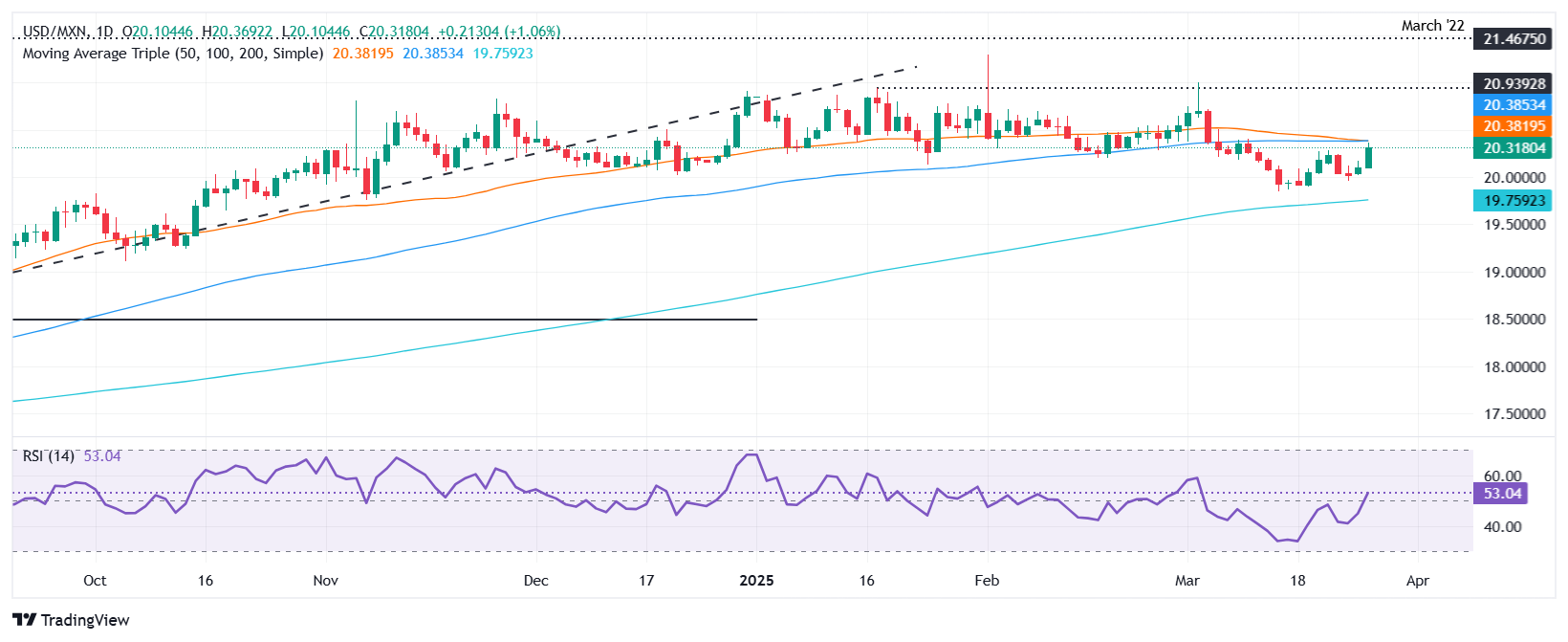
- USD/MXN surges to 20.36 as tariff fallout combines with looming 50 bps Banxico rate cut expectations.
The Mexican Peso is feeling the pain of tariffs, depreciating for the second consecutive day against the US Dollar after US President Donald Trump signed an executive order to apply tariffs on auto imports from all countries. The USD/MXN trades at 20.28, up almost 1%.
On Wednesday, Trump signed an executive order adding 25% duties on imported automobiles, effective on April 2. He said that he would announce additional tariffs next week.
In 2024, the US imported $474 billion worth of automotive products, including passenger cars valued at $220 billion. Mexico, Japan, South Korea, Canada and Germany were the biggest suppliers.
Hence, the Mexican Peso immediately plunged after the news late Wednesday but extended its losses during Thursday’s session with the USD/MXN hitting a two-week high of 20.36.
Traders brace for Banco de Mexico’s (Banxico) policy decision. Analysts expect a 50-basis-point (bps) rate cut due to the evolution of the disinflation process and forward guidance provided by the central bank. It should be noted that in February’s meeting, Banxico lowered rates in a 4-1 vote. Jonathan Heath was the dissenting vote, favoring a 0.25% cut.
Across the border, US economic data showed that the labor market remains solid as Initial Jobless Claims dipped compared to the previous reading in the week ending March 22. The final reading of the Gross Domestic Product (GDP) was within estimates, and Pending Home Sales improved in February, compared to the previous reading.
Ahead this week, the US schedule will feature the release of the Fed’s preferred inflation gauge, the core Personal Consumption Expenditures (PCE) Price Index.
Daily digest market movers: Mexican Peso drops ahead of Banxico’s meeting
- The Citi Expectations Survey indicates that private economists anticipate Banxico will reduce rates by 50 basis points in March with estimates suggesting Mexico’s primary reference rate will conclude 2025 at 8%, down from 8.25%.
- The same survey projects that inflation expectations are anchored in the high 3% range, while GDP is forecast to expand by 0.6%, down from 0.8% in the last survey.
- The USD/MXN is projected to finish at 20.98 in 2025, down from 21.00 in the last poll.
- US Initial Jobless Claims for the week ending March 22, increased below estimates of 225K, reaching 224K in the week ending March 22.
- US GDP for Q4 2024 final reading was confirmed at 2.3% QoQ (QoQ), up from 1.9%, slightly below estimates of 2.4%.
- Pending Home Sales dipped 3.6% YoY in February, although this improvement was compared to January’s 5.2% plunge.
- Traders had priced the Fed to ease policy by 64 basis points (bps) throughout the year, according to data from the Chicago Board of Trade.
USD/MXN technical outlook: Mexican Peso plunges as USD/MXN rises past 20.25
The USD/MXN uptrend resumed on Wednesday and extended into Thursday due to external shocks closely linked to the Mexican economy. The exotic pair is testing key resistance at the confluence of the 50-day and 100-day Simple Moving Averages (SMA) near 20.35/36. Momentum supports buyers as the Relative Strength Index (RSI) turned bullish.
Therefore, once that area is surpassed, the next stop would be the 20.50 psychological mark, ahead of testing the March 4 peak of 20.99, followed by the year-to-date (YTD) high of 21.28.
Conversely, the USD/MXN must drop below 20.20 for sellers to have a chance to drive the exchange rate toward the 20.00 figure. If hurdled, the next support would be the 200-day SMA at 19.72.
Mexican Peso FAQs
The Mexican Peso (MXN) is the most traded currency among its Latin American peers. Its value is broadly determined by the performance of the Mexican economy, the country’s central bank’s policy, the amount of foreign investment in the country and even the levels of remittances sent by Mexicans who live abroad, particularly in the United States. Geopolitical trends can also move MXN: for example, the process of nearshoring – or the decision by some firms to relocate manufacturing capacity and supply chains closer to their home countries – is also seen as a catalyst for the Mexican currency as the country is considered a key manufacturing hub in the American continent. Another catalyst for MXN is Oil prices as Mexico is a key exporter of the commodity.
The main objective of Mexico’s central bank, also known as Banxico, is to maintain inflation at low and stable levels (at or close to its target of 3%, the midpoint in a tolerance band of between 2% and 4%). To this end, the bank sets an appropriate level of interest rates. When inflation is too high, Banxico will attempt to tame it by raising interest rates, making it more expensive for households and businesses to borrow money, thus cooling demand and the overall economy. Higher interest rates are generally positive for the Mexican Peso (MXN) as they lead to higher yields, making the country a more attractive place for investors. On the contrary, lower interest rates tend to weaken MXN.
Macroeconomic data releases are key to assess the state of the economy and can have an impact on the Mexican Peso (MXN) valuation. A strong Mexican economy, based on high economic growth, low unemployment and high confidence is good for MXN. Not only does it attract more foreign investment but it may encourage the Bank of Mexico (Banxico) to increase interest rates, particularly if this strength comes together with elevated inflation. However, if economic data is weak, MXN is likely to depreciate.
As an emerging-market currency, the Mexican Peso (MXN) tends to strive during risk-on periods, or when investors perceive that broader market risks are low and thus are eager to engage with investments that carry a higher risk. Conversely, MXN tends to weaken at times of market turbulence or economic uncertainty as investors tend to sell higher-risk assets and flee to the more-stable safe havens.
Recommended Articles


