

NY Fed Survey of Consumers shows households bracing for higher prices

Source Fxstreet

The New York Fed's September Survey of Consumers revealed that American households expect short-term inflation to rise, while in the long term, they expect prices to cool but remain above the Federal Reserve’s 2% goal.

Inflation expectations for the one-year ahead rose to their highest level since May 2023, from 3.6% to 3.9% in September. For three years, Americans expect a rise in prices from 3.2% to 3.3%, and for five years and beyond, at 3%, unchanged.

Digging into the report, inflation expectations rose due to c. Regarding labour market expectations, they mostly remained positive

About perceptions and expectations about households' financial situation, the New York Fed wrote that “both deteriorated, with larger shares of households reporting a worse financial situation compared to a year ago and expecting a worse financial situation a year from now.”
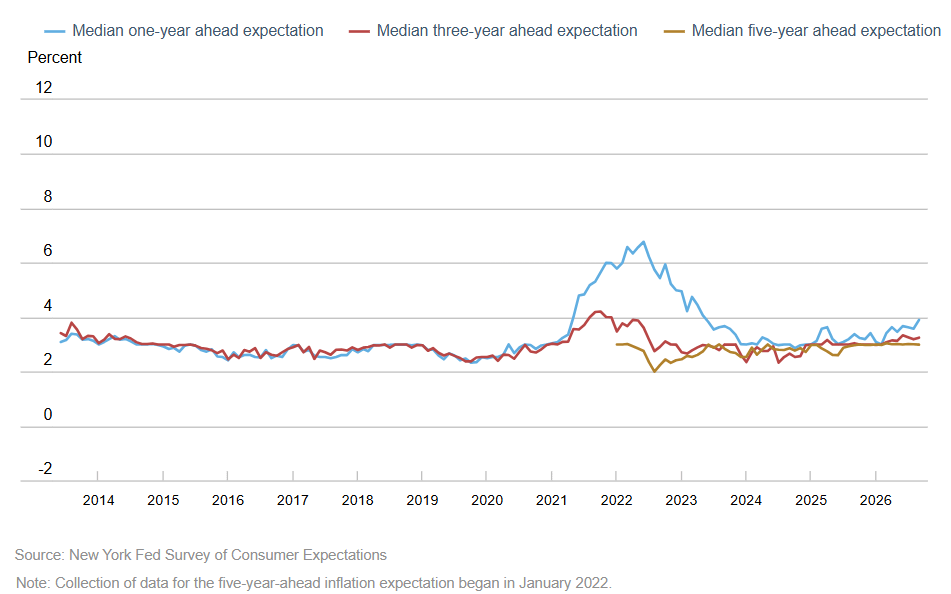
NY Fed Inflation Expectations Chart - Source: NY Fed

Fed FAQs

Monetary policy in the US is shaped by the Federal Reserve (Fed). The Fed has two mandates: to achieve price stability and foster full employment. Its primary tool to achieve these goals is by adjusting interest rates. When prices are rising too quickly and inflation is above the Fed’s 2% target, it raises interest rates, increasing borrowing costs throughout the economy. This results in a stronger US Dollar (USD) as it makes the US a more attractive place for international investors to park their money. When inflation falls below 2% or the Unemployment Rate is too high, the Fed may lower interest rates to encourage borrowing, which weighs on the Greenback.

The Federal Reserve (Fed) holds eight policy meetings a year, where the Federal Open Market Committee (FOMC) assesses economic conditions and makes monetary policy decisions. The FOMC is attended by twelve Fed officials – the seven members of the Board of Governors, the president of the Federal Reserve Bank of New York, and four of the remaining eleven regional Reserve Bank presidents, who serve one-year terms on a rotating basis.

In extreme situations, the Federal Reserve may resort to a policy named Quantitative Easing (QE). QE is the process by which the Fed substantially increases the flow of credit in a stuck financial system. It is a non-standard policy measure used during crises or when inflation is extremely low. It was the Fed’s weapon of choice during the Great Financial Crisis in 2008. It involves the Fed printing more Dollars and using them to buy high grade bonds from financial institutions. QE usually weakens the US Dollar.

Quantitative tightening (QT) is the reverse process of QE, whereby the Federal Reserve stops buying bonds from financial institutions and does not reinvest the principal from the bonds it holds maturing, to purchase new bonds. It is usually positive for the value of the US Dollar.

Disclaimer: For information purposes only. Past performance is not indicative of future results.
placeholder
Gold Price Forecast: XAU/USD retraces gains and nears two-month lows at $4,104Gold (XAU/USD) retraces Tuesday’s gains on Wednesday and resumes its broader bearish trend, with the US Dollar (USD) appreciating across the board, as investors brace for the release of the minutes of the latest Federal Reserve (Fed) meeting.
Author  FXStreet
13 hours ago
Gold (XAU/USD) retraces Tuesday’s gains on Wednesday and resumes its broader bearish trend, with the US Dollar (USD) appreciating across the board, as investors brace for the release of the minutes of the latest Federal Reserve (Fed) meeting.
placeholder
WTI rises to near $89.50 as Middle East supply threats offset Persian Gulf recoveryWest Texas Intermediate (WTI) oil price extends its gains for the second successive day, trading around $89.50 per barrel during the Asian hours on Wednesday. Crude oil climbed as persistent risks to Middle East energy flows overshadowed signs of rising supply from the region.
Author  FXStreet
21 hours ago
West Texas Intermediate (WTI) oil price extends its gains for the second successive day, trading around $89.50 per barrel during the Asian hours on Wednesday. Crude oil climbed as persistent risks to Middle East energy flows overshadowed signs of rising supply from the region.
placeholder
AUD/USD Price Forecast: Struggles to return to 0.7000 amid firm US DollarThe Australian Dollar (AUD) gives back its early gains after rising to near 0.6975 and turns marginally lower at around 0.6964 against the US Dollar (USD) during the European trading session on Tuesday.
Author  FXStreet
Yesterday 08: 58
The Australian Dollar (AUD) gives back its early gains after rising to near 0.6975 and turns marginally lower at around 0.6964 against the US Dollar (USD) during the European trading session on Tuesday.
placeholder
Japanese Yen drifts lower as sustained USD buying offsets intervention fearsThe USD/JPY pair attracts some buyers following the previous day's two-day price moves, trading above the 158.00 mark during the early part of the European session on Tuesday.
Author  FXStreet
Yesterday 07: 53
The USD/JPY pair attracts some buyers following the previous day's two-day price moves, trading above the 158.00 mark during the early part of the European session on Tuesday.
placeholder
Gold holds steady below $4,150 amid elevated US yields Gold price (XAU/USD) trades on a flat note near $4,140 during the early Asian session on Tuesday. Pressure from a stronger US Dollar (USD) and elevated US Treasury yields was offset by reduced expectations of a Federal Reserve (Fed) rate hike this month.
Author  FXStreet
Yesterday 01: 14
Gold price (XAU/USD) trades on a flat note near $4,140 during the early Asian session on Tuesday. Pressure from a stronger US Dollar (USD) and elevated US Treasury yields was offset by reduced expectations of a Federal Reserve (Fed) rate hike this month.
goTop
quote