


United States Dollar Index surrenders opening gains as AI risks continue to weigh
- The US Dollar opened higher due to French fiscal risks, but gives back gains amid AI risks.
- French bond yields surge to 4.85% amid social unrest over rising cost of living.
- The uncertainty regarding the continuation of AI investment keeps the US Dollar under pressure.
The US Dollar (USD) turns almost flat after giving back its opening gains, driven by rallying bond yields in France. Social unrest in France on the back of rising cost of living had resulted in some improvement in the safe-haven appeal of the US Dollar; however, it failed to capitalizes on it further due to continued Artificial Intelligence (AI) concerns.
In the Asian trade on Monday, the US Dollar Index (DXY), which tracks the Greenback’s value against six major currencies, trades flat at around 101.80 after retreating from its intraday high of 102.01. 10-year yields on French bonds are up 1.55% to near 4.85%. French bond yields are not so far from its over two-decade high of 5% posted earlier this month.
French President Emmanuel Macron condemned on Sunday "shocking" scenes of violence on the sidelines of protests over the cost of living in a televised address to the nation, a day after France suffered one of its worst days of unrest in years, Reuters reported. These protests have further spread to Lisbon and Milan.
The US Dollar fails to hold onto the relief as AI stocks continue to face pressure amid uncertainty regarding the continuation of the investment cycle in the sector.
Dollar’s AI tailwind seen as emerging vulnerability in US-centric risk-off shocks
Strategists at OCBC highlight that AI-linked investment has become a key support for the US macro and market story, noting that “AI has supported US growth, equities, yields and the USD.” However, they caution that “that strength cuts both ways.” If the investment cycle cools, “those same supports could reverse, leaving the Dollar vulnerable even in a risk-off environment.”
OCBC stresses that “the USD does not always benefit from risk aversion.” When the shock is US-centric, “as with the recent AI financing jitters, pressure on US assets can overwhelm the USD’s traditional safe-haven appeal.” This is significant, they argue, because “AI has become an important pillar of US growth resilience.”
In FX terms, OCBC describes “an unusual combination: risk-off, lower Treasury yields and a softer USD.” They emphasise that “this is not the typical global risk-off shock where investors simply rush into USD.” Instead, “if the source of stress is US-centric, Treasury safe-haven demand can push yields lower even as weaker US asset returns reduce the relative appeal of the USD.”
For now, OCBC views “the latest AI jitters as a bump rather than a break in the broader investment story.” While “concerns look overdone, but they are far from over,” the episode is seen as “a useful reminder for FX.” As they conclude, “the more the USD benefits from AI-driven US growth resilience on the way up, the more exposed it becomes if that support starts to fade.”
On the monetary policy front, traders remain confident that the Federal Reserve (Fed) will keep interest rates steady in the policy meeting later this month, according to the CME FedWatch tool. The likelihood of the Fed leaving interest rates unchanged elevated after several officials indicated that there is no urgency for another interest rate hike.
US Dollar Index Technical Analysis
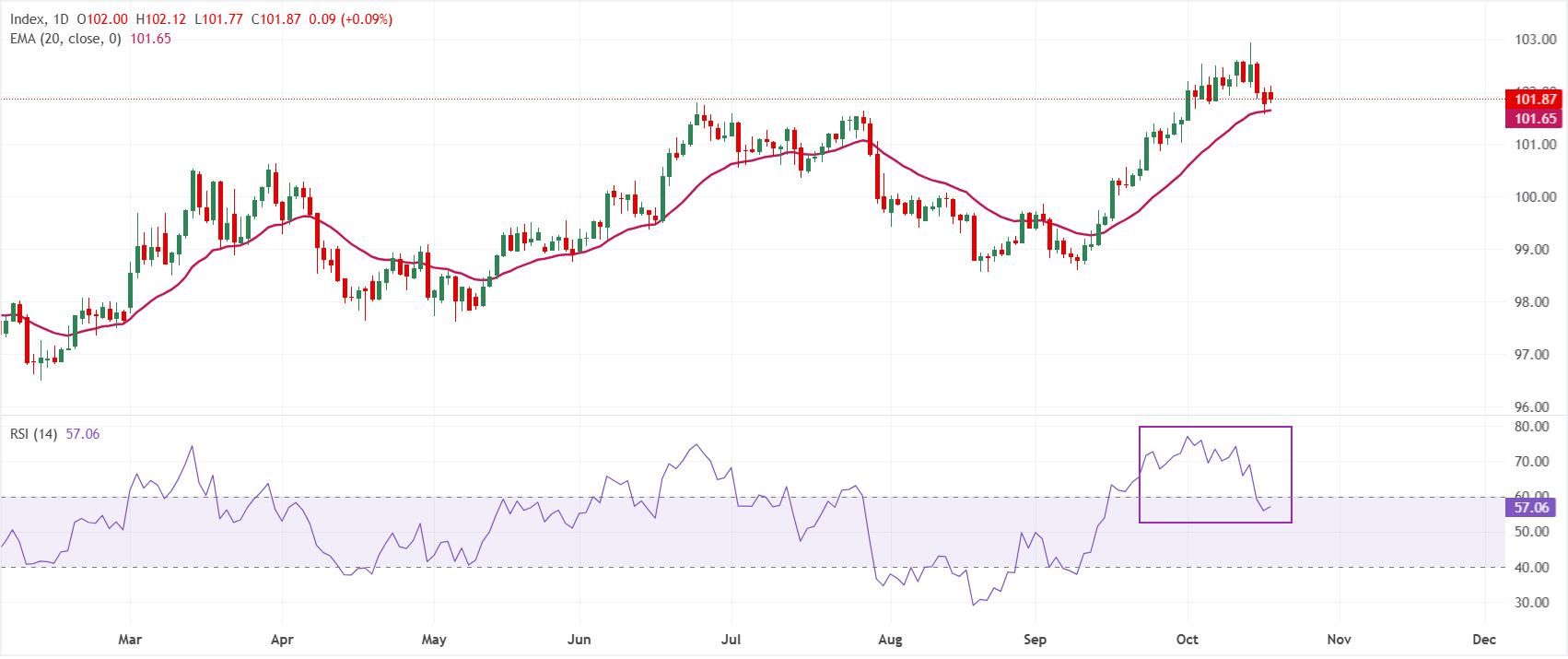
In the daily chart, Dollar Index Spot trades at 101.87, holding above its 20-day exponential moving average (EMA) at 101.65 and preserving a constructive short-term bullish bias. The price action remains supported by this rising EMA, while the Relative Strength Index (RSI) at 57 stays above the neutral 50 line, suggesting ongoing positive momentum rather than overbought conditions.
On the downside, initial support is located at the 20-day EMA near 101.65, where a clear break would signal fading bullish pressure and open the way for a deeper corrective pullback. As long as the index defends this moving average on closing bases, the broader outlook favors dip-buying interest, with scope for the advance to extend while momentum holds in positive territory.
(The technical analysis of this story was written with the help of an AI tool. Know more.)
US Dollar FAQs
The US Dollar (USD) is the official currency of the United States of America, and the ‘de facto’ currency of a significant number of other countries where it is found in circulation alongside local notes. It is the most heavily traded currency in the world, accounting for over 88% of all global foreign exchange turnover, or an average of $6.6 trillion in transactions per day, according to data from 2022. Following the second world war, the USD took over from the British Pound as the world’s reserve currency. For most of its history, the US Dollar was backed by Gold, until the Bretton Woods Agreement in 1971 when the Gold Standard went away.
The most important single factor impacting on the value of the US Dollar is monetary policy, which is shaped by the Federal Reserve (Fed). The Fed has two mandates: to achieve price stability (control inflation) and foster full employment. Its primary tool to achieve these two goals is by adjusting interest rates. When prices are rising too quickly and inflation is above the Fed’s 2% target, the Fed will raise rates, which helps the USD value. When inflation falls below 2% or the Unemployment Rate is too high, the Fed may lower interest rates, which weighs on the Greenback.
In extreme situations, the Federal Reserve can also print more Dollars and enact quantitative easing (QE). QE is the process by which the Fed substantially increases the flow of credit in a stuck financial system. It is a non-standard policy measure used when credit has dried up because banks will not lend to each other (out of the fear of counterparty default). It is a last resort when simply lowering interest rates is unlikely to achieve the necessary result. It was the Fed’s weapon of choice to combat the credit crunch that occurred during the Great Financial Crisis in 2008. It involves the Fed printing more Dollars and using them to buy US government bonds predominantly from financial institutions. QE usually leads to a weaker US Dollar.
Quantitative tightening (QT) is the reverse process whereby the Federal Reserve stops buying bonds from financial institutions and does not reinvest the principal from the bonds it holds maturing in new purchases. It is usually positive for the US Dollar.
Recommended Articles


