


Dow Jones futures tick higher as easing Middle East tensions boost market sentiment
- Dow Jones futures advance as Trump canceled planned strikes on Iran, easing immediate concerns over oil supplies and inflation.
- Iranian leadership rejected Trump's negotiation offer, refusing to permit a second corridor in the Strait of Hormuz.
- Tech stocks led Monday's Wall Street rally, with Amazon hitting a $3 trillion market capitalization.
Dow Jones futures rise 0.17% to trade around 53,430 during European hours on Tuesday. Meanwhile, S&P 500 futures gain 0.23% to trade near 7,650, while Nasdaq 100 futures advance 0.68%, trading near 29,090.
US stock futures tick higher as investor sentiment got a boost from easing geopolitical tensions. The market rallied after President Donald Trump canceled planned military strikes against Iran in favor of reviving negotiations. This decision helped alleviate immediate concerns surrounding oil supply disruptions, rising inflation, and the broader outlook for interest rates.
However, diplomatic friction remains high. President Trump characterized his offer for talks as a "last chance" following the called-off military action. Iranian leadership quickly dismissed the proposal, with General Mohsen Rezaei, an advisor to Iran's Supreme Leader, rejecting the conditions outright and asserting that Iran will not permit a second corridor in the Strait of Hormuz.
Despite the back-and-forth, Wall Street kicked off the week on a high note, propelled by falling crude prices and a powerful rally in heavyweight technology shares. During Monday’s regular trading session, the tech-heavy Nasdaq Composite surged 2.13%, while the S&P 500 and the Dow Jones Industrial Average advanced 1.48% and 1.32%, respectively.
Megacap tech stocks led the charge, highlighted by Amazon soaring 4.6% to cross the $3 trillion market capitalization threshold for the first time. Investor attention now shifts toward the next wave of corporate earnings due Tuesday, featuring reports from major names including SpaceX, AMD, Caterpillar, Merck, and McDonald’s.
Williams reiterates confidence in Fed path as markets test hawkish resolve
Fed’s Williams delivers a moderately hawkish message, with a 6/10 FXS Speechtracker score slightly above the 5.8/10 historical average, underscoring confidence that current rate policy is “well positioned” to achieve 2% inflation. The repeated emphasis on acting if inflation drifts off the 2% path, strong support for the latest FOMC decision, and a firm commitment to price stability signal a willingness to tighten further if needed, even as optimism about gradually easing inflation and a cooling impact from Middle East tensions tempers the tone. Acknowledgment of market pricing as “valuable information” but not binding, alongside dismissal of financial stability risks from AI investment, reinforces a stance that keeps the Fed’s reaction function clearly data-dependent and somewhat above the established baseline in hawkishness.
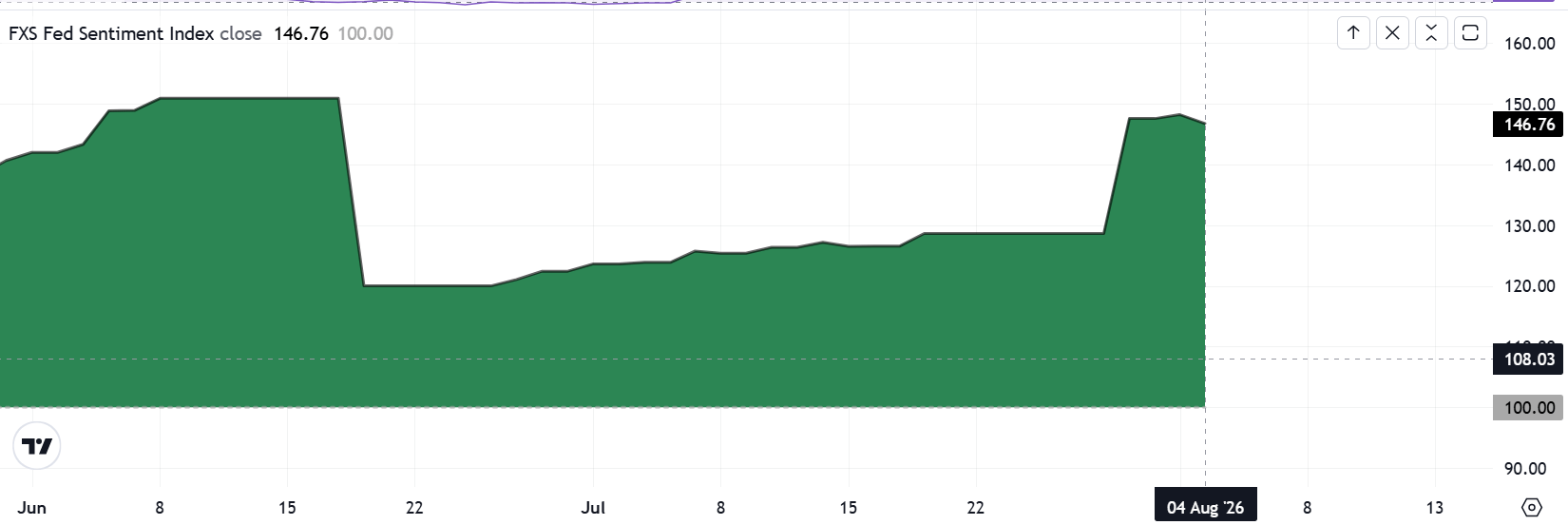
The FXS Fed Sentiment Index fell by 1.47 points to 146.76, indicating a modest pullback in perceived hawkishness despite remaining firmly in hawkish territory above the 100 neutral line. This suggests that while the speech is still clearly restrictive in tone, markets see a slightly less aggressive path for the Dollar relative to recent Fed communications, consistent with the balanced but vigilant stance reflected in the FXS Speechtracker score.
Dow Jones FAQs
The Dow Jones Industrial Average, one of the oldest stock market indices in the world, is compiled of the 30 most traded stocks in the US. The index is price-weighted rather than weighted by capitalization. It is calculated by summing the prices of the constituent stocks and dividing them by a factor, currently 0.152. The index was founded by Charles Dow, who also founded the Wall Street Journal. In later years it has been criticized for not being broadly representative enough because it only tracks 30 conglomerates, unlike broader indices such as the S&P 500.
Many different factors drive the Dow Jones Industrial Average (DJIA). The aggregate performance of the component companies revealed in quarterly company earnings reports is the main one. US and global macroeconomic data also contributes as it impacts on investor sentiment. The level of interest rates, set by the Federal Reserve (Fed), also influences the DJIA as it affects the cost of credit, on which many corporations are heavily reliant. Therefore, inflation can be a major driver as well as other metrics which impact the Fed decisions.
Dow Theory is a method for identifying the primary trend of the stock market developed by Charles Dow. A key step is to compare the direction of the Dow Jones Industrial Average (DJIA) and the Dow Jones Transportation Average (DJTA) and only follow trends where both are moving in the same direction. Volume is a confirmatory criteria. The theory uses elements of peak and trough analysis. Dow’s theory posits three trend phases: accumulation, when smart money starts buying or selling; public participation, when the wider public joins in; and distribution, when the smart money exits.
There are a number of ways to trade the DJIA. One is to use ETFs which allow investors to trade the DJIA as a single security, rather than having to buy shares in all 30 constituent companies. A leading example is the SPDR Dow Jones Industrial Average ETF (DIA). DJIA futures contracts enable traders to speculate on the future value of the index and Options provide the right, but not the obligation, to buy or sell the index at a predetermined price in the future. Mutual funds enable investors to buy a share of a diversified portfolio of DJIA stocks thus providing exposure to the overall index.
Recommended Articles


