


SanDisk Earnings Preview: Wall Street Bets on Continued AI Storage Boom With Highest Price Target of $3,050
TradingKe - SanDisk ( SNDK) will release its fiscal fourth-quarter and full-year 2026 results after the U.S. market close on August 5. The market will use this to assess whether the growth cycle driven by AI data center investments, rising NAND prices, and tight supply can continue.
Ahead of this earnings release, SanDisk's stock has just undergone a sharp correction. Although data center storage demand remains strong, investors in July concentrated on reducing their holdings in AI and storage chip stocks that had previously posted large gains, leading to a cumulative decline of approximately 47% for SanDisk during the month. Under these circumstances, the earnings results and the outlook for the new fiscal year will directly influence the market's assessment of the sustainability of the company's growth.
Market Expectations Higher Than SanDisk Official Guidance
SanDisk expects fourth fiscal quarter revenue to be between $7.75 billion and $8.25 billion. Calculated based on the $8.0 billion midpoint of the guidance, revenue will grow by approximately 34% quarter-over-quarter, representing an increase of over 320% compared to the $1.9 billion in the same period last year.
In terms of profitability, the company expects non-GAAP diluted earnings per share to be $30 to $33, far higher than the $0.29 in the same period last year; the non-GAAP gross margin is expected to reach 79% to 81%, sitting at a rarely seen high level in the memory chip industry.
Wall Street's expectations even exceed the company's guidance. While statistics from different data platforms vary slightly, the current market consensus is roughly for revenue of $8.3 billion to $8.4 billion and adjusted EPS of $34 to $35. This means investors are looking for SanDisk's actual revenue to break through the upper limit of its guidance, rather than simply meeting management's targets.
The elevated expectations also increase the risk of post-earnings volatility. Even if the fourth fiscal quarter results maintain rapid growth, the stock price could still come under pressure if the gross margin fails to reach the upper end of the range, or if management provides a relatively cautious outlook for fiscal year 2027.
AI Data Centers Remain the Core Growth Driver
The most critical metric to watch for the fourth fiscal quarter remains data center revenue. As hyperscalers expand AI infrastructure, the usage of enterprise SSDs in model training, inference, and data processing continues to increase, driving up demand for high-capacity NAND products.
Compared with the training stage, AI inference requires frequent access to large volumes of data. Since applications like KV Cache, Retrieval-Augmented Generation (RAG), and AI Agents need to balance capacity, speed, and cost, enterprise SSDs may consequently take on more data caching and storage tasks.
SanDisk currently covers high-performance applications through TLC enterprise SSDs and is utilizing the Stargate platform to expand high-capacity QLC products. If cloud service providers increasingly adopt architectures that transfer KV Cache from DRAM or HBM to SSDs, demand for enterprise NAND could be further amplified.
In the third fiscal quarter, data center revenue reached $1.47 billion, soaring 645% year-over-year and growing 233% quarter-over-quarter; edge business revenue grew 295% to $3.66 billion; while consumer business revenue grew 44% year-over-year, it experienced a slight decline quarter-over-quarter.
Investors will focus on whether the data center business continues to maintain high growth in the fourth fiscal quarter, and whether the average selling price (ASP) can remain strong. If enterprise SSD demand continues to expand, high gross margin levels are expected to be further solidified.
However, this path remains uncertain; if AI enterprises continue to keep more caching tasks in DRAM and HBM, the incremental demand captured by enterprise SSDs may fall below market expectations.
NAND Prices and Long-Term Contracts Determine Margin Sustainability
Due to the highly cyclical nature of the memory industry, product prices and profit margins typically decline rapidly when suppliers engage in concentrated capacity expansion or end-market demand slows. To mitigate this volatility, SanDisk is promoting a new business model centered around multi-year customer partnerships.
To date, the company has signed five long-term agreements. These contracts typically feature a mechanism combining fixed and floating pricing, alongside stronger purchase commitments, which help stabilize NAND prices and margins. Therefore, the market will closely monitor management's latest updates regarding contract coverage for fiscal year 2027, capacity planning, and its partnership with Kioxia.
Wall Street Maintains Bullish View on SanDisk Following Stock Pullback
Following a sharp prior rally, SanDisk's stock price pulled back by approximately 47% cumulatively in July, marking its worst monthly performance since it re-listed as an independent company in 2025.
The market generally believes that this correction stems primarily from a cooling of the core AI trade, profit-taking, and investor concerns over high valuations in the storage industry, future capacity release, and the sustainability of AI capital expenditures.
However, Wall Street remains optimistic about the company's long-term growth thesis. Although Susquehanna analyst Mehdi Hosseini lowered the price target from $3,250 to $3,050, he still maintained a "Buy" rating.
He noted that the price target adjustment mainly reflects revisions to the earnings forecast model and some remaining uncertainty over which storage architecture will ultimately be adopted in the AI inference era.
Looking at the market consensus, the overall sentiment among analysts remains positive. According to TipRanks statistics, of the 12 analysts covering SanDisk, 10 rate it as a "Buy." The core logic behind the market's bullish outlook remains unchanged, including AI infrastructure construction continuing to drive enterprise storage demand, NAND supply remaining relatively tight, and long-term supply agreements helping to enhance revenue visibility and mitigate industry cyclicality.
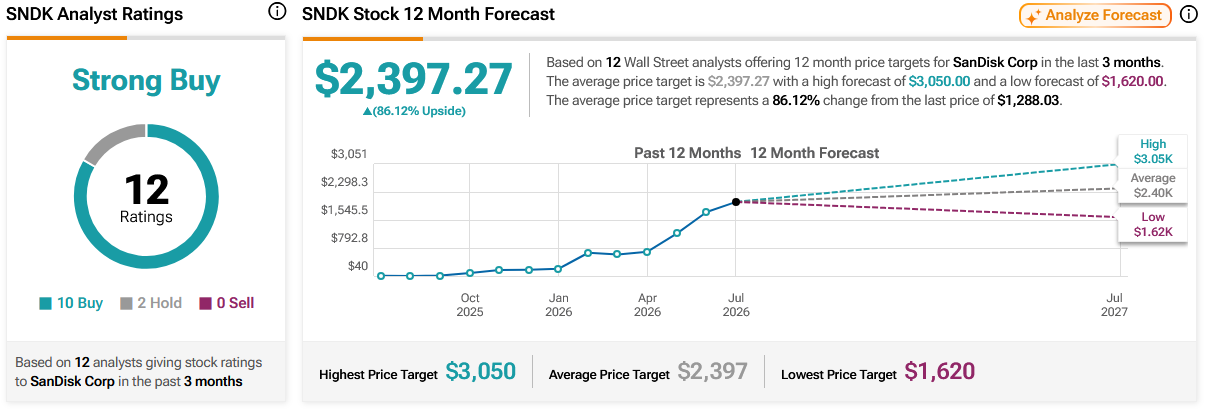
Source: TipRanks
Recommended Articles


