


3 Magnificent ETFs I'm Buying Hand Over Fist in 2026
Key Points
Investing in the S&P 500 is akin to investing in the broader U.S. economy.
The Schwab U.S. Dividend Equity ETF has strict criteria for company inclusion, ensuring quality.
The "Magnificent Seven" stocks account for over 38% of the Invesco Nasdaq 100 ETF.
- 10 stocks we like better than Vanguard S&P 500 ETF ›
Investing in ETFs is the best route for many investors because they take a lot of the hassle out of investing. They can provide instant diversification, reduce the risk that comes with investing in individual stocks, and you don't have to sacrifice returns.
I hold a handful of ETFs in my portfolio, but three in particular that I'm consistently investing in are the Vanguard S&P 500 ETF (NYSEMKT: VOO), the Schwab U.S. Dividend Equity ETF (NYSEMKT: SCHD), and the Invesco Nasdaq 100 ETF (NASDAQ: QQQM). Investing in all three gives you exposure to a foundational index, a blue chip dividend ETF, and a thriving growth ETF.
Where to invest $1,000 right now? Our analyst team just revealed what they believe are the 10 best stocks to buy right now, when you join Stock Advisor. See the stocks »
Image source: Getty Images.
1. The Vanguard S&P 500 ETF
VOO can be a foundation for most portfolios because it's essentially banking on the growth of the U.S. economy. It tracks around 500 of the largest U.S. companies, so although it doesn't represent the entire U.S. economy, those companies contribute a lot.
Over the past few years, VOO has become more concentrated in tech stocks than usual, but it still holds stocks from every major sector.
- Information Technology: 38%
- Financials: 11.8%
- Communication Services: 9.7%
- Consumer Discretionary: 9.3%
- Healthcare: 8.9%
- Industrials: 8.8%
- Consumer Staples: 4.6%
- Energy: 3%
- Utilities: 2.2%
- Materials: 1.8%
- Real Estate: 1.8%
After returning 24.3%, 23.4%, and 16.4% in 2023 through 2025, this year has been relatively modest for VOO, which is up 9.3% as of the start of August. Even so, those are respectable returns and position VOO for a fourth straight year of double-digit gains.
We can't predict how any stock or ETF will perform, but even if VOO hits a rough patch, it's an ETF I load up on for the long haul. The S&P 500 has stood the test of time and proven to be one of the best ways to build wealth over time.
2. Schwab U.S. Dividend Equity ETF
SCHD is my go-to dividend ETF because of its focus on high-quality companies. To be included, a company must have 10 years of dividend payouts, five years of dividend increases, and solid financial standing. That reduces the chance of running into a yield trap.
SCHD is also a switch-up from the tech-leaning S&P 500 and Nasdaq-100 ETFs, reducing some overlap with other popular funds. Its most represented sectors are healthcare (20.72%), consumer staples (20.38%), energy (14.07%), industrials (11.55%), and financials (10.05%).
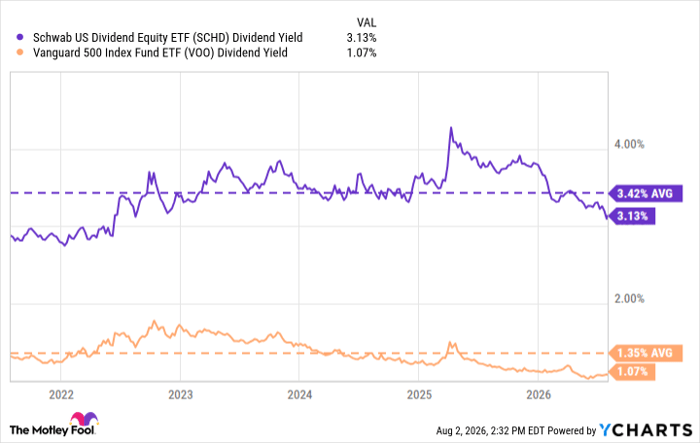
These sectors are known for stable cash flows and shareholder-friendly practices, which have helped SCHD maintain an attractive dividend. Its current yield is around 3.1%, slightly below its 3.4% average over the past five years, but nearly triple that of an S&P 500 ETF like VOO.
SCHD Dividend Yield data by YCharts
This year, investors have been rotating into more value-leaning stocks, and SCHD is reaping the rewards. It's up 20.7% year-to-date, which is far from the norm but a much-appreciated two-for-one. It's a great income option this year and beyond.
3. Invesco Nasdaq 100 ETF
QQQM mirrors the Nasdaq-100, which tracks the largest 100 non-financial companies on the Nasdaq stock exchange. It contains only large-cap growth stocks, so you get the potential for high growth mixed with the stability that often comes with large-cap stocks.
That doesn't make QQQM immune to high volatility or down periods, but holding market leaders helps cushion the blow and supports longevity.
QQQM only just began trading in October 2020, but has been a consistent market outperformer since. It has averaged 15.8% annual returns compared with the S&P 500's 14% average over that span. Over the past decade, the Nasdaq-100 has outperformed the S&P 500 495% to 245%.
Although it holds companies from all non-financial sectors, QQQM is also tech-heavy, with the sector making up 65.75% of the ETF. This means there's a decent amount of overlap with VOO, but QQQM's performance is much more reliant on large-cap tech stocks. The "Magnificent Seven" stocks account for just over 38% of the ETF.
VOO is meant to provide broad U.S. exposure, and SCHD is meant as an income source, so adding a growth-focused ETF like QQQM is a great complement to the two.
Should you buy stock in Vanguard S&P 500 ETF right now?
Before you buy stock in Vanguard S&P 500 ETF, consider this:
The Motley Fool Stock Advisor analyst team just identified what they believe are the 10 best stocks for investors to buy now… and Vanguard S&P 500 ETF wasn’t one of them. The 10 stocks that made the cut could produce monster returns in the coming years.
Consider when Netflix made this list on December 17, 2004... if you invested $1,000 at the time of our recommendation, you’d have $386,727!* Or when Nvidia made this list on April 15, 2005... if you invested $1,000 at the time of our recommendation, you’d have $1,232,139!*
Now, it’s worth noting Stock Advisor’s total average return is 906% — a market-crushing outperformance compared to 208% for the S&P 500. Don't miss the latest top 10 list, available with Stock Advisor, and join an investing community built by individual investors for individual investors.
See the 10 stocks »
*Stock Advisor returns as of August 4, 2026.
Stefon Walters has positions in Vanguard S&P 500 ETF. The Motley Fool has positions in and recommends Vanguard S&P 500 ETF. The Motley Fool has a disclosure policy.
Recommended Articles


