


Ripple CTO David Schwartz addresses concerns over declining XRPL activity
Ripple’s chief technology officer, David Schwartz, addressed some concerns over the XRP Ledger’s declining on-chain activity and its perceived lack of adoption, against the backdrop of 30% to 40% drop in XRPL usage reported in this year’s first quarter.
On Wednesday, YouTuber and crypto commentator Andrei Jikh asked several questions about Ripple’s operations, citing the lack of significant on-chain volume despite the company’s 300+ bank partnerships and 13-year tenure in business.
In a long post on X, Jikh asked why XRP has yet to show billions in daily on-chain transactions. He also raised concerns about XRP’s use case, particularly if volatile digital assets like XRP are better than stablecoins in payments, and whether Ripple’s infrastructure, which he claimed was US-based, can be trusted by international financial institutions.
Schwartz attempts to cool down Ripple distrust talks
Responding to Jikh’s questions, Ripple CTO David Schwartz admitted that the XRPL has witnessed a slow pace of on-chain adoption. According to Schwartz, one of the main reasons for the subdued XRPL activity is the institutional preferences for using digital assets off-chain.
“Even Ripple can’t use the XRPL DEX for payments yet because we can’t be sure a terrorist won’t provide the liquidity for a payment,” Schwartz stated. “Features like permissioned domains will address this.”
When asked why XRP would be used for transfers over more stable assets, Schwartz reckoned that some use cases actually benefit from volatility. He explained that a bridge currency requires market participants to hold it for liquidity purposes and efficient asset conversions when needed.
“A bridge currency only works if someone is holding it so that you can get it precisely when you need it,” he said. Schwartz added that in situations where the next required asset isn’t known, users might hold a dominant bridge asset like XRP to facilitate future trades more efficiently.
Stablecoins, tokenization on XRPL
Jikh also questioned the relevance of bridge currencies in a future where banks are moving towards stablecoins. Schwartz noted that no single stablecoin could dominate the global market due to jurisdictional and regulatory fragmentation.
“If one stablecoin wins, then no. You would just use that stablecoin as the bridge currency. But I don’t think one stablecoin can win for several reasons…If we’re in a multi-stablecoin world, it still makes sense to have a bridge asset that serves the long tail of tokenized securities, loan portfolios, and so on.”
On the issue of blockchain tokenization preference among institutions, Schwartz propounded that interoperability and scalability on networks, like Circle has implemented with USDC, are more valuable than exclusive infrastructure.
“Why don’t they launch USDC only on their own blockchain? You can see why that’s obviously silly. I think the same kind of logic will apply to tokenized real-world assets over the next year or two.”
Ripple’s Q1 report, released in May 2025, revealed a 30% to 40% decline in both wallet creation and transaction volume in the first quarter.
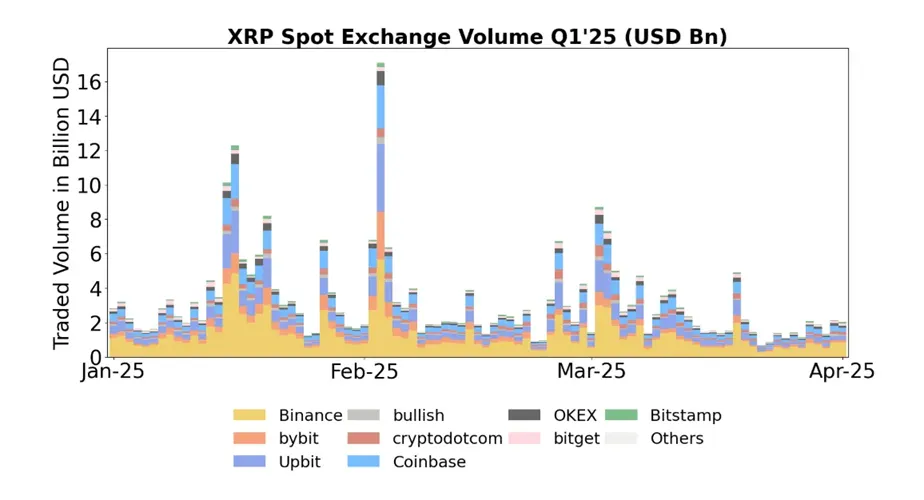
However, the report did not provide absolute figures for the drop, leaving some within the crypto community unsure about the transparency of Ripple’s disclosures and the actual health of the XRPL ecosystem.
XRPL is not centralized
On the topic of foreign countries’ reluctance to use a US-based private company for payments, Schwartz clarified that Ripple’s enterprise payment products do fall under various local jurisdictions, but the XRPL itself is not a centralized, US-controlled network.
While questions surrounding Ripple’s business model and the XRPL’s functionality continue, XRP is showing signs of technical weakness on the charts after falling 2.6% in the past week, now trading at $3.15.
The token’s support zones now sit at $2.92, $2.83, and $2.80, with the potential for a decline if bulls fail to fend off bears at those price levels. A deeper pullback is likely to happen should the market break below the $2.80 threshold.
Want your project in front of crypto’s top minds? Feature it in our next industry report, where data meets impact.
Recommended Articles


