Fed October Meeting Preview: Rate Cuts to Break 4% and an Earlier End to QT

Mitrade
coverImg
Source: DepositPhotos

TradingKey - At the Federal Reserve meeting ending Wednesday, October 29, policymakers are widely expected to follow through on the rate-cutting path outlined in the September Summary of Economic Projections — delivering a 25-basis-point rate cut, the second of 2025. Simultaneously, with bank reserves falling sharply and liquidity risks rising, the Fed may officially end Quantitative Tightening (QT).

Rate Cut Almost Certain — First Sub-4% Since 2022

Wall Street consensus expects the FOMC to lower its target interest rate by 25 bps, bringing it to a range of 3.75%–4.00% — the first time below 4% since late 2022.

According to CME FedWatch Tool data as of October 27:

  • Probability of a 25-bp cut: 96.7%

  • No bets on larger cuts

  • Odds of another 25-bp cut in December: ~96%
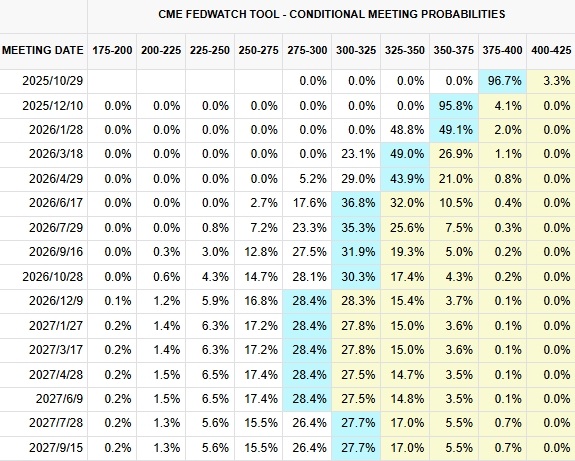
cme-fed-rate-cut-fedwatch-tool

Fed Rate Expectations, Source: CME

This aligns with the September dot plot, where most officials projected two 25-bp cuts this year, citing slowing economic activity and rising downside risks to employment — despite inflation still above target.

Shutdown-Era Data: Mild Inflation, Weak Jobs

The U.S. government shutdown has now entered its fifth week, with no clear end in sight as Democrats and Republicans continue clashing over Medicaid and other spending issues.

Despite the impasse, the Bureau of Labor Statistics (BLS) managed to release the September CPI report — a surprisingly soft read that supports further easing.

Key highlights:

  • Headline CPI YoY: Rose to 3.0% from 2.9%, but below the 3.1% forecast

  • Core CPI YoY: Dropped to 3.0% from 3.1% — the lowest since June

  • Monthly CPI: +0.3%, below expected and prior 0.4%

While much of the moderation came from volatile Owners’ Equivalent Rent (OER), the report still delivered positive news for dovish investors.

Nick Timiraos, Wall Street Journal reporter, noted that the September CPI weakens the case for hawkish resistance to rate cuts in October or December. He added that the data could reinforce a gradual, dovish stance at future meetings.

Employment signals were also weak. The ADP report showed a surprise loss of 32,000 private-sector jobs in September — the largest decline since March 2023 — versus an expected gain of 50,000.

Hawkish Voices Fade

Among the 19 officials who provided interest rate forecasts last month, eight projected two rate cuts within the year, while six anticipated no further rate reductions this year, indicating that a significant portion of policymakers do not view a December rate cut as necessary.

But recent developments have weakened this hawkish push.

Michael Feroli, Chief Economist at JPMorgan, said that while some officials want to signal that a December cut isn’t guaranteed, leadership may view such messaging as too aggressive.

With major uncertainties still looming — including Trump’s tariff threats, prolonged government shutdown, and geopolitical tensions — clarity remains elusive.

Earlier in October, Trump threatened to impose 100% tariffs on Chinese imports starting November 1, though these are likely to be withdrawn during the upcoming U.S.-China summit on October 30.

B Riley Wealth warned that a record-long government shutdown could pose real risks to growth.

Deutsche Bank noted that these headwinds may lead Chair Jerome Powell to keep options open rather than commit to a specific rate path.

Will QT End This Month?

Beyond rate cuts, a major focus is whether the Fed will officially end Quantitative Tightening (QT).

To normalize liquidity after pandemic-era balance sheet expansion, the Fed has been shrinking its holdings via QT. But now, excess liquidity is drying up:

  • Overnight Reverse Repo (ON RRP) usage has plummeted

  • Bank system reserves have declined for eight consecutive weeks

To avoid a repeat of the 2019 repo market crisis, ending QT is becoming urgent.

Months ago, Wall Street expected QT to end by year-end or early 2026. Now, with reserve levels falling faster than expected, Bank of America, JPMorgan, and TD Securities expect the Fed to announce the end of balance sheet runoff this month.

The Fed’s balance sheet has shrunk from a peak of $9 trillion two years ago to around $6.6 trillion. Analysts warn that if reserves fall further, it could trigger volatility in money markets.

Bank of America said that if signs of funding stress emerge, the Fed will prioritize ending QT to stabilize reserve supply and market expectations.

For markets, while rate cuts have historically boosted equities, the 25-bp cut is already fully priced in. Investors are now watching closely for any signal that QT will end — and possibly even reverse.

Barclays stated that the most market-moving outcome would be an immediate end to QT — coupled with signals of direct Treasury purchases to replenish bank reserves.

Read more

  • Spot Gold Breaches Four Key Levels, Putting $3,500 at Risk as Technicals Enter Oversold Alert Zone
  • * The content presented above, whether from a third party or not, is considered as general advice only.  This article should not be construed as containing investment advice, investment recommendations, an offer of or solicitation for any transactions in financial instruments.

    goTop
    quote
    Related Articles
    placeholder
    Core CPI stuck at 0.3% for a third straight month — and BLS couldn't publish the number that would explain itOctober headline CPI rose 0.4% m/m against a 0.3% consensus, and core rose 0.3% for a third consecutive month against 0.2% expected. BLS published no year-on-year figures because October 2025 collection was lost to the government shutdown. Energy cooled to 0.7% from 5.2% — shelter, food and transport services did the rest. The 2-year yield jumped 18 to 21 basis points, the 10-year added 12, and the dollar closed at 102.25.
    Author  Irene Q.
    Nov 11, Wed
    October headline CPI rose 0.4% m/m against a 0.3% consensus, and core rose 0.3% for a third consecutive month against 0.2% expected. BLS published no year-on-year figures because October 2025 collection was lost to the government shutdown. Energy cooled to 0.7% from 5.2% — shelter, food and transport services did the rest. The 2-year yield jumped 18 to 21 basis points, the 10-year added 12, and the dollar closed at 102.25.
    placeholder
    China's factories are pricing in 5.7%. Its shoppers are pricing in 0.7%.China's October PPI rose 5.7% year on year, the fastest since June 2022, while CPI slowed to 0.7% and core CPI to 0.8%. Input prices rose faster than factory-gate prices, squeezing mid-stream margins by roughly five percentage points. The Hang Seng fell 0.13% on a day the S&P 500 rose 2.35%, the only major market to sit out the risk-on session.
    Author  Irene Q.
    Nov 10, Tue
    China's October PPI rose 5.7% year on year, the fastest since June 2022, while CPI slowed to 0.7% and core CPI to 0.8%. Input prices rose faster than factory-gate prices, squeezing mid-stream margins by roughly five percentage points. The Hang Seng fell 0.13% on a day the S&P 500 rose 2.35%, the only major market to sit out the risk-on session.
    placeholder
    The CPI that has no year-over-year number is the one that decides DecemberOctober CPI lands on Nov 10 at 13:30 GMT, and it will be published without a year-over-year figure: BLS never collected October 2025 prices during the federal shutdown. Consensus is +0.3% headline and +0.2% core month-on-month, against +0.6% and +0.3% in September. With December hike odds at 77%, the month-on-month print is now the whole story, and $4,197–4,202 on gold and 4.86% on the 10-year are the levels that price it.
    Author  Irene Q.
    Nov 09, Mon
    October CPI lands on Nov 10 at 13:30 GMT, and it will be published without a year-over-year figure: BLS never collected October 2025 prices during the federal shutdown. Consensus is +0.3% headline and +0.2% core month-on-month, against +0.6% and +0.3% in September. With December hike odds at 77%, the month-on-month print is now the whole story, and $4,197–4,202 on gold and 4.86% on the 10-year are the levels that price it.
    placeholder
    The Fed will sit still on October 28 — but 100 of 100 economists now expect a December hikeA Reuters poll run October 16-20 found 94 of 100 economists expecting the Fed to hold at 3.75-4.00% on October 28 — and all 100 expecting a hike in December, against less than half a month earlier. The market is close to the same price, with CME FedWatch at roughly 17% for October and 82.8% for December. With the Fed in blackout since October 17, here are the five dates that decide the rest of the year, what each one is priced for, and the two directions each can take.
    Author  Irene Q.
    Oct 22, Thu
    A Reuters poll run October 16-20 found 94 of 100 economists expecting the Fed to hold at 3.75-4.00% on October 28 — and all 100 expecting a hike in December, against less than half a month earlier. The market is close to the same price, with CME FedWatch at roughly 17% for October and 82.8% for December. With the Fed in blackout since October 17, here are the five dates that decide the rest of the year, what each one is priced for, and the two directions each can take.
    placeholder
    Housing starts fell to the second-lowest since the pandemic shutdown — with the 10-year at 5.12%, who is left to buy?US housing starts dropped 5.2% to 1.221 million in September, the second-lowest pace since the 2020 pandemic shutdown, and building permits hit a three-and-a-half-year low of 1.400 million. Both figures are worse than they look because July and August were revised up. With the 10-year Treasury at 5.117% — only 19bp below its October 5 peak of 5.311% — and the NAHB builder confidence index at 2012 levels, here are the three numbers, the transmission chain from rates to permits, and the two scenarios into the October 28 FOMC.
    Author  Irene Q.
    Oct 21, Wed
    US housing starts dropped 5.2% to 1.221 million in September, the second-lowest pace since the 2020 pandemic shutdown, and building permits hit a three-and-a-half-year low of 1.400 million. Both figures are worse than they look because July and August were revised up. With the 10-year Treasury at 5.117% — only 19bp below its October 5 peak of 5.311% — and the NAHB builder confidence index at 2012 levels, here are the three numbers, the transmission chain from rates to permits, and the two scenarios into the October 28 FOMC.
    Live Quotes
    Name / SymbolChart% Change / Price
    XAUUSD
    XAUUSD
    0.00%0.00
    USDOLLAR-F
    USDOLLAR-F
    0.00%0.00