

Aave adds Coinbase tokenized stocks as loan collateral

Source Cryptopolitan

Aave now has a dedicated vault using several of the leading tokenized stocks by Coinbase. The vault has immediately attracted liquidity in the days since its launch. 

Aave is carrying a lending vault in its V4 hub on the Base chain, using selected Coinbase tokenized equities as collateral. As Cryptopolitan reported earlier, Aave’s V4 tools aim to tap traditional finance and bring Wall Street activity to existing chains.

The vault accepts tokenized Apple (AAPL), Amazon (AMZN), Google (GOOG), Meta (META), Microsoft (MSFT), Nvidia (NVDA, and Tesla (TSLA). In exchange, users can receive USDC loans to be used as DeFi liquidity or for further trading.
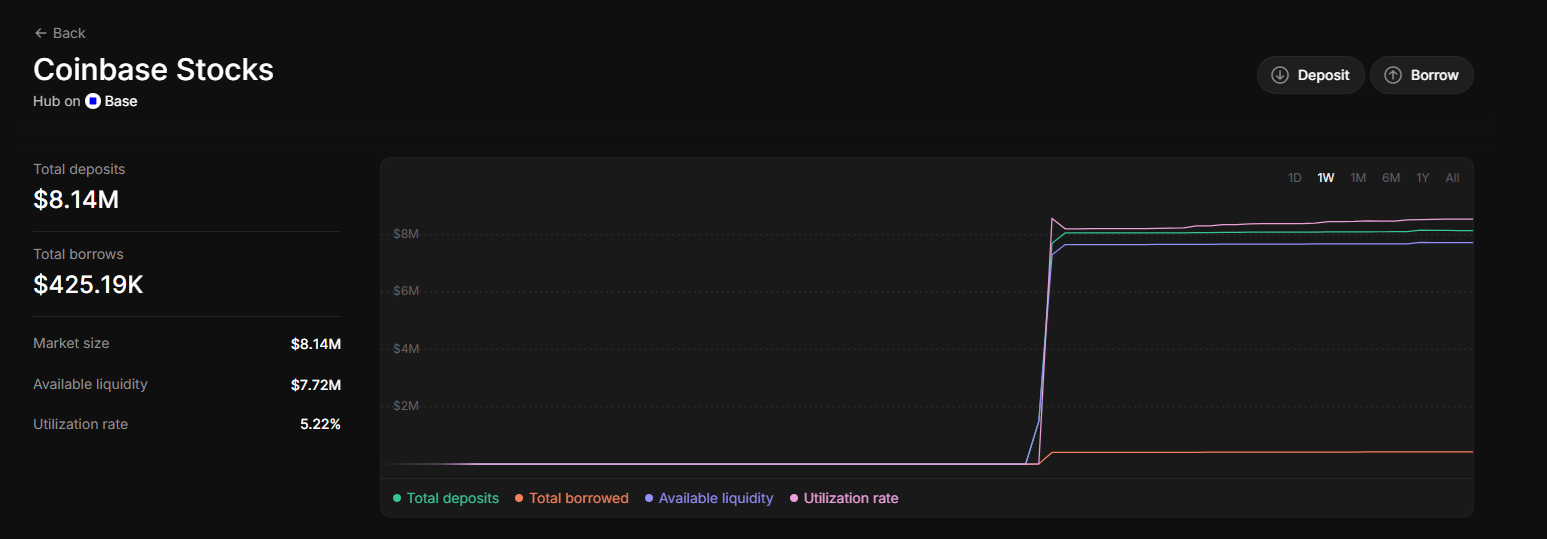
Aave onboards Coinbase tokenized stocks as collateral
The Aave V4 vault based on tokenized Magnificent 7 tech equities immediately attracted collateral, but lending remained at a relatively low utilization rate. | Source: Aave

There is still no standard for using tokenized equities in DeFi. Currently, only Morpho uses curated vaults based on selected Coinbase equities. The vaults are curated by Steakhouse and Chipwork, offering variable-rate USDC loans.

The vault already holds $8.14M in value based on current Coinbase tokenized valuations. For now, the lending utilization is relatively low at 5%. Only around $495K in loans has been issued from the vault. Aave’s goal is to offer much easier access to equity-backed loans, a process that is longer and more involved in traditional finance. 

Most of the Magnificent 7 stocks have made double-digit gains in the past month, with the exception of AMZN. The launch arrives just as markets are showing an upward trend again, and US equities are bringing the S&P500 close to new records. 

Will Aave be able to set the right price?

The problem with tokenized equities as collateral is that the Coinbase token price is supplied based on official stock trading. The Chainlink oracles do not update during the weekend, meaning loan collateral cannot be priced the same as crypto-based loans. 

Stani Kulechov, the founder of Aave, explained Aave’s approach to balancing its lending vault. 

‘We measure the volatility properties of an asset, set liquidation thresholds against the bad debt buffer the market is prepared to defend, and calibrate a liquidation bonus that incentivizes to profitably clear liquidatable positions before the price can travel past the safety margin,’ explained Kulechov in an X post.

The approach is similar to the way Aave handles crypto volatility and prevents liquidations. The goal is to avoid loan liquidations, even if the underlying stocks receive negative news over the weekend. 

In the case of tokenized shares on Coinbase, the actual assets are held with Alpaca Securities LLC, a regulated broker-dealer. The custodian will not lend or move the shares in any way, and they only serve to back the traded tokens. 

In the case of dividends, they will be reinvested and not paid out. Token holders will just have a claim on a growing number of shares. 

AAVE trades near three-year peak

The addition of stocks as collateral arrives as Aave increased its relevance in the DeFi space. The recovery of ETH and the expansion of tokenized asset trading boosted demand for lending. 

Aave recovered its total value locked to over $19B, the highest level since the hack of Kelp DAO. The protocol achieves over $5M in monthly earnings.  

Aave carries over $13B in tokenized loans, most of which use ETH as their main collateral. Most loans are denominated in USDT and USDC. 

As a result, AAVE tokens trade close to their three-month peak and near the upper range for 2026. AAVE traded around $148.08, with $255M in daily volume. AAVE open interest fluctuates around $233M, after a recent drop of 9% following liquidations. 

If you're reading this, you’re already ahead. Stay there with our newsletter.

Disclaimer: For information purposes only. Past performance is not indicative of future results.
placeholder
October hike odds climb toward 60% as Goldman and BofA both flip — what Warsh's "dose of accommodation" really changedRate futures now price roughly 55% to 62% for a 25bp hike at the October 27-28 FOMC, up from about 30% before Chair Warsh's post-meeting framing that the Fed is merely "removing some accommodation." Goldman Sachs has added an October hike to its forecast and Bank of America now sees moves in both October and December. Here is the repricing, the language behind it, and the two data points that decide it.
Author  Irene Q.
Sep 23, Wed
Rate futures now price roughly 55% to 62% for a 25bp hike at the October 27-28 FOMC, up from about 30% before Chair Warsh's post-meeting framing that the Fed is merely "removing some accommodation." Goldman Sachs has added an October hike to its forecast and Bank of America now sees moves in both October and December. Here is the repricing, the language behind it, and the two data points that decide it.
placeholder
Memory chips surge, Nasdaq notches a second straight record close — why the Dow fell 185 points anywayMicron gained 5%, SanDisk 6.8%, Seagate 4% and Western Digital 3% as the memory complex led the Nasdaq Composite to a second consecutive record close of 27,244.28. But the Dow fell 185 points as JPMorgan, Wells Fargo and Schwab slid more than 3% each — a split tape that says more about positioning than about the economy.
Author  Irene Q.
Sep 23, Wed
Micron gained 5%, SanDisk 6.8%, Seagate 4% and Western Digital 3% as the memory complex led the Nasdaq Composite to a second consecutive record close of 27,244.28. But the Dow fell 185 points as JPMorgan, Wells Fargo and Schwab slid more than 3% each — a split tape that says more about positioning than about the economy.
placeholder
US input costs rose at the fastest pace in four years — the September flash PMI beat is an inflation story, not a growth storyUS September flash PMIs came in far above expectations, with the composite at 58.4, a five-year high. But the detail that moved markets was input cost inflation at its fastest since October 2022, driven by fuel, transport and supply shortages. Brent is back above $100 and the 10-year Treasury yield has hit its highest since 2007.
Author  Suzie
Sep 24, Thu
US September flash PMIs came in far above expectations, with the composite at 58.4, a five-year high. But the detail that moved markets was input cost inflation at its fastest since October 2022, driven by fuel, transport and supply shortages. Brent is back above $100 and the 10-year Treasury yield has hit its highest since 2007.
placeholder
WTI (USOIL) Is down 2.03% on Sep 25: Here Is WhyWTI (USOIL) is down 2.03% at Sep 24 22:20(UTC+0), now at $92.517, with a 7-day down of 3.63%.What is driving WTI (USOIL)’s stock price down today?The drop in WTI crude oil prices was primarily driven by
Author  TradingKey
Sep 25, Fri
WTI (USOIL) is down 2.03% at Sep 24 22:20(UTC+0), now at $92.517, with a 7-day down of 3.63%.What is driving WTI (USOIL)’s stock price down today?The drop in WTI crude oil prices was primarily driven by
placeholder
Four jobs reports in five days: what JOLTS, ADP, claims and the September payrolls mean for the October Fed decisionThe US labour market faces its densest data week of the month. JOLTS job openings land Tuesday (7.2 million expected), ADP on Wednesday (70,000 expected), initial claims on Thursday and the September non-farm payrolls on Friday (100,000 expected, down from 162,000). Markets price a 64%-70% chance of another quarter-point Fed hike on October 28. The dollar index sits at 100.77 and the S&P 500 at 7,729.8.
Author  Mitrade
5 hours ago
The US labour market faces its densest data week of the month. JOLTS job openings land Tuesday (7.2 million expected), ADP on Wednesday (70,000 expected), initial claims on Thursday and the September non-farm payrolls on Friday (100,000 expected, down from 162,000). Markets price a 64%-70% chance of another quarter-point Fed hike on October 28. The dollar index sits at 100.77 and the S&P 500 at 7,729.8.
goTop
quote