


New York sues Polymarket, reigniting the state-versus-federal fight over event contracts
On September 24, New York Attorney General (NYAG) Letitia James sued Polymarket US, accusing the company of operating as an unlicensed gambling business and asking a state court to stop it from operating in New York.
Unlike other cases, the present one is distinctive owing to the fact that Polymarket US does not operate beyond the federal framework. QCX LLC, also known as Polymarket US, has been a designated contract market by CFTC since July 9, 2025. However, this does not mean that state gambling laws do not apply to its event contracts, and that is where the case arises from. In the New York petition, filed pursuant to Executive Law §63(12), the petitioner seeks an injunction, restitution, disgorgement, and penalties.
The specific acts New York says are illegal
The NYAG office alleges that Polymarket violated the constitutional gambling restrictions of New York, three penal-law provisions, the state’s sports wagering law, and the federal Wire Act. The simple argument of the state is that Polymarket did not get the permission of the New York State Gaming Commission before it began promoting betting in the state of New York.
“Respondent is not licensed with the New York State Gaming Commission in any capacity.”— New York Attorney General’s petition
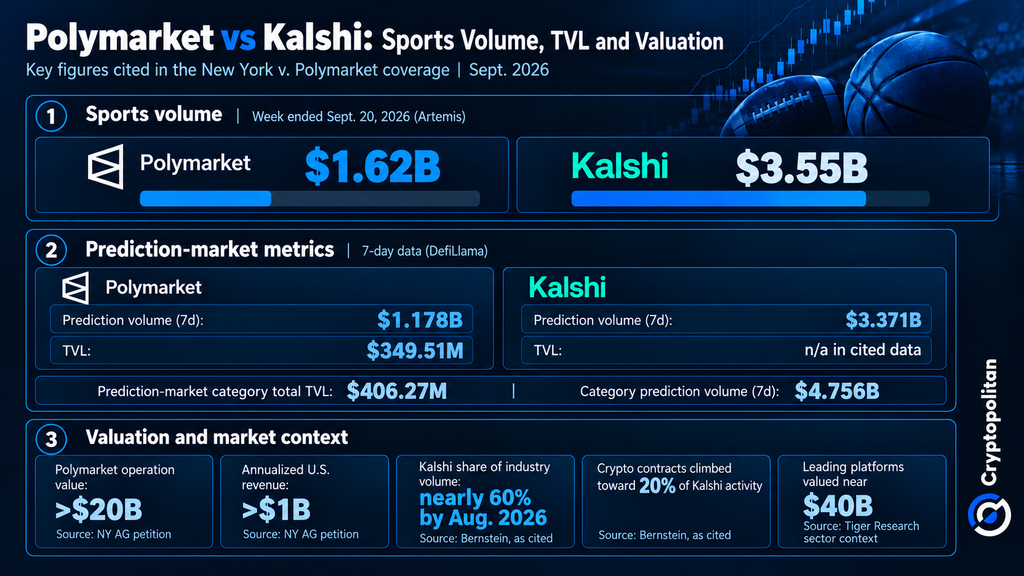
The filing also refers to Polymarket’s own marketing efforts, which included a post in August 2025 asking users to “TRADE EVERY FOOTBALL GAME IN ALL 50 STATES”, and contracts involving the Super Bowl, the Mets, and college football. The petition claims the entire Polymarket business has a purported valuation of more than $20 billion and US revenues of more than $1 billion on an annual basis.
Why the timing matters for a booming market
The legal action comes at a time when prediction markets are increasing their market share considerably. DefiLlama has logged a total of $406.27 million in TVL and $4.756 billion in volume for the last 7 days. Polymarket has $349.51 million in TVL and $1.178 billion in weekly volume, while Kalshi reported $3.371 billion in weekly volume.
Sports have proved to be a significant category for Polymarket as many contracts referred to in New York’s case deal with sporting events. Data from Artemis for the week ending on September 20th indicates that Polymarket had about $1.62 billion in sports volume, while the figure for Kalshi was around $3.55 billion. But sports volume makes up a much bigger share of Polymarket’s overall trading activity with about 46.6% of its $3.47 billion in weekly volume, compared to about 23.2% of Kalshi’s $15.27 billion. That makes sports far more central to Polymarket’s business mix—and helps explain why a legal challenge focused partly on sports contracts could have a significant impact on the platform.
A jurisdictional clash that was already in court
The case of New York did not begin the battle between federal and state authorities; it simply escalated it. CFTC has already brought a lawsuit against New York in April, and claimed that according to federal law, it holds absolute control over event contracts offered on registered exchanges.
However, according to James’ petition, event contracts should instead be considered as gambling that falls under state jurisdiction. Bernstein has previously mentioned that regulatory clarity on US sports prediction markets is expected to take longer than 2027 or 2028 since courts continue struggling with what the limit of derivatives regulation is and what state gaming authority covers.
The significance of this uncertainty for an industry stems from the fact that the fragmented regulation can lead to higher compliance costs, plus barriers in accessing markets and liquidity being divided among different jurisdictions.
The same fight, playing out worldwide
The classification problem is not uniquely American. ESMA said in July that event contracts may qualify as financial instruments depending on the underlying question. If they are derivatives with binary payouts, existing restrictions on retail binary options can apply; the same products may also fall under national gambling laws.
In Asia, Tiger Research says major markets still largely approach prediction markets through gambling regulation rather than financial-market rules, while leading platforms have reached valuations near $40 billion.
Crypto-based markets add another dimension. Chainalysis argues that public-ledger settlement can make activity such as wash trading and manipulation easier for investigators to trace than on less transparent systems.
The bigger question is where activity moves if regulators keep drawing different lines. Bernstein forecasts annual prediction-market volume could reach $10 trillion by 2035, up from about $410 billion in 2026. That remains a forecast, not a settled outcome, and depends on broader adoption as well as regulators eventually giving the market clearer rules.
Don’t just read crypto news. Understand it. Subscribe to our newsletter. It's free.
Recommended Articles


