


OECD: AI boom masks global economy slowdown as Middle East energy worries persists
The OECD has credited spending by companies in the artificial intelligence trade for making up for some of the problems that the Middle East energy shock would have caused for the global economy this year.
The capital wave has gone into data centers, semiconductors and other AI infrastructure, with technology export boosts in Japan and South Korea feeding the expanding activity in the United States.
The interim outlook put out on Wednesday has now cut targets for 2027, reminiscent of similar pessimistic outlooks the OECD made for 2026 in earlier projections.
2027 gets a downgrade after 2026 went better than expected
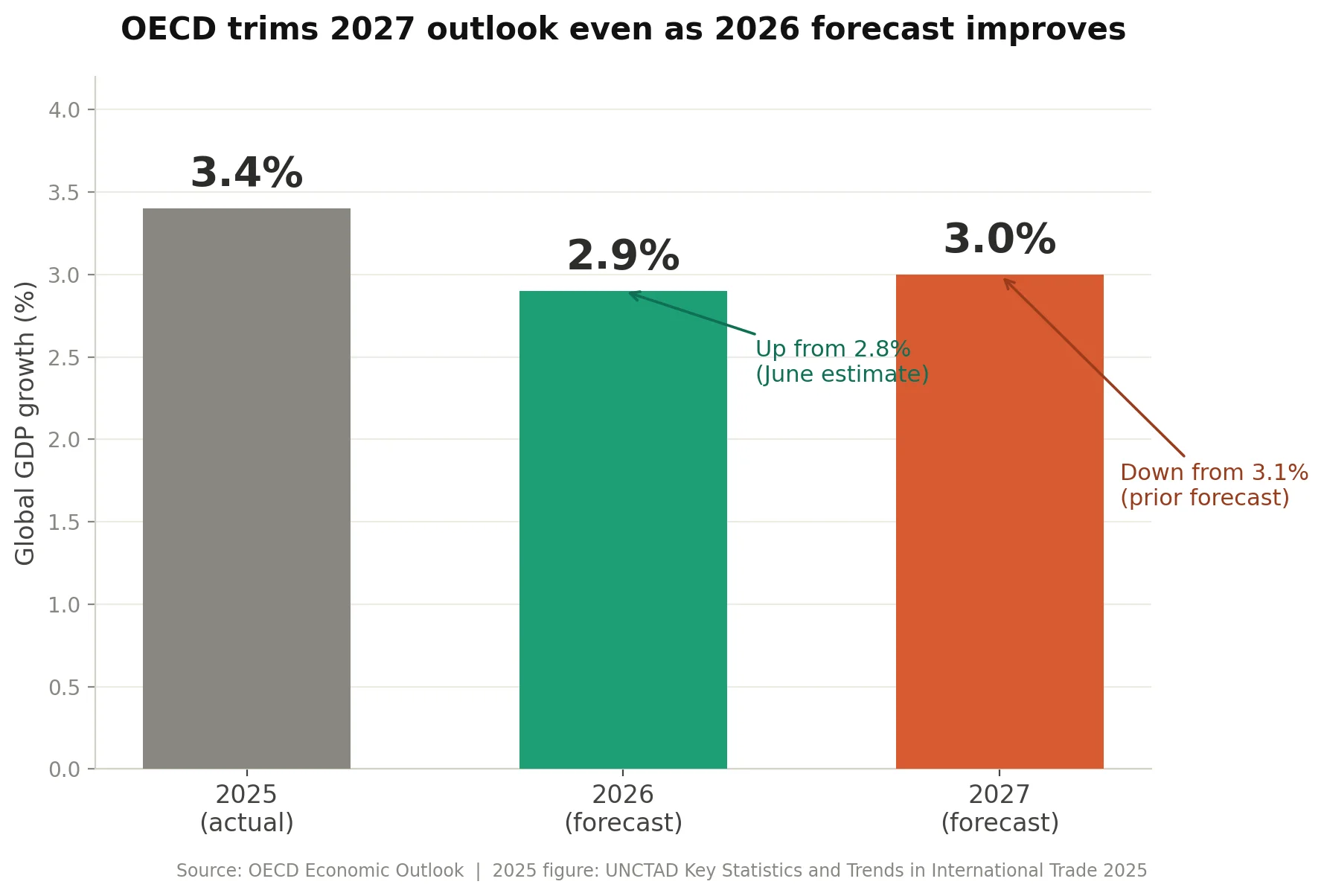
The 2.9% that the Organisation for Economic Co-operation and Development (OECD) is now expecting on 2026 global output is an upgrade on the 2.8% the Paris-based body predicted as recently as June.
Even with the projections turning optimistic, it is still short of the 3.4% the global economy managed last year.
The OECD is not expecting 2027 to be as positive, trimming its 3.1% forecast by one percentage point. The new 3.0% target was tied to the Middle East conflict affecting commodity prices.
AI money is choosing winners
The gains were not evenly distributed, with winners and losers split along AI gains and energy cost exposure lines.
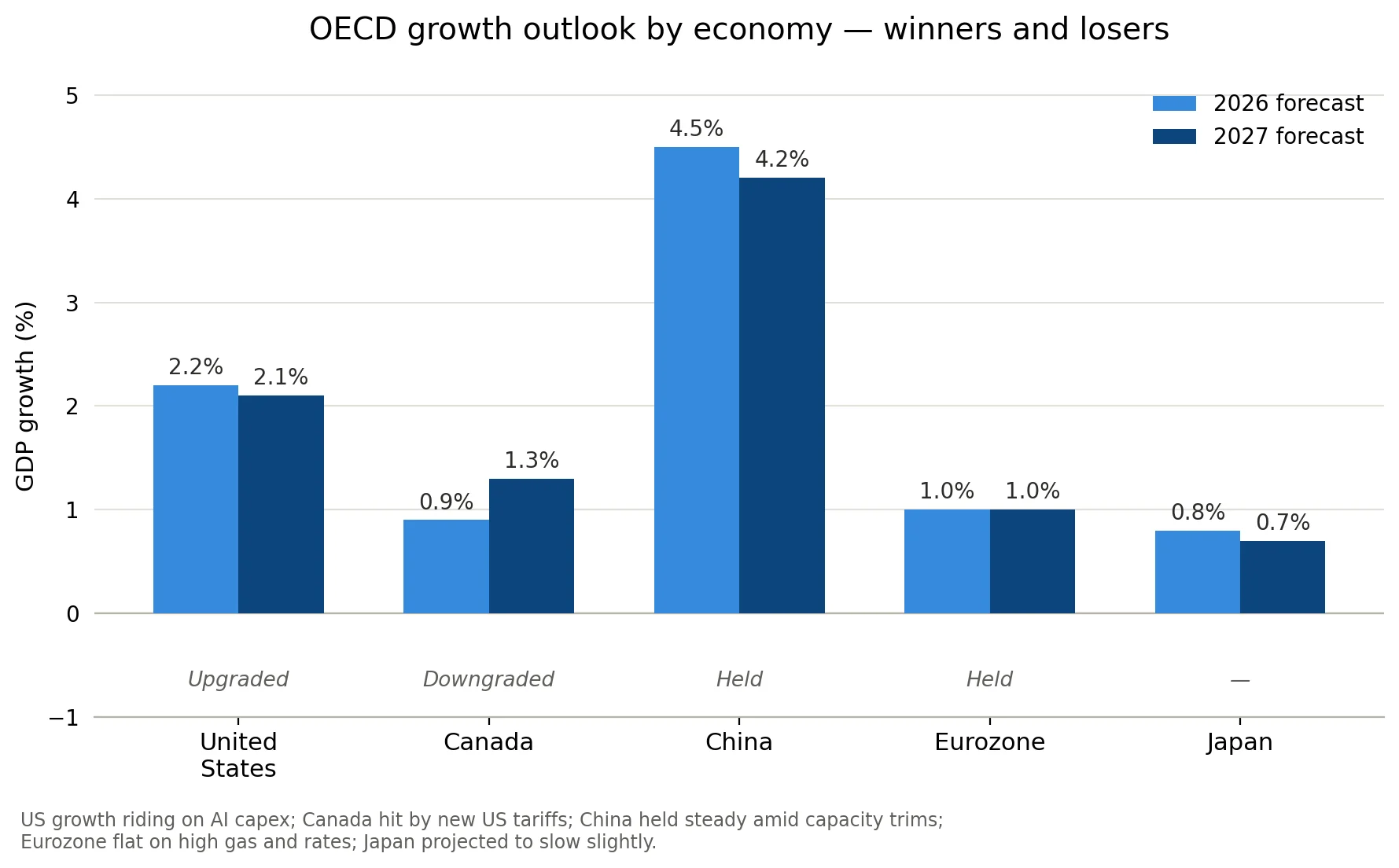
The biggest winner of them all, the United States, got an OECD upgrade on June’s numbers to 2.2% for 2026 growth and 2.1% in 2027. That growth is riding on corporate AI capital spending, scaling speed bumps from slowing household demand under tariffs and pricier energy.
North of the border, Canada got the biggest downgrade over new US tariffs on Canadian goods. The OECD dropped its 2026 forecast to 0.9% from 1.2%. The 2027 forecast also went in the same direction, falling to 1.3% from 1.7%.
The OECD held China projections at 4.5% this year and 4.2% in 2027. Beijing’s numbers came in at the same level as June, as investments have been throttled as the country looks to trim excess industrial capacity.
Eurozone growth remains stuck at 1.0% this year and next, with high gas prices and interest rates offsetting new defense outlays.
Expectations for Japan are 0.8% in 2026 and 0.7% in 2027.
The energy shock is feeding back into prices
Inflation is the channel the OECD watches most closely. Across the G20, it now sees consumer prices rising 4.1% in 2026, a touch above June’s 4.0%, and marked its 2027 call up more sharply to 3.6% from 3.1%.
In the eurozone, where European gas storage sits at 15-year lows heading into winter, inflation is projected at 3.0% this year and 2.9% next. US inflation is seen at 3.6% in 2026 before cooling to 2.6%.
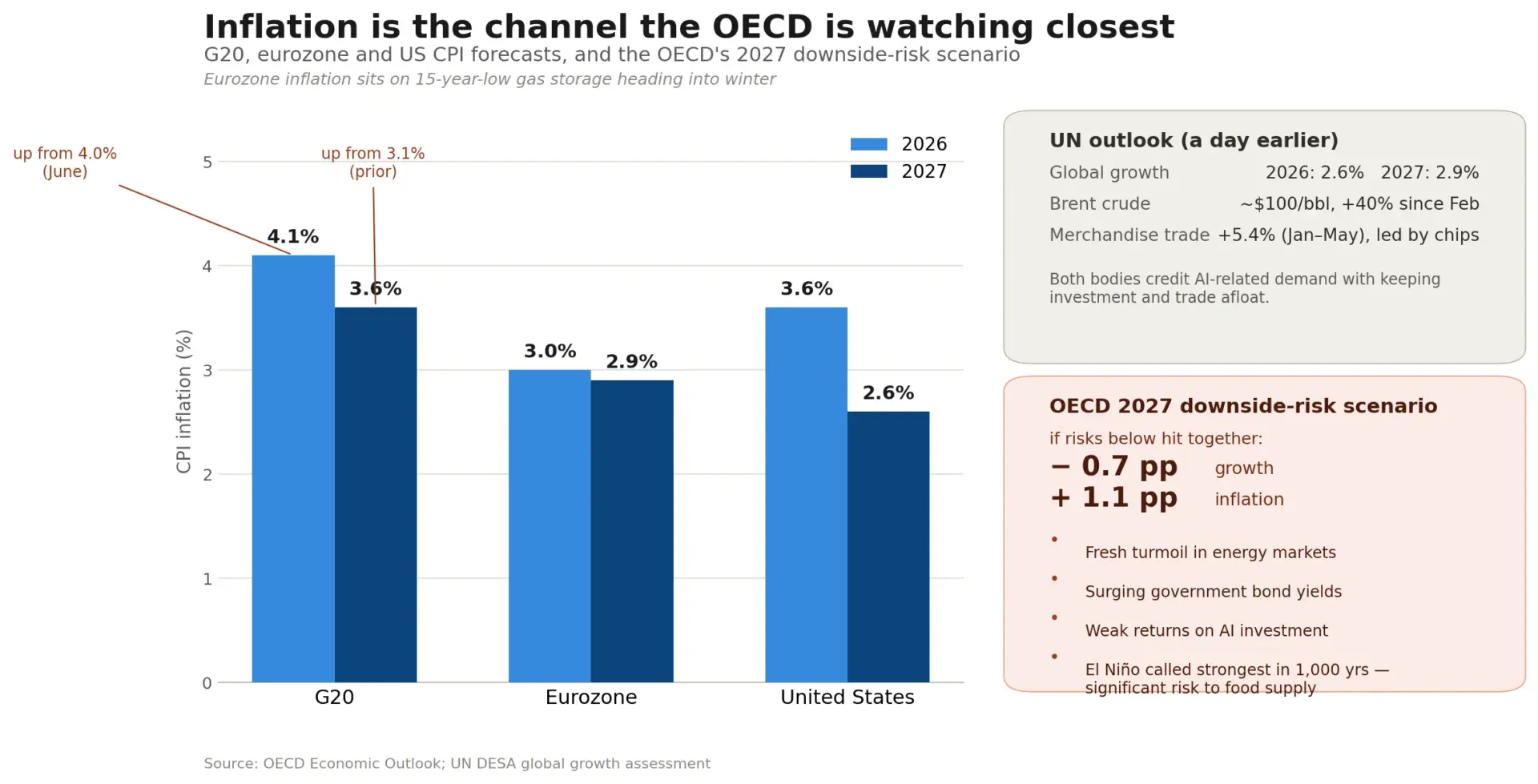
A separate UN assessment released a day earlier, on Tuesday, tells a gloomier version of the same story. The UN Department of Economic and Social Affairs put global growth at just 2.6% in 2026 and 2.9% in 2027, and noted Brent crude has climbed roughly 40% since February to around $100 a barrel.
Like the OECD, it credited strong demand for AI-related technology with keeping investment and trade afloat, citing merchandise trade growth of 5.4% in the first five months of the year led by semiconductors and electronics.
The OECD laid out a cluster of downside risks that, if they hit together, could subtract 0.7 percentage points from 2027 growth and add 1.1 points to inflation. The list includes fresh turmoil in energy markets, surging government bond yields, weak returns on AI investment and extreme weather from an El Niño the OECD called the strongest in 1,000 years and a “significant downside risk” to food supply.
That last item on AI matters for markets that have leaned hard on the technology theme. A loss of confidence in AI company valuations, the OECD warned, ranks among the events that could stall the global expansion.
Crypto and AI-linked equities have tracked that optimism closely: Bitcoin hit an eight-month high above $86,000 on Monday alongside record closes for the Nasdaq, Cryptopolitan reported.
If you're reading this, you’re already ahead. Stay there with our newsletter.
Recommended Articles


