


South Korea blocks Polymarket as prediction markets face global split
Polymarket has been blocked by South Korea, and 18 of its users have been referred to prosecutors on suspicion of illegal gambling. But the news is not about the sum of 17.6 billion won, but about what this case shows about the growing global divide on how crypto prediction markets should be regulated.
The division is becoming increasingly difficult to ignore. While South Korea is prosecuting event contract trading as gambling under its criminal law, the United States is declaring it controlled by its derivatives laws. More rigorous enforcement in South Korea, which is one of the largest crypto retail markets in the world, may not diminish demand. Instead, the enforcement could motivate platforms towards stricter geofencing and drive users and liquidity towards jurisdictions where they are more effectively regulated.
Eighteen users referred, one platform blocked
South Korean law enforcement revealed that 26 users of Polymarket had been charged on September 15, with 18 referred to the prosecutors. The total amount of money they used had risen to 17.6 billion won, with one user contributing 5.7 billion won.
On August 18, the Korea Media and Communications Standards Commission (KMCSC) decided to restrict Polymarket from being accessed from South Korea, after it concluded that the platform contributed to illegal gambling. The Commission invoked the provisions of the Criminal Act and the National Sports Promotion Act. It disregarded Polymarket’s attempts to convince the Commission of its stance that the removal of the Korean version of its website, payment methods in won, and ownership of the Polymarket account deprived it of Korean jurisdiction.
The Criminal Act of South Korea punishes gambling under its Article 246, while Article 247 discusses the running of the gambling place. The crux of the issue for Polymarket is whether the attributes of Polymarket, including its order-book model, the probability contracts involved in trades, and the potential to exit a position before transaction settlement, could exempt it from the applicability of those provisions.
Gambling law meets the event-contract defense
The essence of this controversy is defined by definitions. In particular, the South Korean officials pay attention to the fact that by engaging in such markets, people risk their money on uncertain outcomes, whereas the proponents of prediction markets pay attention to the way they operate and how prices reflect expectations of outcomes and contracts can be sold even before their expiration.
According to the Tiger Research report, the basic contract provides for a $1 payment in the case of the event happening and $0 otherwise. Therefore, the price of the contract reflects the probability of the event’s occurrence and the oracle makes the final decision after the expiration of the contract. Thus, this is the essence of the discussion about the nature of these instruments.
A top-two crypto market, not on Polymarket’s block list
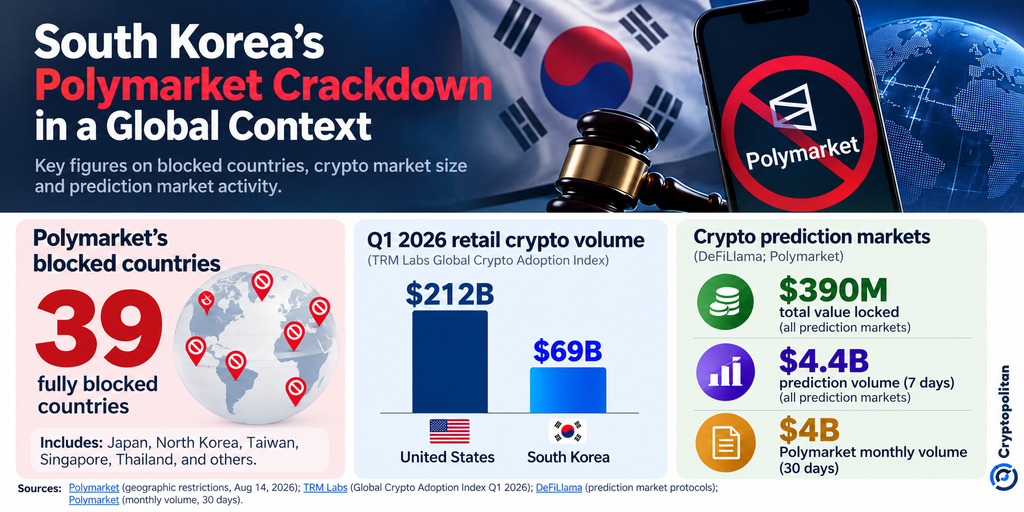
Given the size of the South Korean market, the crackdown is more than just a story about domestic enforcement. This is highlighted by the fact that blockchain intelligence firm TRM Labs ranked South Korea second in the world in terms of retail crypto volume, with approximately USD 69 billion, behind the US (approximately USD 212 billion) in the Global Crypto Adoption Index for the first quarter of 2026.
There is also a mismatch between platform access rules and Korean enforcement. Polymarket’s geographic restrictions that were updated on August 14, state that they have excluded 39 countries from access to their platform. Among those are Japan, North Korea, Singapore, Taiwan, and Thailand. The name of South Korea does not appear on the fully blocked or the close-only lists.
This contradiction shows that national enforcement could create compliance risks above and beyond the geographical restrictions of a given platform.
Why the West’s regulated path is pulling liquidity
Prediction markets are influential already now. As per DeFiLlama, there is $390 million in value locked and $4.4 billion in trading volumes for prediction markets in seven days. Polymarket saw $4 billion in trading volume in one month.
Still, the US government decided to follow a completely different way. When the US Commodity Futures Trading Commission (CFTC) is regulating designated contract markets (DCMs), including Kalshi, as it stated in its recent submission to the CFTC, the regulator called for federal oversight of event contract markets.
Such a regulatory path helped event contract markets to get even more users through partnerships with CNN and Robinhood. As previously noted by Cryptopolitan, restrictive measures in certain Asian jurisdictions may lead users, liquidity, and innovation to Western services regulated in some way.
And South Korean measures add to this gap even more. The importance of the event on a global scale is related to the 18 people who will face criminal charges. It is also about the liquidity of prediction markets, compliance issues, and the development of the platforms.
The smartest crypto minds already read our newsletter. Want in? Join them.
Recommended Articles


