

Bitcoin Faces Bear Trap. What Signals Are Released After Rapidly Surging Post Brief Dip Below $58,000?

Source Tradingkey

TradingKey - Bitcoin's rapid rebound today after dipping below $58,000 reflects a technical bounce following a short-term decline, rather than a trend reversal.

On Wednesday (July 1), the price of Bitcoin ( BTC) briefly fell below $58,000, hitting a low of $57,792, a new low for the year. However, after briefly losing this key level, Bitcoin quickly pulled back and surged by about $1,000, exhibiting classic bear-trap characteristics. Nonetheless, the current market environment is extremely complex. Is this rapid surge the starting gun for the return of the bull market, or is it the dying struggle of the bulls in despair?
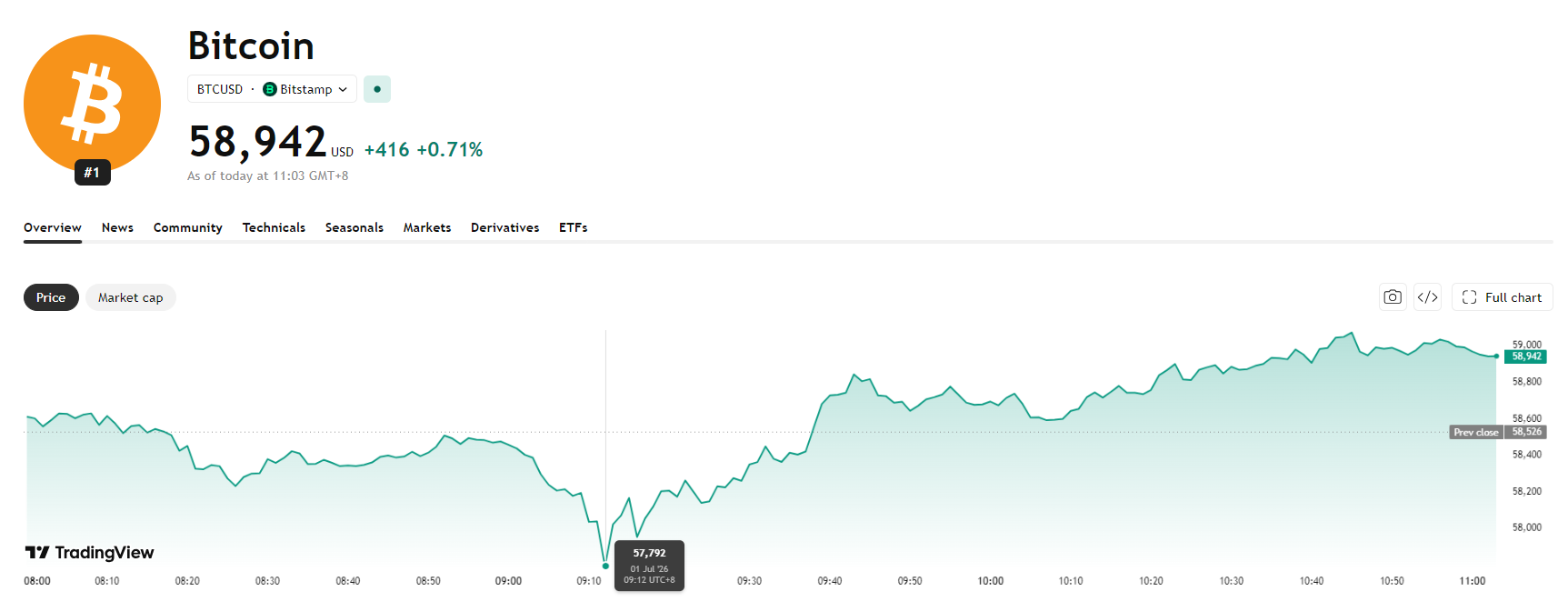
bitcoin-btc-price-01ebae9edaa340b1b8eb84bed694f784Bitcoin price chart, Source: TradingView

Bitcoin's dip below $58,000 and subsequent quick recovery has sent a strong signal of leverage flushing in terms of market structure. Previously, over $1.6 billion in leveraged long positions had accumulated around the $58,000 mark. Bitcoin's downward move successfully triggered stop-losses and liquidations for some bulls. According to Coinglass data, the crypto market saw $270 million in liquidations over the past 24 hours alone, with long positions accounting for 76%.

Despite Bitcoin's technical rebound, this surge failed to quickly stabilize above $60,000. The fundamental reason is that the market's core narrative has undergone a structural shakeup. Strategy ( MSTR ), the world's largest corporate holder of Bitcoin, announced on June 29 the launch of a "Digital Credit Capital Framework," allowing it to sell up to $1 billion to $1.25 billion in Bitcoin to fund USD reserves, support preferred stock dividends, and implement stock buybacks. This means the crypto market has gained a potential super selling pressure source, greatly suppressing the sustainability of the rebound.

In addition, fund flows for US spot Bitcoin ETFs reflect a severe lack of capital, which is another warning sign that Bitcoin's rebound is unlikely to last. According to SoSoValue statistics, US spot Bitcoin ETFs saw total outflows of over $4 billion throughout June, setting a record high for monthly net outflows. The fund sell-off surged again at the end of June. Over the past week, outflows approached $1.8 billion, marking the second-highest weekly outflow during this wave.

Therefore, it can be concluded that Bitcoin's thrilling pullback at $58,000 does not signal a reversal back into a full bull market, but rather a technical "phoenix rising" test after an excessive short-term decline. However, historical data suggests that Bitcoin has entered a mid-term level of deep correction. In past bear markets, Bitcoin's maximum drawdown was typically around 80%, and it has now fallen 53%. Therefore, before macro liquidity becomes clearer, such as the Federal Reserve's policy direction, it is recommended to remain cautious and avoid blindly chasing high leverage at elevated levels.

Disclaimer: For information purposes only. Past performance is not indicative of future results.
placeholder
Bitcoin CME gaps at $35,000, $27,000 and $21,000, which one gets filled first?Prioritize filling the $27,000 gap and even try higher.
Author  FXStreet
Aug 22, 2023
Prioritize filling the $27,000 gap and even try higher.
placeholder
Pinduoduo Earnings Incoming: Morgan Stanley Sees Long-Term Profit Potential​Insights – On November 21, Chinese e-commerce giant Pinduoduo (PDD) will release its Q3 2024 earnings.
Author  Mitrade
Nov 20, 2024
​Insights – On November 21, Chinese e-commerce giant Pinduoduo (PDD) will release its Q3 2024 earnings.
placeholder
Elon Musk’s xAI and Neuralink Launch New Funding Rounds​Billionaire Elon Musk recently raised funds for his two high-profile tech companies, xAI and Neuralink.
Author  Insights
Jun 03, 2025
​Billionaire Elon Musk recently raised funds for his two high-profile tech companies, xAI and Neuralink.
placeholder
Bitcoin briefly loses 2025 gains as crypto plunges over the weekend.Bitcoin experienced a sharp decline this weekend, briefly erasing its 2025 gains and dipping below its year-opening value of $93,507. The cryptocurrency fell to a low of $93,029 on Sunday, representing a 25% drop from its all-time high in October. Although it has rebounded slightly to around $94,209, the pressures on the market remain significant. The downturn occurred despite the reopening of the U.S. government on Thursday, which many had hoped would provide essential support for crypto markets. This year initially appeared promising for cryptocurrencies, particularly after the inauguration of President Donald Trump, who has established the most pro-crypto administration thus far. However, ongoing political tensions—including Trump's tariff strategies and the recent government shutdown, lasting a historic 43 days—have contributed to several rapid price pullbacks for Bitcoin throughout the year. Market dynamics are also being influenced by Bitcoin whales—investors holding large amounts of Bitcoin—who have been offloading portions of their assets, consequently stalling price rallies even as positive regulatory developments emerge. Despite these sell-offs, analysts from Glassnode argue that this behavior aligns with typical patterns seen among long-term investors during the concluding stages of bull markets, suggesting it is not indicative of a mass exodus. Notably, Bitcoin is not alone in its struggles, as Ethereum and Solana have also recorded declines of 7.95% and 28.3%, respectively, since the start of the year, while numerous altcoins have faced even steeper losses. Looking ahead, questions linger regarding the viability of the four-year cycle thesis, particularly given the increasing institutional support and regulatory frameworks now in place in the crypto landscape. Matt Hougan, chief investment officer at Bitwise, remains optimistic, suggesting a potential Bitcoin resurgence in 2026 driven by the “debasement trade” thesis and a broader trend toward increased adoption of stablecoins, tokenization, and decentralized finance. Hougan emphasized the soundness of the underlying fundamentals, pointing to a positive outlook for the sector in the longer term.
Author  Mitrade
Nov 17, 2025
Bitcoin experienced a sharp decline this weekend, briefly erasing its 2025 gains and dipping below its year-opening value of $93,507. The cryptocurrency fell to a low of $93,029 on Sunday, representing a 25% drop from its all-time high in October. Although it has rebounded slightly to around $94,209, the pressures on the market remain significant. The downturn occurred despite the reopening of the U.S. government on Thursday, which many had hoped would provide essential support for crypto markets. This year initially appeared promising for cryptocurrencies, particularly after the inauguration of President Donald Trump, who has established the most pro-crypto administration thus far. However, ongoing political tensions—including Trump's tariff strategies and the recent government shutdown, lasting a historic 43 days—have contributed to several rapid price pullbacks for Bitcoin throughout the year. Market dynamics are also being influenced by Bitcoin whales—investors holding large amounts of Bitcoin—who have been offloading portions of their assets, consequently stalling price rallies even as positive regulatory developments emerge. Despite these sell-offs, analysts from Glassnode argue that this behavior aligns with typical patterns seen among long-term investors during the concluding stages of bull markets, suggesting it is not indicative of a mass exodus. Notably, Bitcoin is not alone in its struggles, as Ethereum and Solana have also recorded declines of 7.95% and 28.3%, respectively, since the start of the year, while numerous altcoins have faced even steeper losses. Looking ahead, questions linger regarding the viability of the four-year cycle thesis, particularly given the increasing institutional support and regulatory frameworks now in place in the crypto landscape. Matt Hougan, chief investment officer at Bitwise, remains optimistic, suggesting a potential Bitcoin resurgence in 2026 driven by the “debasement trade” thesis and a broader trend toward increased adoption of stablecoins, tokenization, and decentralized finance. Hougan emphasized the soundness of the underlying fundamentals, pointing to a positive outlook for the sector in the longer term.
placeholder
Gold Price Forecast: Does Gold Falling Below $4,000 Mean the Bull Market Is Over? Will It Still Rise in the Second Half of 2026?Heading into the second half of 2026, the gold market has transitioned from a strong-performing asset at the start of the year into one pulling back from its highs. Recently, gold prices
Author  TradingKey
Jun 29, Mon
Heading into the second half of 2026, the gold market has transitioned from a strong-performing asset at the start of the year into one pulling back from its highs. Recently, gold prices
goTop
quote