

Palladium (XPDUSD) Volatility Intensified on Jul 1: What to Watch

Source Tradingkey

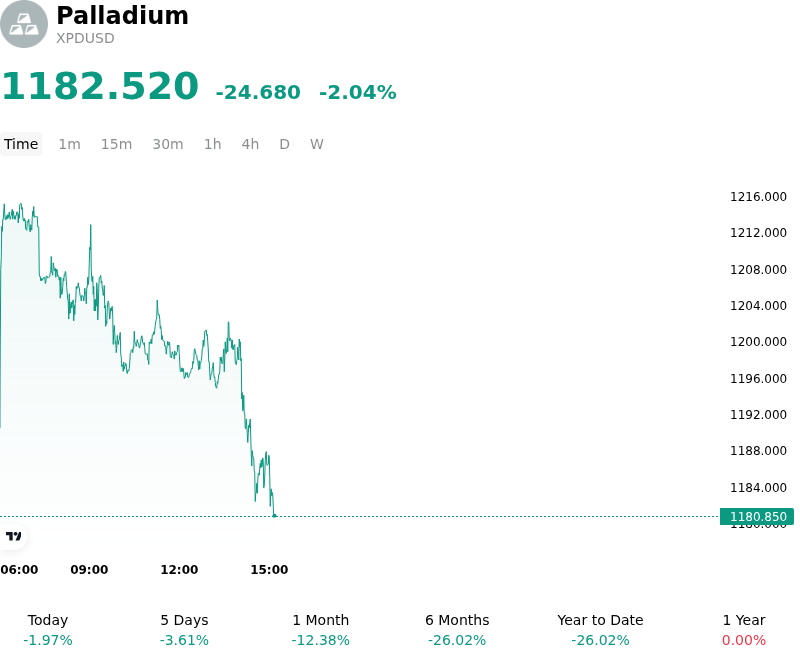
Palladium (XPDUSD) is down 2.04% at Jul 1 03:10(ET), now at $1182.52, with a 7-day up of 1.34%.
SummaryOverview

What is driving Palladium (XPDUSD)’s stock price down today?

The recent downward movement in spot palladium (XPDUSD) reflects a combination of deteriorating medium-term supply-demand fundamentals and broader macroeconomic headwinds.

On the supply side, the market has had to reprice global balance expectations following key industry updates. Norilsk Nickel, the world’s largest producer, recently released a market review forecasting a global palladium surplus of 300,000 ounces in 2026 and 200,000 ounces in 2027. This official shift toward an oversupply outlook, combined with rising secondary recycling rates, has fundamentally dampened investor sentiment and heavily capped technical recovery attempts. Furthermore, geopolitical risk premiums have significantly eased. The US International Trade Commission recently concluded its anti-dumping and countervailing duty investigations into unwrought palladium from Russia, ruling against punitive tariffs. By determining that imports do not materially injure domestic producers, the ruling guaranteed the stable flow of Russian supply—which accounts for approximately 40% of global output—and cleared away a key regulatory overhang that had previously supported prices.

Demand-side expectations also continue to soften due to structural and cyclical challenges. High global borrowing costs are actively suppressing vehicle manufacturing and general industrial activity, dampening near-term physical procurement from automotive catalyst manufacturers. More structurally, the secular automotive transition toward battery electric vehicles continues to permanently erode long-term demand projections for palladium-based catalytic converters, leaving the metal with diminishing long-term consumption runways.

These weak fundamentals are being compounded by a challenging macroeconomic backdrop. Recent hawkish policy guidance from the Federal Reserve, which signals a higher-for-longer interest rate path, has bolstered the US Dollar Index and pushed Treasury yields upward. In a higher-yield environment, non-yielding assets face persistent selling pressure. The combination of a stronger dollar, rising interest rates, and confirmed oversupply projections has triggered sustained institutional liquidations, driving XPDUSD below critical support thresholds.

Technical Analysis of Palladium (XPDUSD)

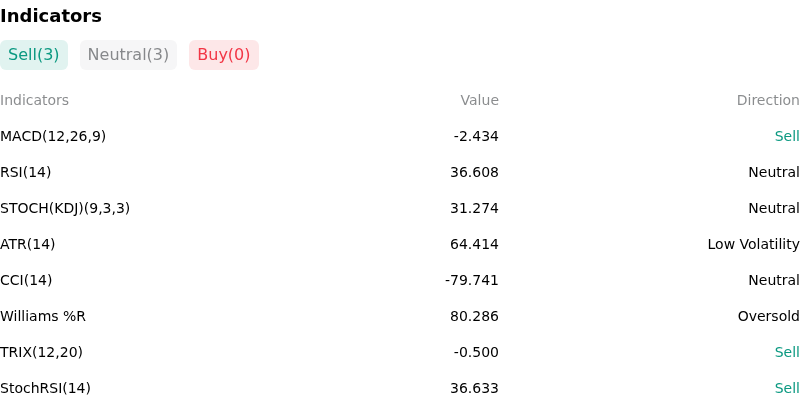
Technically, Palladium (XPDUSD) shows a MACD (12,26,9) value of -2.434, indicating a sell signal. The RSI at 36.608 suggests neutral condition and the Williams %R at 80.286 suggests oversold condition. Please monitor closely.
IndicatorAnalysis

More details about Palladium (XPDUSD)

Recent Events and Risks:

  • Transition to Global Supply Surplus: Official market reviews from major producers, including Norilsk Nickel, project that the global palladium market has transitioned from structural deficits into a direct supply surplus of 300,000 ounces in 2026 and 200,000 ounces in 2027. This oversupply outlook is heavily capping medium-term price appreciation and inviting structural short positions.
  • Unwinding of Regulatory and Tariff Risk Premiums: The U.S. International Trade Commission recently concluded its anti-dumping and countervailing duty investigations into unwrought palladium from Russia, determining that imports do not materially injure domestic producers. By ruling against punitive tariffs, regulators have ensured the uninterrupted flow of Russian supply—which accounts for 40% of global output—eliminating a major geopolitical risk premium and triggering immediate long liquidation.
  • Deteriorating Automotive Demand and EV Transition: Intraday volatility continues to be pressured by weak industrial appetite as the automotive sector, which accounts for over 80% of global palladium demand, faces a structural contraction. The secular consumer shift toward battery electric vehicles (BEVs) permanently bypasses palladium-intensive gasoline catalytic converters, prompting persistent downward revisions in baseline physical consumption.
  • Macro-Driven Capital Outflows and Dollar Strength: The Federal Reserve’s hawkish monetary guidance has signaled a higher-for-longer interest rate path, elevating Treasury yields and strengthening the U.S. Dollar Index (DXY). This restrictive macro environment increases the opportunity cost of holding non-yielding precious metals, exposing XPDUSD to systematic liquidations and risk-off pressure.
Disclaimer: For information purposes only. Past performance is not indicative of future results.
placeholder
Bitcoin CME gaps at $35,000, $27,000 and $21,000, which one gets filled first?Prioritize filling the $27,000 gap and even try higher.
Author  FXStreet
Aug 22, 2023
Prioritize filling the $27,000 gap and even try higher.
placeholder
Pinduoduo Earnings Incoming: Morgan Stanley Sees Long-Term Profit Potential​Insights – On November 21, Chinese e-commerce giant Pinduoduo (PDD) will release its Q3 2024 earnings.
Author  Mitrade
Nov 20, 2024
​Insights – On November 21, Chinese e-commerce giant Pinduoduo (PDD) will release its Q3 2024 earnings.
placeholder
Elon Musk’s xAI and Neuralink Launch New Funding Rounds​Billionaire Elon Musk recently raised funds for his two high-profile tech companies, xAI and Neuralink.
Author  Insights
Jun 03, 2025
​Billionaire Elon Musk recently raised funds for his two high-profile tech companies, xAI and Neuralink.
placeholder
Bitcoin briefly loses 2025 gains as crypto plunges over the weekend.Bitcoin experienced a sharp decline this weekend, briefly erasing its 2025 gains and dipping below its year-opening value of $93,507. The cryptocurrency fell to a low of $93,029 on Sunday, representing a 25% drop from its all-time high in October. Although it has rebounded slightly to around $94,209, the pressures on the market remain significant. The downturn occurred despite the reopening of the U.S. government on Thursday, which many had hoped would provide essential support for crypto markets. This year initially appeared promising for cryptocurrencies, particularly after the inauguration of President Donald Trump, who has established the most pro-crypto administration thus far. However, ongoing political tensions—including Trump's tariff strategies and the recent government shutdown, lasting a historic 43 days—have contributed to several rapid price pullbacks for Bitcoin throughout the year. Market dynamics are also being influenced by Bitcoin whales—investors holding large amounts of Bitcoin—who have been offloading portions of their assets, consequently stalling price rallies even as positive regulatory developments emerge. Despite these sell-offs, analysts from Glassnode argue that this behavior aligns with typical patterns seen among long-term investors during the concluding stages of bull markets, suggesting it is not indicative of a mass exodus. Notably, Bitcoin is not alone in its struggles, as Ethereum and Solana have also recorded declines of 7.95% and 28.3%, respectively, since the start of the year, while numerous altcoins have faced even steeper losses. Looking ahead, questions linger regarding the viability of the four-year cycle thesis, particularly given the increasing institutional support and regulatory frameworks now in place in the crypto landscape. Matt Hougan, chief investment officer at Bitwise, remains optimistic, suggesting a potential Bitcoin resurgence in 2026 driven by the “debasement trade” thesis and a broader trend toward increased adoption of stablecoins, tokenization, and decentralized finance. Hougan emphasized the soundness of the underlying fundamentals, pointing to a positive outlook for the sector in the longer term.
Author  Mitrade
Nov 17, 2025
Bitcoin experienced a sharp decline this weekend, briefly erasing its 2025 gains and dipping below its year-opening value of $93,507. The cryptocurrency fell to a low of $93,029 on Sunday, representing a 25% drop from its all-time high in October. Although it has rebounded slightly to around $94,209, the pressures on the market remain significant. The downturn occurred despite the reopening of the U.S. government on Thursday, which many had hoped would provide essential support for crypto markets. This year initially appeared promising for cryptocurrencies, particularly after the inauguration of President Donald Trump, who has established the most pro-crypto administration thus far. However, ongoing political tensions—including Trump's tariff strategies and the recent government shutdown, lasting a historic 43 days—have contributed to several rapid price pullbacks for Bitcoin throughout the year. Market dynamics are also being influenced by Bitcoin whales—investors holding large amounts of Bitcoin—who have been offloading portions of their assets, consequently stalling price rallies even as positive regulatory developments emerge. Despite these sell-offs, analysts from Glassnode argue that this behavior aligns with typical patterns seen among long-term investors during the concluding stages of bull markets, suggesting it is not indicative of a mass exodus. Notably, Bitcoin is not alone in its struggles, as Ethereum and Solana have also recorded declines of 7.95% and 28.3%, respectively, since the start of the year, while numerous altcoins have faced even steeper losses. Looking ahead, questions linger regarding the viability of the four-year cycle thesis, particularly given the increasing institutional support and regulatory frameworks now in place in the crypto landscape. Matt Hougan, chief investment officer at Bitwise, remains optimistic, suggesting a potential Bitcoin resurgence in 2026 driven by the “debasement trade” thesis and a broader trend toward increased adoption of stablecoins, tokenization, and decentralized finance. Hougan emphasized the soundness of the underlying fundamentals, pointing to a positive outlook for the sector in the longer term.
placeholder
Gold Price Forecast: Does Gold Falling Below $4,000 Mean the Bull Market Is Over? Will It Still Rise in the Second Half of 2026?Heading into the second half of 2026, the gold market has transitioned from a strong-performing asset at the start of the year into one pulling back from its highs. Recently, gold prices
Author  TradingKey
Jun 29, Mon
Heading into the second half of 2026, the gold market has transitioned from a strong-performing asset at the start of the year into one pulling back from its highs. Recently, gold prices
goTop
quote