


Kalshi Crosses $4 Billion in Weekly Volume for the First Time
Kalshi has hit a new milestone this past week by crossing $4 billion in weekly notional volume. For perspective, last year, this number stood at $54.5 million. That represents a growth of approximately 7,424%. However, beyond Kalshi’s own growth story, what’s even more interesting is the speed at which the platform has closed the gap on rival platform Polymarket. In fact, even in March of this year, the two leading prediction market platforms were close to a 50-50 split on weekly volume. Today, Kalshi is processing 2.05x what Polymarket is.
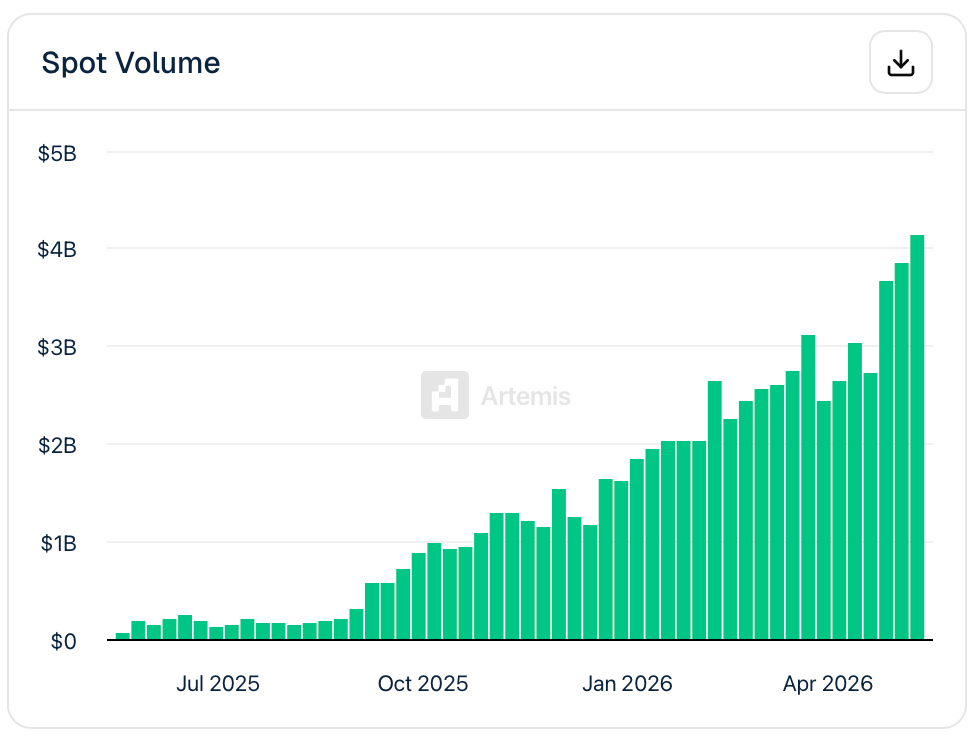
Source: Artemis
A Flip That Stopped Being Quiet
The same week as Kalshi clocked in $4.1 billion in volume, Polymarket saw $2 billion. This is marginally up from the previous week but still down from volumes seen through March and April. The trend has had a noticeable shift in Kalshi’s favour since the last week of April and part of the move was attributed to a V2 upgrade Polymarket rolled out on April 28th, which was poorly received by users. The cutover paused trading for roughly an hour and every open limit order on the platform was wiped at the same time. Users had to re-place orders once the new system went live.
The volumes and user activity on the platform fell sharply after this. Monthly volumes fell for the first time in April after seven consecutive monthly highs and trader count fell by around 12% between March and April, from around 733,000 to 643,000, as reported by The Block.
A Polymarket spokesperson directly attributed the April volume slide to the upgrade, with VP of engineering Josh Stevens telling Bloomberg, “We’ve let people down, and I’m not going to dress that up.” Founder Shayne Coplan went on to acknowledge at a Harvard event that “there’s been a few times over the course of the business where the way the company ran was suboptimal.”
Kalshi’s Single Order Book Advantage
Kalshi was launched as a CFTC-regulated US exchange from day one, with every contract trading on a single, unified order book. Liquidity stays concentrated in one pool, which keeps spreads tight and pricing clean across markets.
Polymarket runs two parallel products. The global, wallet-based platform on Polygon still serves international users and holds most of the historical volume. The newer US-facing product runs through QCEX, the CFTC-regulated venue Polymarket acquired in July 2025 for $112 million and relaunched to US users in December after receiving CFTC approval as an intermediated exchange. The two products do not share liquidity, meaning a single Polymarket market is effectively split across two separate order books with two different settlement layers.
For anyone running size right now, that fragmentation is a real friction point. Kalshi doesn’t have it.
US Distribution Is the Other Lever
Outside of regulation, the distribution stack has done the rest of the work. Kalshi contracts reach retail traders through PrizePicks across 38 states, through Coinbase’s prediction markets integration, and through brokerage flow from Robinhood and Webull. On the institutional side, Clear Street joined as the first FCM on the exchange in May, opening access to institutional trading desks and ETF issuers.
The capital backdrop fits the picture. Kalshi just closed a $1 billion Series F at a $22 billion valuation led by Coatue, with the pitch leaning on annualized trading volume now around $178 billion and institutional flow up 800% in six months.
Polymarket, for its part, is still rebuilding its American footprint after being locked out of the US for years. The competitive picture today looks less like two equal platforms and more like a US-native exchange running away from a global platform that is playing catch-up at home. Whether that gap is permanent or a function of one quarter’s execution is the question worth tracking from here.
Don’t just read crypto news. Understand it. Subscribe to our newsletter. It's free.
Recommended Articles


